US futures slip and world markets are mixed after the Supreme Court
nixes Trump's tariffs
[February 23, 2026] By
ELAINE KURTENBACH
BANGKOK (AP) — U.S. futures slipped and world markets were mixed on
Monday after the Supreme Court struck down most of President Donald
Trump’s sweeping tariffs.
Despite the ruling, tariffs aren’t going away. Trump said Friday he
would use other avenues to tax imports, such as an executive order
imposing a 10% global tariff that he later raised to 15%. He said he’s
looking at other tariffs, including ones that would require Commerce
Department investigations.
Trump administration officials said they expect other countries to abide
by trade agreements based on the tariffs that have been overturned. But
the reaction to the latest developments has been tentative given
uncertainty over what he will do.
The mixed reactions are “highlighting the winners-and-losers effect of
shifts in tariff policy that has just delivered a boost to countries who
previously had a comparatively bad deal,” Benjamin Picton of Rabobank
said in a commentary.
“U.S. tariff policy will continue to be a source of uncertainty for
markets as traders attempt to price in the implications of what is still
a movable feast,” he wrote.
Bitcoin tumbled as much as 5% early Monday, dropping below $65,000,
though it recovered about half of that decline later in the day. The
sell-off has been driven by investors pulling out of speculative assets
and concerns about future cryptocurrency regulation.
The original cryptocurrency, pitched as “digital gold,” has lost nearly
half of its value since Oct. 6, when it hit a record high of
$126,210.50.

Germany's DAX fell 0.5% to 25,137.69 and the CAC 40 in Paris was
unchanged at 8,515.65. Britain's FTSE 100 was also nearly unchanged at
10,685.10.
The future for the S&P 500 lost 0.2% and that for the Dow Jones
Industrial Average dropped 0.3%. The future for the Nasdaq composite
index was down 0.3%.
Markets in Japan and mainland China were closed for holidays.
Hong Kong led regional gains as its Hang Seng index surged 2.5% to
27,081.91.
In South Korea, the Kospi gained 0.7% to 5,846.09.
Australia's S&P/ASX 200 shed 0.6% to 9,026.00.
[to top of second column] |
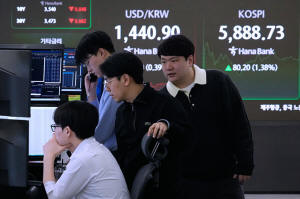
Currency traders watch monitors near a screen showing the Korea
Composite Stock Price Index (KOSPI), top right, and the foreign
exchange rate between U.S. dollar and South Korean won at the
foreign exchange dealing room of the Hana Bank headquarters in
Seoul, South Korea, Monday, Feb. 23, 2026. (AP Photo/Ahn Young-joon)
 Taiwan's Taiex added 0.5% and the
Sensex in India was up 0.6%. The SET in Bangkok ended nearly flat.
On Friday, Wall Street kept calm after the Supreme Court's ruling
against the tariffs, which had triggered panic in financial markets
when they were announced last year. The S&P 500 rose 0.7%, while the
Dow added 0.5% and the Nasdaq composite rose 0.9%.
Discouraging reports Friday showing slowing U.S. economic growth and
accelerating inflation drew a relatively muted response.
The reports highlight the Federal Reserve's dilemma over interest
rates, but did not change traders’ expectations much for what the
Fed will ultimately do. Traders are still betting that the Fed will
lower rates at least twice this year, according to data from CME
Group.
Lower interest rates would give the economy and investment prices a
boost, but they also risk worsening inflation. Fed officials said at
their last meeting that they want to see inflation fall further
before they would support cutting rates further.
In other dealings early Monday, U.S. benchmark crude oil lost 33
cents to $66.15 per barrel. Brent crude, the international standard,
gave up 34 cents to $70.96 per barrel.
The U.S. dollar slipped to 154.85 Japanese yen from 154.94 yen. The
euro rose to $1.1799 from $1.1797.
The price of gold rose 1.8%, while the price of silver was up 5.2%.
All contents © copyright 2026 Associated Press. All rights reserved
 |