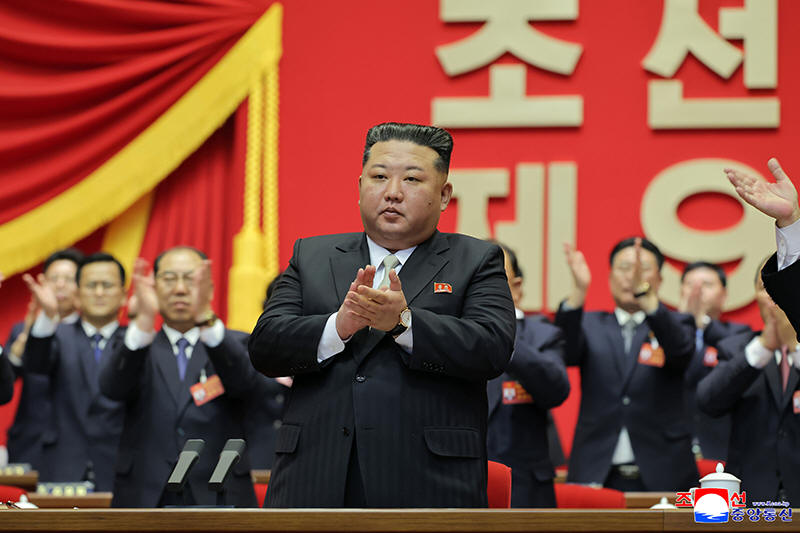
Kim reelected to top post of North Korea’s ruling party as it hails his
nuclear buildup
[February 23, 2026]
By KIM TONG-HYUNG
SEOUL, South Korea (AP) — North Korean leader Kim Jong Un was reelected
to the top post of the ruling Workers’ Party, with delegates crediting
him for bolstering the country’s nuclear arsenal and strengthening its
regional standing, state media reported Monday.
The report from the party congress, a major propaganda spectacle where
Kim is expected to outline his political and military goals for the next
five years, suggests he will double down on accelerating a nuclear
arsenal already equipped with missiles capable of threatening Asian U.S.
allies and the American mainland.
The party also released a new roster for its powerful Central Committee
that confirmed a generational shift in Kim’s leadership circle, with
aging military chiefs and the 76-year-old head of Pyongyang’s
rubber-stamp parliament among dozens replaced in the 138-member body.
The congress, which began last Thursday, comes as Kim grows increasingly
assertive in regional politics, following an aggressive expansion of his
nuclear arsenal and closer ties with Russia forged through joint war
efforts in Ukraine, which have deepened his standoffs with Washington
and Seoul. Kim has also pursued stronger ties with China, traveling to
Beijing last September and having his first summit with Chinese
President Xi Jinping in six years.
Analysts say Kim will likely use the meeting to unveil new military
goals, including strengthening conventional forces and integrating them
with nuclear capabilities, while reemphasizing a campaign for economic
“self-reliance” through mass mobilization, following gradual
post-pandemic gains fueled by rebounding trade with China and arms
exports to Russia.
Party credits Kim’s leadership as a boost to national pride
North Korea’s official Korean Central News Agency said Kim was reelected
as the party’s general secretary with the “unshakable will and unanimous
desire” of thousands of delegates on the fourth day of meetings Sunday.

Under party rules, the congress, which Kim has held every five years
since 2016, elects the general secretary to serve as the party’s top
representative and leader. Kim, 42, has held the party’s top post
throughout his rule, though the title changed from first secretary to
chairman at the congress in 2016 and then to general secretary at the
congress in 2021.
The party said in a statement that by building up nuclear forces, Kim
has created a military capable of handling “any threat of aggression”
and “any form of war,” and credited his leadership with “reliably
guaranteeing” the country’s future and “boosting the pride and
self-esteem” of North Koreans.
It also praised Kim’s recent foreign policy, which it said raised
national prestige. China's state-run Xinhua news agency said Xi
congratulated Kim on his reelection.
[to top of second column]
|
This photo provided Monday, Feb. 23, 2026, by the North Korean
government, its leader Kim Jong Un, center, claps hands as he was
re-elected to the top post of the ruling Workers’ Party, during the
party's Congress in Pyongyang, Sunday, Feb. 22, 2026. Independent
journalists were not given access to cover the event depicted in
this image distributed by the North Korean government. The content
of this image is as provided and cannot be independently verified.
Korean language watermark on image as provided by source reads: "KCNA"
which is the abbreviation for Korean Central News Agency. (Korean
Central News Agency/Korea News Service via AP)

Party’s leadership reshuffle reflects generational shift
KCNA said the congress adopted revisions to party rules during Sunday’s
meeting but did not immediately provide details. Experts had anticipated
that Kim would use the congress to entrench his hard-line stance toward
South Korea and possibly rewrite party rules to codify his
characterization of inter-Korean relations as between two “hostile”
states.
State media so far haven’t mentioned any comments by Kim or other senior
leaders at the congress directly addressing relations with Washington
and Seoul.
Yoon Min Ho, a spokesperson at South Korea’s Unification Ministry,
described Kim’s reelection as a predictable move to further burnish his
leadership and that Seoul will closely watch further messages from the
congress.
The most notable change to the new Central Committee list was the
exclusion of Choe Ryong Hae, chairman of the standing committee of the
Supreme People’s Assembly, who during an earlier part of Kim’s rule was
seen as the second most powerful individual in Pyongyang. Also left out
were military marshals Pak Jong Chon and Ri Pyong Chol, who had rose in
the leadership ranks while Kim sped up his nuclear development over the
past decade.
Yoon also noted the removal of senior officials who handled inter-Korean
affairs, including Kim Yong Chol and Ri Son Gwon, who served key roles
in carrying out Kim Jong Un’s diplomacy with then-South Korean President
Moon Jae-in and President Donald Trump in 2018 and 2019.
North Korea has suspended all meaningful diplomacy with the United
States and South Korea since the collapse of a 2019 summit between Kim
Jong Un and Trump over disagreements about exchange sanctions relief for
steps to wind down Kim’s nuclear and missile program.
Kim’s government has rejected dialogue offers from Trump since the
American president began his second term, urging Washington to drop its
demand for North Korea’s denuclearization as a precondition for talks.
Inter-Korean relations further deteriorated in 2024 when Kim abandoned
the North’s long-standing goal of peaceful reunification and declared
the war-divided South a permanent enemy.
All contents © copyright 2026 Associated Press. All rights reserved |