EU fails to pass new sanctions targeting Russia after Hungary objects
[February 24, 2026]
By SAM McNEIL and SYLVIE CORBET
BRUSSELS (AP) — The European Union failed to pass new sanctions on
Russia on Monday after surprise objections from Hungary, the bloc's top
diplomat said.
“This is a setback and a message we did not want to send today,” said
Kaja Kallas, the EU’s foreign policy chief. Foreign ministers had
scrambled to finalize the sanctions along with a massive new loan for
Kyiv ahead of the fourth anniversary of a war that has left an estimated
1.8 million Russian and Ukrainian soldiers dead, wounded or missing.
Monday's meeting sought to make Russia pay a greater economic price for
the all-out war it launched against its neighbor on Feb. 24, 2022, and
which shows no sign of ending.
Hungary, seen as the EU's most pro-Russian member, threatened over the
weekend to hold up both the sanctions and the 90 billion euro ($106
billion) loan meant to help Ukraine meet its military and economic needs
for the next two years.
German Chancellor Friedrich Merz marked what he called “four monstrous
years of war” at a pro-Ukrainian event in Berlin on Monday.
“I appeal again to our European partners: Do not let up in your support,
in our common support, for Ukraine,” Merz said. “We are standing at a
crossroads that could decide on the well-being of our whole continent.”
In Paris, French President Emmanuel Macron declared that “our
determination to continue supporting Ukraine is unwavering.” He met with
Finland's President Alexander Stubb, another staunch supporter of Kyiv
who urged European allies to raise the costs on Russian President
Vladimir Putin.

Grappling with Hungary's objections
Many EU leaders had hoped to move forward on the 20th package of
sanctions targeting Russia’s shadow fleet and energy revenues before
Tuesday's anniversary of the war.
But Hungary said it would stand firm until Russian oil deliveries to
Hungary resume. It had previously agreed to the loan to Ukraine. Kallas
said reneging on that goes against EU treaties.
Russian oil shipments to Hungary and Slovakia have been interrupted
since Jan. 27 after what Ukrainian officials say were Russian drone
attacks damaged the Druzhba pipeline, which carries Russian crude across
Ukrainian territory and into Central Europe.
Hungarian Prime Minister Viktor Orbán doubled down Monday on an
unsubstantiated allegation that Ukraine is deliberately holding back
shipments of Russian oil, and accused Kyiv of seeking to topple his
government. He referred to the oil supply disruptions as a “Ukrainian
oil blockade” led by President Volodymyr Zelenskyy.
“No one has the right to put our energy security at risk,” Hungarian
Foreign Minister Péter Szijjártó told journalists ahead of the meeting.
Raising the pressure on Russia
Some European leaders stressed that the most effective way to get Russia
to agree to peace in Ukraine is to raise the cost to Moscow of
continuing the war.
[to top of second column]
|
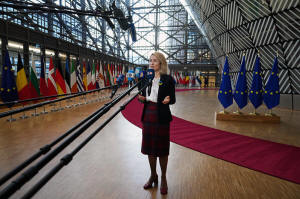
European Union foreign policy chief Kaja Kallas speaks with the
media as she arrives for a meeting of EU foreign ministers at the
European Council building in Brussels, Monday, Feb. 23, 2026. (AP
Photo/Virginia Mayo)

“This war will only end when Russia no longer sees any sense in
continuing it, when Russia can no longer expect more territorial
gains, when Russia’s costs for this madness have simply become too
high,” Merz said. “We must dry up Moscow’s war financing.”
Finland's leader argued that Russia's war was a “strategic failure”
as he made the case for ratcheting up pressure on Putin.
“It is also a military failure — he is now losing many soldiers —
and, on top of that, it is an economic failure,” Stubb said,
speaking in French. “Putin is not winning this war, but he cannot
make peace.”
The EU already has sent Ukraine 194.9 billion euros ($229.8 billion)
in financial assistance while squeezing Russia’s key energy exports.
Nearly every country in Europe has significantly reduced or ceased
Russian energy imports since Moscow launched its full-scale war in
Ukraine. Yet Hungary and Slovakia, both EU and NATO members, have
maintained and even increased supplies of Russian oil and gas, and
received a temporary exemption from an EU policy prohibiting imports
of Russian oil.
Hungary's looming election
Facing a crucial election in less than two months, Orbán has
launched an aggressive anti-Ukraine campaign and accused the
opposition Tisza party, which leads in most polls, of conspiring
with the EU and Ukraine to install what he called Monday a
“pro-Ukraine government aligned with Brussels and Kyiv.”
Poland’s Foreign Minister Radosław Sikorski said he believed
Hungary’s veto threat could really be about Orbán’s fierce fight to
hold onto power.
Orbán, the EU’s longest-serving leader, will face the greatest
challenge to his power since he took office in 2010.
“I would have expected a much greater feeling of solidarity from
Hungary for Ukraine,” Sikorski said in Brussels. “The ruling party
managed to create a climate of hostility towards the victim of
aggression. And then it is now trying to exploit that in the general
election. It’s quite shocking.”
___
Corbet reported from Paris. Associated Press writers Justin Spike in
Budapest and Geir Moulson in Berlin contributed to this report.
All contents © copyright 2026 Associated Press. All rights reserved
 |