Judge blocks release of special counsel Jack Smith's report on Trump
classified documents case
[February 24, 2026]
By ALANNA DURKIN RICHER and ERIC TUCKER
WASHINGTON (AP) — A federal judge on Monday permanently barred the
release of a report by special counsel Jack Smith on his investigation
into President Donald Trump’s hoarding of classified documents, a
prosecution that was once seen as the most perilous of the four criminal
cases the Republican faced.
U.S. District Judge Aileen Cannon, who was nominated to the bench by
Trump, granted a request from the president to keep under wraps the
report on an investigation alleging that Trump stored sensitive
documents at his Mar-a-Lago estate after he left the White House
following his first term and that he obstructed government efforts to
get them back.
Smith and his team produced a two-volume report on the classified
documents investigation and a separate probe into Trump’s efforts to
overturn the 2020 presidential election after he lost to Democrat Joe
Biden. Both investigations produced indictments that were abandoned by
Smith’s team after Trump’s November 2024 election win in light of
longstanding Justice Department legal opinions that say sitting
presidents cannot face federal prosecution.
Attorney General Pam Bondi had already determined that the report was
“an internal deliberative communication that is privileged and
confidential and should not be released” outside the Justice Department,
according to court papers. The Trump administration has characterized
Smith's investigation as politically motivated and said in recent court
papers that the report belongs in the “dustbin of history."

Cannon's order blocking the release also applies to Bondi's successors
at the Justice Department. Cannon, who in 2024 dismissed the case after
concluding that Smith was unlawfully appointed after multiple other
favorable rulings for Trump, said the release of the report would
present a “manifest injustice” to the president and his two
co-defendants.
“Special Counsel Smith, acting without lawful authority, obtained an
indictment in this action and initiated proceedings that resulted in a
final order of dismissal of all charges,” she wrote. “As a result, the
former defendants in this case, like any other defendant in this
situation, still enjoy the presumption of innocence held sacrosanct in
our constitutional order.”
A First Amendment group and a watchdog organization have been pressing
for the report's release.
Chioma Chukwu, executive director of American Oversight, said it "will
continue using every tool available to force this information into the
open and to defend the public’s right to the truth through the release
of this report.”
Scott Wilkens, senior counsel at The Knight First Amendment Institute at
Columbia University — another group pushing for the report's public
release — said “there is no legitimate basis for its continued
suppression.”
[to top of second column]
|
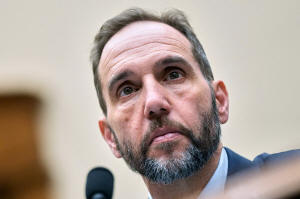
Former Justice Department special counsel Jack Smith testifies
before the House Judiciary Committee at the Capitol in Washington,
Jan. 22, 2026. (AP Photo/Mark Schiefelbein, File)

“Judge Cannon’s decision to permanently block the release of this
extraordinarily significant report is impossible to square with the
First Amendment and the common law,” Wilkens said in an emailed
statement.
A lawyer for Trump, Kendra Wharton, praised Cannon's ruling, saying
in a statement that Smith was unconstitutionally appointed and that
his report “should never see the light of day.”
Cannon wrote that though it is true that special counsels have
historically released reports at the conclusion of their work, they
have done so either after electing not to bring charges in a
particular case or “after adjudications of guilt by plea or trial."
Though Cannon suggested that an adjudication of guilt typically
precedes the release of a special counsel report, there have been
instances in which defendants charged by a special counsel have been
acquitted at trial and the allegations against them have nonetheless
been subsequently rehashed in a publicly released report.
The classified documents case was once considered the most serious
of the four criminal cases against him. It accused Trump of
repeatedly enlisting aides and lawyers to help him hide records
demanded by investigators and cavalierly showing off a Pentagon
“plan of attack” and classified map.
The first volume of Smith’s report on Trump’s 2020 election
interference case was released last year shortly before Trump
returned to the White House. Smith has defended his decision to
bring those charges, saying he believes they would have resulted in
a conviction had voters not elected Trump in 2024.
Cannon last year granted a defense request to at least temporarily
halt the release of the report dealing with the classified documents
case. That edict meant that Smith could not discuss the substance of
that investigation when he testified last month before the House
Judiciary Committee.
All contents © copyright 2026 Associated Press. All rights reserved
 |