FedEx joins other US companies in seeking a refund after Trump tariffs
are ruled illegal
[February 25, 2026] By
MICHELLE CHAPMAN
FedEx is suing the U.S. government, the latest company to request a
refund on what it paid for tariffs set by President Donald Trump last
year after the Supreme Court ruled that the tariffs are illegal.
More than 1,000 companies have filed suit in the U.S. Court of
International Trade in efforts to recoup costs from the illegal tariffs,
including large U.S. corporations like Costco and Revlon. Most of the
lawsuits were already in process ahead of the Supreme Court decision
Friday.
FedEx said in a filing with the U.S. Court of International Trade that
they have “suffered injury” from having to pay the tariffs and that the
relief they're seeking from the court would redress those injuries.
Tim Meyer, a law professor at Duke University, said each case is likely
to have to be tried individually.
“We’re going to have to wait and see how the government decides to
handle the refund claims,” he said. “And then if the government chooses
not to set up a process for the refunds, ultimately the Court of
International Trade is going to have to adjudicate over a thousand
cases.”

The National Retail Federation said in a statement on Friday that the
Supreme Court's ruling provided certainty for U.S. businesses and
manufacturers.
“We urge the lower court to ensure a seamless process to refund the
tariffs to U.S. importers,” it said. "The refunds will serve as an
economic boost and allow companies to reinvest in their operations,
their employees and their customers.”
The Supreme Court struck down President Donald Trump’s far-reaching
global tariffs on Friday. Trump said he was “absolutely ashamed” of some
justices who ruled 6-3 against him, calling them “disloyal to our
Constitution” and “lapdogs.” At one point he even raised the specter of
foreign influence without citing any evidence.
[to top of second column] |
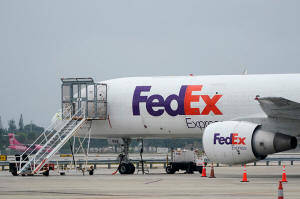
A FedEx cargo plane is shown on the tarmac at Fort
Lauderdale-Hollywood International Airport, Tuesday, April 20, 2021,
in Fort Lauderdale, Fla. (AP Photo/Wilfredo Lee, File)
 The court’s ruling found tariffs
that Trump imposed under an emergency powers law were
unconstitutional, including the sweeping “reciprocal” tariffs he
levied on nearly every other country.
The Treasury had collected more than $133 billion from the import
taxes the president has imposed under the emergency powers law as of
December, federal data shows. The impact over the next decade has
been estimated at some $3 trillion. A study by the Federal Reserve
Bank of New Yor k found U.S. businesses and consumers are paying
nearly 90% of the tariffs that Trump has imposed.
Trump has vowed to collect tariffs through other means. He reached
for a stopgap option immediately after his defeat Friday at the
Supreme Court: Section 122 of the Trade Act of 1974 allows the
president to impose tariffs of up to 15% for up to 150 days. But any
extension beyond 150 days must be approved by a Congress likely to
balk at passing a tax increase as November’s midterm elections loom.
All contents © copyright 2026 Associated Press. All rights reserved
 |