China restricts exports to 40 Japanese entities with ties to military
[February 25, 2026] By
SIMINA MISTREANU
BANGKOK (AP) — China on Tuesday restricted exports to 40 Japanese
entities it says are contributing to Japan's “remilitarization,” in the
latest escalation of tensions with Tokyo.
Beijing has shown continued displeasure with Tokyo since Japanese Prime
Minister Sanae Takaichi in November implied Japan could intervene if
China used military force against Taiwan, an island democracy China
claims as its own.
The Chinese Commerce Ministry put 20 Japanese companies on an export
control list and 20 others on a separate watchlist.
Companies on the export control list will not be able to import from
China dual-use goods, which can be used for civilian and military
purposes. They include multiple business subsidiaries of Mitsubishi
Heavy Industries involved in shipbuilding and the production of aircraft
engines and maritime machinery, as well as some of Kawasaki Heavy
Industries and Fujitsu, among others.
Foreign organizations or individuals are also banned from providing
dual-use items originating in China to the 20 entities, the ministry
said.
“All ongoing related activities must cease immediately,” its statement
read.
The separate watchlist has 20 Japanese companies for which Chinese
exporters are required to submit individual export license applications,
along with risk assessment reports and written pledges that the dual-use
items will not be used by Japan's military. It includes Subaru
Corporation, Mitsubishi Materials Corporation and the Institute of
Science Tokyo, among others.

The Chinese Commerce Ministry said the measures, aiming to curb Japan’s
remilitarization and nuclear ambitions, “are entirely legitimate,
reasonable, and legal.”
The restrictions “are only aimed at a small number of Japanese entities,
and the relevant measures only target dual-use items,” it added. “They
will not affect normal economic and trade exchanges between China and
Japan, and honest and law-abiding Japanese entities have absolutely
nothing to worry about.”
Japan condemns restrictions
Tokyo issued a formal protest of the measures to China’s Deputy Chief of
Mission to Japan Shi Yong, according to a statement by the Japanese
Foreign Ministry.
The restrictions, solely targeting Japan, largely differ from
international practices and are “absolutely unacceptable,” said Masaaki
Kanai, head of the ministry's Asian and Oceanian Affairs Bureau.
[to top of second column] |
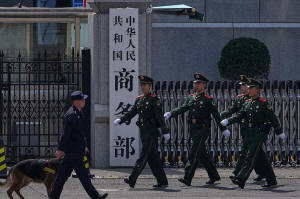
Paramilitary soldiers and a police officer with a sniffer dog march
past the main entrance gate of China's Ministry of Commerce, in
Beijing, on April 3, 2025. (AP Photo/Andy Wong, File)
 “The measures announced today will
never be tolerated. This is deplorable indeed. We strongly protest
to China and urge them to lift them (the controls),” Kei Sato,
Japan’s deputy chief Cabinet secretary, said during a routine
briefing on Tuesday.
Sato said the contents of China’s measures would “need to be
examined.”
“We will take actions accordingly,” he added.
Some aspects are unclear, including whether they include rare earths
trading, he added.
Some companies on list say they already have few dealings with
China
Most affected companies contacted by The Associated Press who
responded said they had no immediate comment.
Representatives of industrial equipment supplier Yashima Denki Co.
and chemical manufacturer NOF Corp, both on the watchlist, said they
believed their companies would be hardly affected by the measures as
they had limited trade with China.
Beijing has repeatedly criticized Tokyo over Takaichi's November
comments as well as what it describes as Japan's ambitions to
“remilitarize.”
China regards Taiwan as its own breakaway province, to be annexed by
force if necessary, and bristles at any comments by foreign
governments showing support for Taiwan's sovereignty.
Takaichi’s party secured a landslide victory in parliamentary
elections earlier this month, which will allow her to double down on
a significant conservative shift in Japan’s security, immigration
and other policies.
___
Associated Press writers Mari Yamaguchi and Yuri Kageyama in Tokyo
and business editor Elaine Kurtenbach in Bangkok contributed to this
report.
All contents © copyright 2026 Associated Press. All rights reserved
 |