German leader presses China for fair trade and help ending Ukraine war
[February 25, 2026] By
KEN MORITSUGU and GEIR MOULSON
BEIJING (AP) — German Chancellor Friedrich Merz called Wednesday for
deepening ties with China, while pushing for fairer trade rules between
the two countries and seeking Chinese help on Ukraine.
Merz, who arrived in Beijing late morning for a whirlwind two-day visit,
acknowledged differences during meetings with the country's top leaders
and called for collaboration “wherever possible.”
“We have a few issues that we need to talk about today in the course of
my visit,” he told Chinese Premier Li Qiang. “But I think there is also
great potential for further growth of both our economies.”
Both Europe and China have been buffeted by U.S. President Donald
Trump’s tariffs, and Europe further by his demands that it take more
responsibility for its own security and cede control of Greenland to the
U.S.
Shifting geopolitics
Merz, on his first trip to China since taking office last May, has
championed building a stronger Europe both economically and militarily
to assert itself in an emerging new world order.
Before landing in the Chinese capital, Merz indicated he would press for
a fair economic playing field for German companies and China’s
assistance in bringing about an end to Russia’s four-year-old war in
Ukraine.

He stressed that for all the differences Europe has with China, “the big
global political problems can no longer be tackled today without
involving Beijing.” Cooperation is needed to resolve crises and wars,
including that in Ukraine, he said, noting that “Beijing’s voice is
heard, including in Moscow.”
Many European governments have been frustrated that China hasn’t done
more to pressure Russia to end the fighting. It has maintained trade and
close diplomatic ties with Russia and said its position on the conflict
is impartial and objective.
“We hope all parties will seize the opportunity to reach a
comprehensive, lasting and binding peace agreement,” Chinese Foreign
Ministry spokesperson Mao Ning said earlier this week.
Pushing against Trump's tariffs
Merz is the latest in a parade of world leaders to visit Beijing as
China seeks support from other nations to push back against Trump’s use
of tariffs to demand concessions from trading partners, and his
challenges to the United Nations and the global order that has governed
international and economic relations in the post-World War II era.
[to top of second column] |
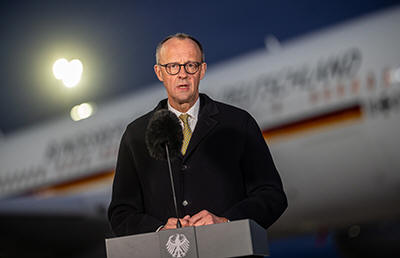
Germany's Federal Chancellor Friedrich Merz (CDU) speaks during a
press statement before his departure for China, in Brandenburg,
Germany, Tuesday, Feb. 24, 2026. (Michael Kappeler/dpa via AP)
 In his predeparture remarks, Merz
also emphasized the importance of placing Germany's China policy in
a European context, saying it was no coincidence that he is visiting
not long after French President Emmanuel Macron and British Prime
Minister Keir Starmer and ahead of a planned trip by U.S. President
Donald Trump in early April.
“Our message from a European point of view is the same: We want a
balanced, reliable, regulated and fair partnership with China,” Merz
said. “This is our offer. At the same time, it is what we also hope
for and expect from the Chinese side.”
“At a time when the world is experiencing turbulence and
transformation, China and Germany, as major economies and advocates
of multilateralism, share the responsibility to uphold the stability
of global industrial and supply chains and oppose protectionism and
economic coercion,” China's official Xinhua News Agency said in a
commentary.
Economically, a flood of Chinese exports is threatening factory jobs
in Europe. Germany's imports from China rose 8.8% to 170.6 billion
euros ($201 billion) last year, while its exports to China fell 9.7%
to 81.3 billion euros ($96 billion).
European leaders want Chinese companies to build factories in their
countries. They also want China to reduce manufacturing overcapacity
that is driving down prices in industries such as electric vehicles
and solar panels, and to remove barriers faced by foreign companies
in what is the world's second-largest economy.
“We also want to discuss how we can find a remedy, for example,
where systemic overcapacities have arisen, where there are export
restrictions and where there are access restrictions … that distort
and prevent competition," Merz said.
___
Moulson reported from Berlin.
All contents © copyright 2026 Associated Press. All rights reserved
 |