US childhood literacy rates are lagging. Pediatricians could be part of
the solution
[February 25, 2026]
By MAKIYA SEMINERA
For some young children in Columbus, Ohio, reading assessments don’t
start in the kindergarten classroom — they happen first in the doctor’s
office.
With concerns rising about lagging childhood literacy rates across the
country, Nationwide Children’s Hospital has begun screening children’s
literacy skills starting at age 3 during pediatrician visits. The idea
is to catch reading struggles early on and guide parents on how to help
their kids.
“They are all doing developmental screenings, they’re all talking to
parents repeatedly,” said Sara Bode, the hospital's medical director of
school-based health. “So this is an opportunity.”
The pediatric hospital chose clinics to provide the literacy screenings
largely based on their proximity to schools with lower performance
scores on kindergarten readiness assessments. Across Columbus City
Schools, more than 63% of kindergarteners were behind on language and
literacy skills during the 2024-2025 school year, according to state
kindergarten readiness assessment, or KRA, data.
Concerns about childhood literacy extend far beyond Columbus.
Nationally, the percentage of fourth graders considered proficient in
reading sits just above 30%, according to the 2024 National Assessment
of Educational Progress, known as the nation's report card. Reading
proficiency has dipped 4 percentage points since 2019 as schools have
struggled to make up for pandemic learning losses.

Literacy screenings are not typically conducted in medical settings, but
several prominent pediatric care centers, including Boston Children’s
Hospital, promote early literacy resources to families in recognition of
reading's importance for a child's development.
Kids who enter kindergarten with lower reading ability often struggle to
catch up in later grades. Almost three-fourths of kindergarteners who
test in the bottom 20% of students for readiness exams remain in the
bottom 20% of their class by fifth grade, according to The Children’s
Reading Foundation, a nonprofit organization.
Development screenings typically focus on other milestones
Physicians' assessments of childhood development have often focused more
on other milestones, such as walking or talking on time. But a child
could ace a standard pediatric screening and still be behind in other
areas needed to be ready for kindergarten, Bode said.
To address that dilemma, the pediatric hospital implemented literacy
screenings in about half of its 13 clinics, assigning a literacy
coordinator to each. The program launched in 2022 and has since
conducted more than 2,400 screenings. Many of the children come from
high-needs populations, as Nationwide serves families that are uninsured
or on Medicaid.
Screeners aren’t meant to diagnose learning disabilities like dyslexia,
but rather identify areas where kids could use additional support.
Having support outside the education system to flag early reading
difficulties is a step in the right direction, but choosing the right
screening tool is key, said Devin Kearns, an early literacy professor at
North Carolina State University.
Coordinators at Nationwide use a tool that assesses kids as they read
through a book during primary care visits — either in English or
Spanish. It took some practice to refine the timing — avoiding moments
after vaccinations when children were upset, for example — but the
reading assessments take only about 10 minutes.

[to top of second column]
|
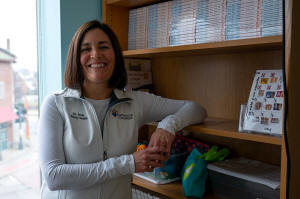
Dr. Sara Bode is the Medical Director of Children's Health at
Nationwide Children's hospital photographed at Linden Primary Care
Center at Nationwide Children's Hospital, Thursday, Dec. 11, 2025,
in Columbus, Ohio. (AP Photo/Jessica Phelps)
 After a child completes a screening,
the coordinator can create a personalized literacy plan that
highlights the areas that need more practice.
The visit is also an opportunity to model activities that parents
can do at home with their kids, such as reading a book aloud, said
Carneshia Edwards, who leads the hospital's kindergarten readiness
team.
“When we’re doing the screenings, families are kind of concerned
that their kids don’t know certain things and it’s not necessarily
about that piece of it,” Edwards said. “It’s just more so exposing
them more than anything.”
Giving families tools to improve reading at home
Before Juri Sleet completed her literacy screening at age 3, her
grandmother, Quintina Davis, worried Juri didn’t have enough
opportunities for early learning. But meeting with the literacy
coordinator at her clinic opened Davis’ eyes to all the activities
she could do at home with Juri.
“She didn’t know as much, but our coordinator was very patient with
her,” Davis said.
After each screening, coordinators put together literacy kits, a
medley of tools and activities for at-home practice. Those materials
are also influenced by Columbus City Schools teachers' feedback on
what students need help with when they enter kindergarten.
The kits' contents largely depend on donations the program receives.
There are often items such as dry-erase boards for writing letters
and books to practice reading. But the kits can also have safety
scissors or pencils with rubbery grippers to improve motor skills.
“Parents are the first teachers, so we really try to encourage them
to sit down with their child and just kind of work with them before
going into kindergarten,” Edwards said.

Coordinators stay in touch with the families they met with in the
clinic, sometimes referring children to early education programs
such as the federally-funded preschool program Head Start or the
SPARK program, which does educational home visits.
Then, when a child returns to the clinic a year later, the
coordinator meets with them again. For Juri, now 4, the follow-up
visit put into perspective how much she had progressed in a year,
her grandmother said.
Over the course of a year, Juri had made strides in recognizing
letters, sounds and sight words. Juri also enrolled in preschool at
a local YMCA with the help of her literacy coordinator, Davis said.
She’s been doing “awesome” there, Davis said, and she can’t wait to
watch her grow even more.
“The goal is to make sure by the time she starts kindergarten, that
she’s absolutely ready without having a lot of challenges,” Davis
said. “So right now, I think she is heading towards that way.”
___
Patrick Aftoora-Orsagos in Columbus, Ohio, contributed to this
report.
All contents © copyright 2026 Associated Press. All rights reserved |