Penguins in party hats? Birthday cards cheer families of babies treated
for botulism
[February 25, 2026]
By JONEL ALECCIA
The California program that provides the world’s only medical treatment
for potentially deadly infant botulism also offers traumatized families
hope of a different sort – silly cards on their babies’ first birthdays.
Every year, staff at the state’s Infant Botulism Treatment and
Prevention Program decorate and mail roughly 200 cards to celebrate the
recovery of children affected by the rare and dangerous condition.
In recent months, that group has included dozens of U.S. babies affected
by an outbreak of botulism tied to contaminated ByHeart infant formula.
Amy Mazziotti, of Burbank, California, received a birthday card for her
son, Hank, in September, months after he was hospitalized for 12 days
with botulism after drinking ByHeart formula.
“The fact that they take the time to send hand-drawn cards to each baby
is incredibly special," Mazziotti said. “When you’re worried about your
baby, it’s the small acts like this that somehow feel really big.”
The cards are coordinated by Robin Hinks, a program assistant whose
duties include decorating, tracking and mailing them.
“I am a big fan of drawing animals with party hats,” said Hinks, who
favors crayons and colored pencils. “Like, here’s a frog with some
balloons and a little penguin.”
The program’s primary purpose is to help diagnose and treat the disease
that occurs when babies ingest botulism spores that germinate in the
intestine and produce a dangerous toxin that attacks the nervous system,
causing paralysis. Death rates were once as high as 90%, but now are
less than 1% with treatment.
The only treatment, known as BabyBIG, is an IV medication made from the
pooled blood plasma of adults who have been immunized against botulism.
California’s program is the sole source worldwide.
Because the disease is so rare, with about 200 cases treated each year,
the botulism center has become a source of information and connection
for families facing the ordeal.
“Support of the babies and their families remains paramount to our
program and our mission,” said Dr. Jessica Khouri, the program’s senior
medical officer.
[to top of second column]
|
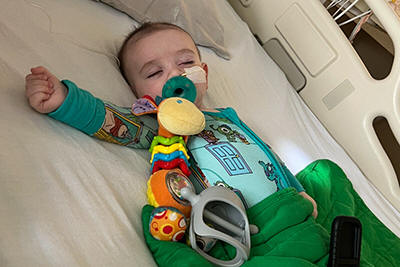
This photo provided by Amy Mazziotti shows Hank Mazziotti, 8 months,
being treated for infant botulism in March 2025 in Los Angeles. (Amy
Mazziotti via AP, File)
 Heather Goody, of Gallipolis, Ohio,
said she felt alone when her daughter, MaryEllen, contracted infant
botulism in 2016. Nearly a decade later, Goody still runs a Facebook
group, Infant Botulism Awareness, to connect the parents of sick
babies. It now has more than 500 members.
She still recalls how touching it was to receive a card on
MaryEllen’s first birthday.
“It brought all the feels, but most importantly the feeling of
gratitude that she was thriving in all areas of life,” Goody said.
Maintaining that connection was a priority for the late Dr. Stephen
Arnon, who with colleagues in 1976 identified the rare form of
botulism that affects babies younger than 1 — and then spent the
next 45 years figuring out how to treat it.
Arnon, who died in 2022, stayed in close touch with families of kids
sickened by infant botulism, updating them as his scientific work
progressed.
Today, nearly 1,500 families are part of the botulism program's
parent network, which includes children treated two decades ago. The
group shares everything from preschool graduations to college
acceptances and other milestones.
“Former patients have gone on to have families of their own and keep
in touch with us,” Khouri said. “It really is an incredible part of
the work we do.”
___
The Associated Press Health and Science Department receives support
from the Howard Hughes Medical Institute’s Department of Science
Education and the Robert Wood Johnson Foundation. The AP is solely
responsible for all content.
All contents © copyright 2026 Associated Press. All rights reserved |