Bird flu outbreak in California elephant seals prompts officials to
cancel popular tours
[February 26, 2026]
By REBECCA BOONE
Researchers say seven seal pups have tested positive for an avian flu
virus at California’s Año Nuevo State Park and several more are showing
signs of the illness. The outbreak has prompted park officials to cancel
the park's popular seal-watching tours for the remainder of the seal
breeding season.
Researchers with University of California-Santa Cruz and University of
California-Davis made the announcement Wednesday, calling it the first
detected outbreak of the virus among marine mammals in California.
The worldwide bird flu outbreak that began in 2020 has led to the deaths
of millions of domesticated birds and spread to wildlife around the
world, and seals and sea lions appear to be particularly vulnerable to
the disease. The virus has led to the deaths of thousands of sea lions
in Chile and Peru, thousands of elephant seals in Argentina, and
hundreds of seals in New England in recent years.
The virus is considered to be a low risk to humans, but officials said
people should avoid approaching the seals and keep pets away from the
animals.
Thousands of elephant seals come to Año Nuevo State Park, about 90
minutes south of San Francisco, every winter to fight, mate and give
birth. The annual spectacle draws tourists and wildlife watchers eager
to see the largest seals on the planet, some watching from public
viewing areas and others signing up for docent-led guided walks through
the breeding grounds, known as rookeries.
But for now, the viewing area is closed, and tours at Año Nuevo have
been canceled “out of an abundance of caution,” said Jordan Burgess, the
deputy district superintendent of the California Department of Parks and
Recreation. Officials hope the move will help prevent any spread of the
disease that might be caused by people tracking through the areas where
the elephant seals are living, she said.
[to top of second column]
|
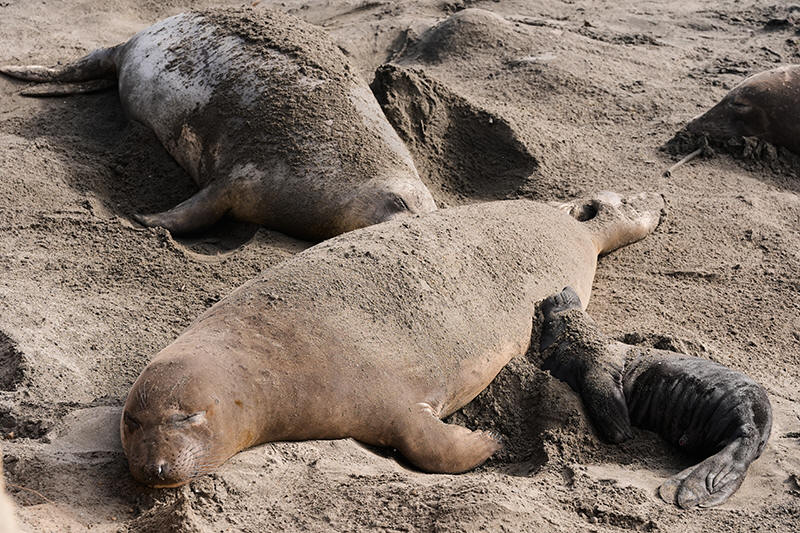
An elephant seal pup, right, rests next to female elephant seals on
a beach at Año Nuevo State Park, Friday, Jan. 16, 2026, in Pescadero,
Calif. (AP Photo/Godofredo A. Vásquez,File)
 “We're definitely not panicking
about human exposure at this point,” but rather trying to ensure the
health of the seals and people in general, Burgess said.
Christine Johnson, the director of the Institute for Pandemic
Insights at UC Davis' Weill School of Veterinary Medicine, said the
outbreak was spotted quickly because researchers have been on high
alert in recent years, watching for any sign of the arrival of the
disease. After sick and dead animals were spotted on Feb. 19 and 20,
researchers collected samples for testing at the California Animal
Health and Food Safety Laboratory System. The screening showed the
animals were infected with HPAI H5N1 virus.
Tests on samples from about 30 more animals are still pending,
Johnson said.
The university researchers are working with state and federal
wildlife managers and The West Coast Marine Mammal Stranding Network
to monitor the animals.
All contents © copyright 2026 Associated Press. All rights reserved
 |