The worst day for Nvidia's stock since last spring drags Wall Street
lower
[February 27, 2026] By
STAN CHOE
NEW YORK (AP) — The worst day for Nvidia’s stock since last spring
dragged the U.S. market lower on Thursday, even though most stocks on
Wall Street rose.
The S&P 500 slipped 0.5% following sharp swings earlier in the week
driven by hopes and worries created by the artificial-intelligence
revolution. The Dow Jones Industrial Average added 17 points, or less
than 0.1%, and the Nasdaq composite sank 1.2%.
Nvidia, whose chips are helping to power the AI boom, reported another
stellar quarter of profit growth that breezed past analysts’
expectations. It also gave a forecast for revenue in the current quarter
that once again topped Wall Street’s estimates.
But such blowout performances have become so typical for Nvidia that
they’re losing their oomph. Its stock sank 5.5% for its worst loss since
April.
“Our customers are racing to invest in AI compute — the factories
powering the AI industrial revolution and their future growth,” Nvidia
CEO Jensen Huang said.
Worries are nevertheless rising that those customers may eventually
curtail their spending on Nvidia’s chips and other AI investments amid
doubts about whether they can make back their billions of dollars
through future gains in productivity.
Because Nvidia’s is the largest stock in the U.S. market by value, it
has more influence on the S&P 500 than any other. It alone accounted for
more than four-fifths of the S&P 500’s loss.

Despite Nvidia’s troubles, seven stocks rose in the S&P 500 for every
three that fell. Among them was Salesforce, which climbed 4% after it
likewise reported a stronger profit for the latest quarter than analysts
expected.
It’s a return to gains for the stock, which is still down nearly 25% for
the young year so far. It’s been under pressure because of worries that
AI-powered competitors could undercut its business.
Salesforce uses AI itself in its offerings that help customers manage
relationships with their own customers. It also made several
announcements that typically give a stock’s price a boost: It will send
up to $50 billion to shareholders through buybacks of its stock, and it
increased its dividend.
“Agentic AI is a tailwind for our business,” CEO Marc Benioff said.
Companies in industries as far flung as trucking logistics and financial
services have also seen their stocks come under sudden and aggressive
attacks this year by investors who fear their businesses may lose out to
AI or even become obsolete.
The sharpest swings have hit software companies, and a widely followed
ETF that tracks the industry rose 2.1% Thursday to trim its loss for the
year so far below 22%.
[to top of second column] |
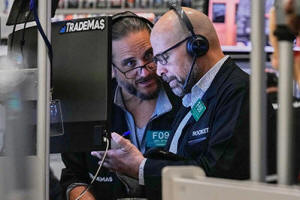
Options traders Chris Dattolo, left, and Steven Rodriguez work on
the floor of the New York Stock Exchange, Friday, Feb. 20, 2026. (AP
Photo/Richard Drew)
 Elsewhere on Wall Street, Warner
Bros. Discovery shares edged down 0.3% after the entertainment giant
reported a $252 million loss for the fourth quarter. That didn’t
seem to bother investors, who are likely more interested in which
acquisition offer — Netflix or Paramount Skydance — the company and
its shareholders ultimately accept.
All told, the S&P 500 fell 37.27 points to 6,908.86. The Dow Jones
Industrial Average added 17.05 to 49,499.20, and the Nasdaq
composite sank 273.69 to 22,878.38.
Some of the sharpest swings in financial markets were for oil, where
prices swung sharply as the United States and Iran held indirect
talks about Iran’s nuclear program.
A peaceful solution would remove the threat of war, which investors
worry could block the global flow of oil and drive up its price. The
U.S. military has already built up the largest force of American
warships and aircraft in the Middle East in decades, which has
raised the stakes. The current round of talks feels “make or break,”
according to strategists at Macquarie.
A barrel of benchmark U.S. crude briefly fell as low as $63.60. But
it erased that loss and rose above $66.50 before settling at $65.21,
up 0.3%. Brent crude, the international standard, also had a zigzag
day and finished at $70.75 per barrel, down 0.1%.
In stock markets abroad, indexes rose modestly in Europe following a
mixed finish in Asia.
South Korea’s Kospi leaped 3.7% to another record, driven by gains
for tech-related stocks. It’s already surged nearly 50% since the
turn of the year.
Hong Kong’s Hang Seng, meanwhile, lost 1.4%.
In the bond market, Treasury yields eased. The yield on the 10-year
Treasury fell to 4.01% from 4.05% late Wednesday.

A report showed that the number of U.S. workers applying for
unemployment benefits ticked up last week, but not by any more than
economists expected. It also remains relatively low compared with
history.
___
AP Business Writers Chan Ho-him and Matt Ott contributed.
All contents © copyright 2026 Associated Press. All rights reserved |