Teenage girls are most likely to tear their ACLs. Parents say more must
be done to protect them
[February 28, 2026]
By MARC LEVY
HARRISBURG, Pa. (AP) — Sofia Tepichin was about 30 minutes into her club
soccer team practice in October when she spotted a fast-approaching
defender. She tapped the ball away and hopped over the defender's
outstretched foot, came down awkwardly, and heard a “pop.”
She immediately fell to the ground, pain shooting through her left knee
and knew it wasn't good. It was, she said, “heartbreaking.”
“And I knew personally that I tore my ACL,” Tepichin said.
Tepichin joined the growing ranks of female high school athletes tearing
their anterior cruciate ligament, a devastating knee injury that
researchers are pressing the sports world to take more seriously.
Decades of research on prevention methods is available, but parents,
researchers and trainers say that teams, coaches and leagues aren't
doing enough to protect the girls and educate parents.
High school female athletes are most vulnerable
Sports fans hear often about high-profile athletes like U.S. Olympic
skier Lindsey Vonn tearing their ACLs, and many ACL injuries are chalked
up to bad luck or a part of sports that will continue to happen at all
competitive levels.
Still, high school-age female athletes suffer these injuries at much
higher rates than their male counterparts — up to eight times more
likely, one study says — and adults, most often in noncontact situations
in sports that require fast changes in direction, researchers say.
Biomechanics researchers, trainers and physical therapists say there are
pre-workout warm ups and strengthening routines — such as FIFA 11+ or
PEP — that can at least reduce the risk of an injury that takes such a
high physical and mental toll on young athletes.

But, they say, most coaches lack training or expert help, and high
school girls compete in settings with far fewer resources than the
professional and collegiate levels. As a result, risk-reduction routines
are rarely included in day-to-day coaching curricula and practices.
“The real crime in this is that the data has been out there for 25
years,” said Holly Silvers-Granelli, a physical therapist and
biomechanics researcher who advises athletes, professional teams and
major sports leagues on injury prevention. “People are clamoring for
answers, and the answers are largely there.”
The trendline of ACL injuries isn't entirely clear, but the National ACL
Injury Coalition — formed by the Aspen Institute and the Hospital for
Special Surgery in New York — said its analysis of data from high school
athletic trainers showed that the average annual ACL injury rate for
high school athletes grew almost 26% from 2007 to 2022.
The rate for girls grew more than 32%, compared to 14.5% for boys, it
said.
On their own to recover
When they get injured, high school athletes and their parents often find
themselves on their own to deal with it. ACL injuries can require
surgery and a year of rehab, physical therapy and strength training,
which insurance may not fully cover.
Recovery changes their routine and identity: They miss out on the
camaraderie of the team and stand on the sidelines, which can be as hard
as the physical trauma, parents say.
Many high school athletes who tear their ACL never perform again at the
same level, if they even return to the sport, the National ACL Injury
Coalition says. And once injured, they carry a heightened risk of
another ACL injury and long-term complications like degenerative joint
disease, researchers say.
The coalition has urged the sports world to treat ACL injuries like
brain injuries, now that professional and youth sports have tried to
improve training, rules and equipment standards to prevent and detect
concussions.
Sophia Gerardi, a sophomore at Pennsylvania’s Apollo Ridge High School
who tore her ACL during a basketball game in December, was told by her
doctors that she’ll forever have to wear a knee brace to play sports.
She had surgery in January, will miss volleyball season and hopes to be
back for next winter’s basketball season.
Like many girls who tore their ACL, she didn’t recall getting any ACL
injury-prevention training.
Surveys of coaches show that many don’t know about risk-reduction
programs, aren’t trained to do them or aren’t encouraged to learn about
them, said Vince Minjares, who leads the Aspen Institute’s ACL injury
prevention project. Some coaches tell Minjares that it takes too much
time.
He hopes that’s changing.
[to top of second column]
|
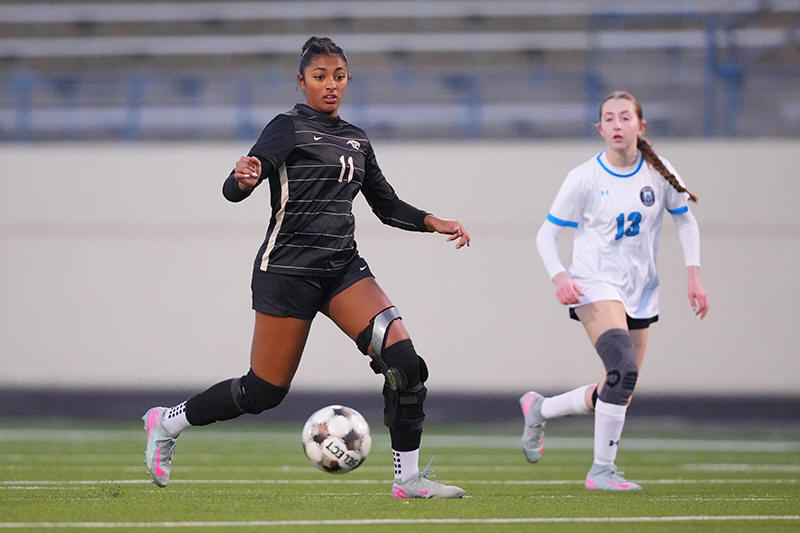
Plano East varsity soccer player Aliya Jacob, left, controls the
ball against Rock Hill's Hanna Schinner during a soccer game, Jan.
30, 2026, in Murphy, Texas. (AP Photo/Julio Cortez)
 ‘What is the solution’
This spring, the American Youth Soccer Organization — one of major
national organizations in U.S. youth soccer — will roll out new age-
and stage-based neuromuscular training programs aimed at preventing
ACL injuries through warm-ups.
Coaches will get a regimen of exercises in bite-sized chunks, with
video instructions. The goal is to build good habits before preteens
age into more physical and demanding competition.
“My biggest shock was that this didn’t already exist,” said Scott
Snyder, AYSO’s senior director of programs and education. “Everyone
I talk to says, ‘Yeah, that makes perfect sense,’ but nobody’s done
it yet.”
Last year, biomechanical researchers at the Scottish Rite for
Children hospital in metropolitan Dallas began providing high school
teams with resources typically only available or affordable at the
professional and collegiate levels.
They created pre-season injury-prevention trainings, tailored for
female athletes, to improve strength and movement quality. At the
start of the eight-week program, each athlete gets a free
motion-capture 3D-level assessment to identify weaknesses in
strength, movement or balance. Another assessment at the end
determines if the program reduced risk.
Future trainings could include nutrition and sleep, said Sophia
Ulman, who directs the hospital's Movement Science Laboratory.
“My team and I got tired of studying ‘why, why, why’ when there’s so
many different possibilities to answer that question. And we wanted
to move into the ‘what is the solution,’” said Ulman. Other
biomechanics labs in the U.S. are trying similar outreach, she said.
One of the teams that participated was Plano East High School in
Texas, where players — including Tepichin — had suffered a rash of
ACL tears the past couple years.
Cristy Cooley, Plano East's coach, said that getting a hands-on
demonstration from trained professionals in proper exercises and
movement patterns makes a big difference.
“It’s one thing talking about it,” Cooley said. “But it’s a totally
different thing to show us.”
‘Something’s got to change’
Like other parents, Tiffany Jacob said she learned a lot about
preventing ACL injuries that she wished she had known before her
daughter — East Plano sophomore Aliya Jacob — tore her ACL last
February. For instance, the surgeon told them three days a week of
strength training is an absolute must for soccer players.
“Something’s got to change,” Tiffany Jacob said. “Coaches, clubs,
something. They have to do something to prevent this because it’s
just such a horrible injury.”

Aliya — who knows at least seven other female soccer players who
tore an ACL, her mother said — is back playing for East Plano now.
She endured twice-a-week physical therapy, the isolation of
rehabilitation and, her mother said, “figuring out who you are when
you’re not playing soccer.”
Tepichin, a high school senior, recalls her surgeon telling her to
take a couple days to get all her sadness and anger out — and then
devote herself to her recovery.
She’ll miss her last year of playing high school and club team
soccer. Her next time on a field could be for Saint Vincent College
in Pennsylvania, where she committed to the NCAA Division III team.
Tepichin has seen a sports psychologist, gotten comfort from others
who underwent the surgery — her sister, her father and her friend —
and found a new routine after having been constantly busy with two
soccer teams and a job.
“There’s not a day that I go that I’m not working out or doing
something,” she said, “or getting better for my health and my
recovery.”
All contents © copyright 2026 Associated Press. All rights reserved |