Legislators, activists continue push for prescription drug affordability
board
[February 28, 2026]
By Jenna Schweikert and UIS Public Affairs Reporting (PAR)
Supporters of a long-awaited measure that would establish a board to
review and regulate statewide prescription drug prices are hoping to
gain momentum for the bill to pass this spring.
Contained in House Bill 1443 and Senate Bill 66, the measure would
establish a Health Care Availability and Access Board with the power to
review certain prescription drugs and set a maximum price if it finds
that the given drug presents “affordability challenges”.
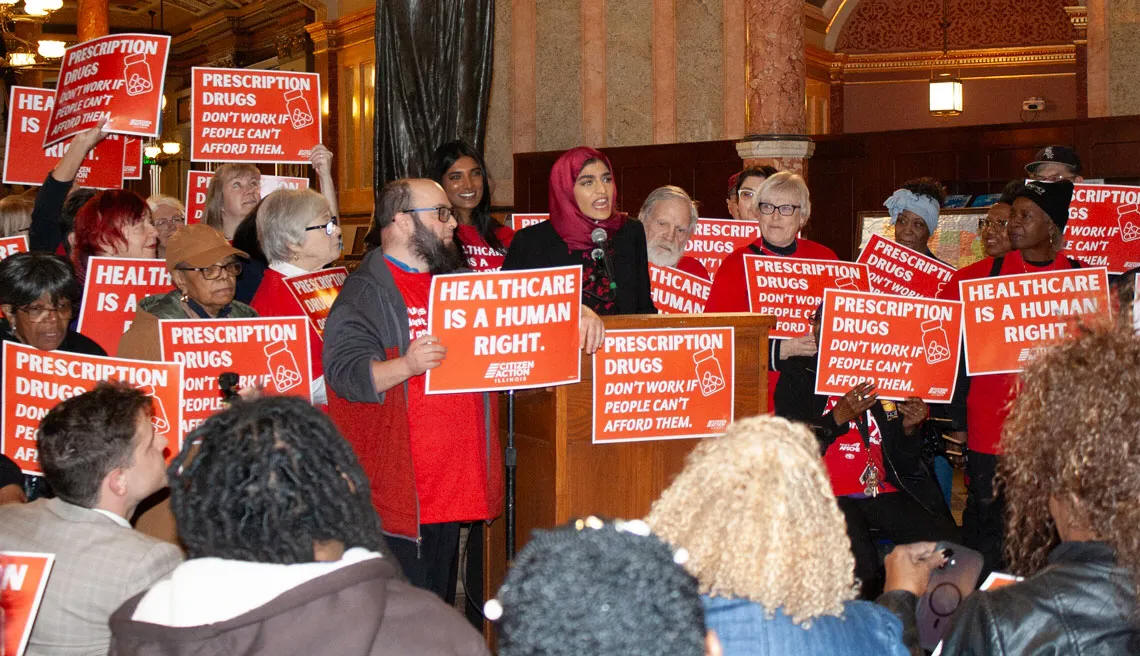
Renewed calls for the initiative, known also as a prescription drug
affordability board, or PDAB, echoed throughout the capitol rotunda on
Feb. 17. Supporters and leaders from Citizen Action/Illinois, a
statewide progressive policy coalition, rallied for the bill.
“Prescription drugs only work if people can actually afford them,” said
Anusha Thotakura, Executive Director of Citizen Action/Illinois. “That’s
what we need our legislators to do, to make sure that we expand access
to high quality and affordable health care and make sure we can afford
our prescription medication.”
First introduced in January 2025, both bills are still awaiting
committee assignments, signaling they are a long way from becoming law.
PDAB functions
At a news conference held after the rally, bill sponsors Sen. Graciela
Guzmán, D-Chicago, and Rep. Nabeela Syed, D-Palatine, pointed to a
similar board established in Colorado as an example of how the board
might function in Illinois. The Colorado board is the first in the
country to set an upper payment limit, or UPL.

Having survived its first legal challenge, Colorado’s UPL is estimated
to save consumers up to $32 million for that drug the first year after
it takes effect.
Illinois’ board would similarly review certain types of prescription
drugs, including expensive specialty drugs, drugs with sudden or extreme
price increases, generic drugs that are similar in price to the name
brand version and drugs suggested for review by the public.
To conduct a review, the PDAB would request information from
manufacturers, insurers, pharmacies, patients and other stakeholders
regarding the drug’s manufacturing costs, market price, health plan
spending and any other relevant data.
If the board finds that a given drug presents an affordability
challenge, it will set a UPL on that product, effective no sooner than
six months after its announcement.
Apart from federal health insurance plans, the UPL would apply to all
purchases and reimbursements of the drug in the state, whether purchased
in person, by mail or by other means, preserving the UPL from
manufacturer to consumer.
The bill also includes a provision for independent pharmacies, which
Citizen Action says are most at risk for low reimbursement rates, so
they cannot be reimbursed at rates lower than the UPL.
Potential savings for state, individuals
A PDAB would reap taxpayer savings in three ways: by stabilizing
insurance premiums and lowering out-of-pocket pharmacy costs and state
health plan spending, according to Citizen Action.
A recent Citizen Action report found that Illinois could save $192
million on state health plan spending in the first year with a PDAB
through automatically adopting the first 10 federally negotiated
Medicare drug prices.
Those prices were set after the 2022 Inflation Reduction Act gave the
Centers for Medicare & Medicaid Services negotiation power over pricing
of certain prescription drugs, although these prices only apply on
federal health insurance plans.
Those lower prices could be automatic for Illinois too, with the PDAB.
“What are we doing as a state when we allow for that $192 million to go
towards lining the pockets of pharmaceutical executives, rather than
investing that money back into our communities?” Syed said. “It is a
waste of taxpayer dollars if we do not implement a prescription drug
affordability board.”
[to top of second column]
|
Rep. Nabeela Syed speaks at a news conference on Feb. 17. Syed is
working on legislation to establish a prescription drug
affordability board with Sen. Graciela Guzman. (Capitol News
Illinois photo by Jenna Schweikert)

Guzmán, Syed and Citizen Action leaders estimated that it would take
about a year to establish the full board if the bill passes.
Legislation for Colorado’s PDAB first passed in 2021. After its first
affordability review, it voted to declare the rheumatoid arthritis drug
Enbrel unaffordable in February 2024, and that UPL is now set to take
effect on Jan. 1, 2027.
“I feel furious that we have not passed the prescription drug
affordability board when it’s clear that this will allow for cost
savings and for us to be better stewards of taxpayer dollars,” Syed
said. “I want to use this moment to urge my colleagues, my fellow
legislators, to understand the urgency this year and why we need to pass
a prescription drug affordability board and finally do right by our
residents.”
Bill resistance
Syed told Capitol News Illinois she faced considerable resistance from
pharmaceutical companies on the first version of the bill that she
introduced in early 2024.
“One of the years when I proposed this, it was me sitting in a room with
some of the advocates and maybe 40 lobbyists opposing this bill,” she
said at the news conference.
Amendments she introduced on that bill, and carried over to the most
recent one, mandate that pharmacy dispensing and provider administration
fees are not included in the UPL.
Syed also told Capitol News Illinois that she believes the
pharmaceutical industry will never support this legislation if it will
cut back on their profits. But she added that she hopes the amendments
will bring more support, or at least less opposition.
“These are life and death situations for some people,” Syed said. “I
feel a strong sense of urgency to my constituents … who are making these
tough decisions and not wanting them to do that whatsoever.”
PhRMA, a policy advocacy group representing pharmaceutical companies,
argues that PDABs can reduce patient access to treatments and don’t
always maintain savings from manufacturer to patient.
“Prescription drug boards put unelected state bureaucrats — many with
little to no clinical experience — between patients and their doctors
and risk reducing access to critical treatments,” said Tom Wilbur, a
PhRMA spokesman. “These boards often fail to address the real drivers of
patient costs, such as insurers and pharmacy benefit managers. Instead,
the focus should be on safeguarding patient access and affordability
from the abusive practices of these middlemen.”

At the rally, Guzmán, Syed and Citizen Action leaders each urged
immediate action on the bill, citing patient reports of rationing drugs
amid rising prescription costs.
“What I am led by is community members that are saying, right now, I’m
making a choice between my prescription drugs and my rent. I’m making a
choice between my insulin and food today,” Guzmán said. “Our communities
are making incredibly tough decisions. That’s not what industry is
doing.”
For now, the bills continue to wait for committee assignments.
Capitol News Illinois is
a nonprofit, nonpartisan news service that distributes state government
coverage to hundreds of news outlets statewide. It is funded primarily
by the Illinois Press Foundation and the Robert R. McCormick Foundation. |