House Democrats say they're headed back to power. Their agenda is a work
in progress
[February 28, 2026]
By JOEY CAPPELLETTI
LEESBURG, Va. (AP) — Gathered at a resort in suburban Virginia, House
Democrats this week were acting like a party on the verge of reclaiming
power as they drafted policy blueprints and spoke confidently about
election victories in November.
“We’re here at this issues conference to talk amongst each other and
with outside stakeholders and experts about a bold, meaningful,
transformational path forward,” said House Democratic leader Hakeem
Jeffries of New York.
After a punishing 2024 cycle, many Democrats believe the high cost of
living as well as voter frustration with President Donald Trump’s second
term have put the majority in the House well within their reach. But
beneath the confidence is a quieter uncertainty: Beyond opposing Trump,
Democrats face the defining challenge of developing a unifying policy
agenda capable of holding together a party undergoing generational and
ideological change.
Any Democratic majority would immediately use subpoena power against the
Republican administration, something they have been unable to do in the
minority. But beyond that, while members agree on the problems facing
voters — affordability, immigration enforcement and countering Trump —
fissures remain between the party’s progressive left and its more
centrist wing.
“We can’t be just anti-Trump," said Michigan Rep. Debbie Dingell, the
caucus’ policy leader. “We have to have an agenda.”
Unity in opposition
The party’s internal tensions were laid bare during the 2024 election
and in the months afterward as Democrats argued over messaging on
immigration, the economy and foreign policy. But when Trump returned to
power and moved quickly to implement his agenda, those disagreements
receded as Democrats moved to an opposition footing.

In the House, Democrats have rallied together to challenge Trump’s
policies, forcing — and succeeding on — votes opposing tariffs and
requiring the release of Department of Justice files related to Jeffrey
Epstein.
“We have become the most effective minority party in U.S. history,” said
California Rep. Ted Lieu, vice chair of the House Democratic Caucus.
But after more than three years as the minority party in the House,
Democrats say the political environment is shifting. Looking back to
November, they point to the ballot initiative in California to redraw
congressional maps, along with strong gubernatorial performances in
Virginia and New Jersey.
Since then, Democrats say there have been other overperformances to show
their momentum, such as flipping a state Senate district in Texas this
month in an area that Trump had won by 17 percentage points in 2024.
“It’s going to be a sprint" to Nov, 3, Election Day, Jeffries said.
“House Democrats are on the verge of a takeover.”
The harder task is governing
If Democrats reclaim the House, their most immediate power would be
oversight. Committee chairs would gain subpoena authority and the
ability to compel testimony — tools that leaders say would be used
aggressively to scrutinize the administration.
“Make no mistake, oversight will be muscular and significant,” said
Colorado Rep. Joe Neguse, a member of the House Judiciary Committee.
House Democratic Caucus leader Pete Aguilar of California said that
“when it comes to oversight and accountability, it is a target-rich
environment.” But he also said Democrats cannot rely on investigations
alone.
The standoff over funding for the Department of Homeland Security has
illustrated how resistance can unify the caucus. Democrats have largely
held together in opposition, using their leverage to outline demands for
accountability.

[to top of second column]
|
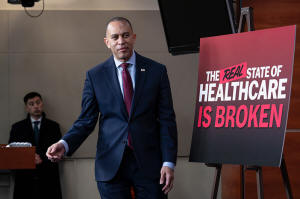
House Minority Leader Hakeem Jeffries, D-N.Y., arrives for a news
conference at the Capitol in Washington, Wednesday, Feb. 18, 2026.
(AP Photo/J. Scott Applewhite)

Yet divisions remain.
Some high-profile progressives, including Reps. Alexandria Ocasio-Cortez
of New York, Ilhan Omar of Minnesota and Ayanna Pressley of
Massachusetts, have called for abolishing U.S. Immigration and
Customs Enforcement. Party leaders and more centrist members, wary
of overreach, have instead advocated major changes, raising
questions about whether resolving the shutdown could expose deeper
splits.
“We cannot allow a federal agency — one that was created for one
purpose to terrorize — to function as an occupying force in our
communities,” Omar, whose district includes Minneapolis and
surrounding suburbs, said on the House floor this month. “Real
accountability starts with abolishing ICE.”
A previous shutdown fight underscored how compromise can strain that
cohesion. When some Democratic senators agreed to reopen the
government without securing an extension of key health care
subsidies, backlash from the party’s left flank was intense.
“The American people asked us over and over to fight for health care
and to lower our costs overall,” Sen. Elizabeth Warren, D-Mass.,
said at the time. “Obviously that broke apart at the end.”
‘A closing argument’
The week’s policy conference came and went with few specifics
attached to the “bold, meaningful, transformational path forward”
that Jeffries previewed at the outset. Instead, members coalesced
around broad themes — lowering costs, protecting health care and
drawing contrasts with Trump — while leaving the details for later.
“That’s the work that we’re still to do,” said Illinois Rep. Nikki
Budzinski when asked about what House Democrats' first bill would be
in a new majority. “We’ve rolled out nine different frameworks. All
of them are equally important, I think, to address affordability,
which is our coalition’s goal. It’s hard to say that there’s one
silver bullet.”
Democrats' “Six for ’06” agenda was not unveiled until the fall of
2006, weeks before voters handed them the majority. In 2018, the
party campaigned under the “For the People” banner months before
translating it into legislation once Democrats were in power.

“I expect to refresh our core message frame ahead of a closing
argument for this fall,” said Illinois Rep. Lauren Underwood. “The
closing argument was 6 for ‘06. Closing argument in 2018 was 'For
the People,' right? So, we’re going to have a closing argument
message frame that you all be delighted and wowed by as we head into
the fall election season.”
Still, the closer Democrats believe they are to reclaiming the
majority, the more pressing the agenda becomes. Oversight may be the
most immediate tool of a new majority. Sustaining power and shaping
the party’s direction beyond a single election cycle will require
more than subpoenas.
“What we tell our members and what we tell candidates who are
running is we have to do all of the things,” Aguilar said. "We have
to do oversight and accountability, and we have to talk about the
affordability agenda and how we’re going to make life better for
people if we are given the opportunity to lead.”
___
AP Congressional Correspondent Lisa Mascaro contributed to this
report.
All contents © copyright 2026 Associated Press. All rights reserved |