US strikes Venezuela and says its leader, Maduro, has been captured and
flown out of the country
[January 03, 2026]
By REGINA GARCIA CANO and KONSTANTIN TOROPIN
CARACAS, Venezuela (AP) — The United States hit Venezuela with a
“large-scale strike” early Saturday and said its president, Nicolás
Maduro, had been captured and flown out of the country after months of
stepped-up pressure by Washington — an extraordinary nighttime operation
announced by President Donald Trump on social media hours after the
attack.
Multiple explosions rang out and low-flying aircraft swept through
Caracas, the capital, as Maduro's government immediately accused the
United States of attacking civilian and military installations. The
Venezuelan government called it an “imperialist attack” and urged
citizens to take to the streets.
It was not immediately clear who was running the country, and Maduro's
whereabouts were not immediately known. Trump announced the developments
on Truth Social shortly after 4:30 a.m. ET.
Maduro, Trump said, “has been, along with his wife, captured and flown
out of the Country. This operation was done in conjunction with U.S. Law
Enforcement. Details to follow.” He set a news conference for later
Saturday morning.
The explosions in Caracas, Venezuela’s capital, early on the third day
of 2026 — at least seven blasts — sent people rushing into the streets,
while others took to social media to report hearing and seeing the
explosions. It was not immediately clear if there were casualties. The
apparent attack itself lasted less than 30 minutes, but it was unclear
if more actions lay ahead, though Trump said in his post that the
strikes were carried out "successfully.”

The Federal Aviation Administration issued a ban on U.S. commercial
flights in Venezuelan airspace because of “ongoing military activity”
ahead of the explosions.
The strike came as the Trump administration has escalated pressure on
Maduro, who has been charged with narco-terrorism in the United States.
The CIA was behind a drone strike last week at a docking area believed
to have been used by Venezuelan drug cartels — the first known direct
operation on Venezuelan soil since the U.S. began strikes in September.
Trump for months had threatened that he could soon order strikes on
targets on Venezuelan land following months of attacks on boats accused
of carrying drugs. Maduro has decried the U.S. military operations as a
thinly veiled effort to oust him from power.
Some streets in Caracas fill up
Armed individuals and uniformed members of a civilian militia took to
the streets of a Caracas neighborhood long considered a stronghold of
the ruling party. But in other areas of the city, the streets remained
empty hours after the attack. Parts of the city remained without power,
but vehicles moved freely.
Video obtained from Caracas and an unidentified coastal city showed
tracers and smoke clouding the landscape sky as repeated muted
explosions illuminated the night sky. Other footage showed an urban
landscape with cars passing on a highway as blasts illuminated the hills
behind them. Unintelligible conversation could be heard in the
background. The videos were verified by The Associated Press.
Smoke could be seen rising from the hangar of a military base in
Caracas, while another military installation in the capital was without
power.
“The whole ground shook. This is horrible. We heard explosions and
planes,” said Carmen Hidalgo, a 21-year-old office worker, her voice
trembling. She was walking briskly with two relatives, returning from a
birthday party. “We felt like the air was hitting us.”
Trump is at his private club in Palm Beach, Florida, where he has spent
the past two weeks for the holiday season. His public schedule showed he
was set to receive an intelligence briefing on Friday evening, hours
before the reported strikes. He offered no immediate comment on social
media.
Venezuela’s government responded to the attack with a call to action.
"People to the streets!” it said in a statement. “The Bolivarian
Government calls on all social and political forces in the country to
activate mobilization plans and repudiate this imperialist attack.”

[to top of second column]
|
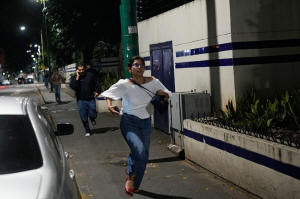
Pedestrians run after explosions and low-flying aircraft were heard
in Caracas, Venezuela, Saturday, Jan. 3, 2026. (AP Photo/Matias
Delacroix)

The statement added that Maduro had “ordered all national defense
plans to be implemented” and declared “a state of external
disturbance.” That state of emergency gives him the power to suspend
people’s rights and expand the role of the armed forces.
The website of the U.S. Embassy in Venezuela, a post that has been
closed since 2019, issued a warning to American citizens in the
country, saying it was “aware of reports of explosions in and around
Caracas.”
“U.S. citizens in Venezuela should shelter in place,” the warning
said.
Inquiries to the Pentagon and U.S. Southern Command since Trump’s
social media post went unanswered. The FAA warned all commercial and
private U.S. pilots that the airspace over Venezuela and the small
island nation of Curacao, just off the coast of the country to the
north, was off limits “due to safety-of-flight risks associated with
ongoing military activity.”
U.S. Sen. Mike Lee, R-Utah, posted his potential concerns,
reflecting a view from the right flank in the Congress. “I look
forward to learning what, if anything, might constitutionally
justify this action in the absence of a declaration of war or
authorization for the use of military force,” Lee said on X.
Regional reaction was not immediately forthcoming in the early hours
of Saturday. Cuba, however, a supporter of the Maduro government and
a longtime adversary of the United States, xxxxx. Iran's Foreign
Ministry also condemned the strikes.
It was not clear if the U.S. Congress had been officially notified
of the strikes.
The Armed Services committees which have jurisdiction over military
matters, have not been notified by the administration of any
actions, according to a person familiar with the matter and granted
anonymity to discuss it.
Lawmakers from both political parties in Congress have raised deep
reservations and flat out objections to the U.S. attacks on boats
suspected of drug smuggling on boats near the Venezuelan coast and
the Congress has not specifically approved an authorization for the
use of military force for such operations in the region.

Brewing tensions
The U.S. military has been attacking boats in the Caribbean Sea and
the eastern Pacific Ocean since early September. As of Friday, the
number of known boat strikes is 35 and the number of people killed
is at least 115, according to numbers announced by the Trump
administration.
They followed a major buildup of American forces in the waters off
South America, including the arrival in November of the nation’s
most advanced aircraft carrier, which added thousands more troops to
what was already the largest military presence in the region in
generations.
Trump has justified the boat strikes as a necessary escalation to
stem the flow of drugs into the U.S. and asserted that the U.S. is
engaged in an “armed conflict” with drug cartels.
On Friday, Venezuela said it was open to negotiating an agreement
with the U.S. to combat drug trafficking.
Maduro also said in a pretaped interview aired Thursday that the
U.S. wants to force a government change in Venezuela and gain access
to its vast oil reserves through the pressure campaign.
Meanwhile, Iranian state television reported on the explosions in
Caracas on Saturday, showing images of the Venezuelan capital. Iran
has been close to Venezuela for years, in part due to their shared
enmity of the U.S.
___
Toropin and Lisa Mascaro reported from Washington.
All contents © copyright 2026 Associated Press. All rights reserved |