Oil stocks sharply higher after US action in Venezuela
[January 06, 2026] By
MICHELLE CHAPMAN
Shares of major U.S. companies in the energy sector are sharply higher
Monday after President Donald Trump announced plans to take control of
Venezuela’s oil industry, saying that it would be American companies
helping to revitalize it following the capture of President Nicolás
Maduro.
While the U.S. action is unlikely to have an immediate impact on crude
prices given the current glut in the market, it could upend energy
markets and have an impact on the geopolitical landscape.
The shale oil revolution made the U.S. the world's largest crude
producer. Recent, massive oil finds off the coast of Guyana are largely
controlled by ExxonMobil and Chevron. U.S. control of the Venezuelan
energy industry, which sits on the world’s largest oil reserves, could
“reshape the balance of power in international energy markets,” analysts
with JP Morgan wrote Monday.
“The combined total could position the US as a leading holder of global
oil reserves, potentially accounting for about 30% of the world’s total
if these figures are consolidated under US influence,” JP Morgan wrote.
“This would mark a notable shift in global energy dynamics."
Venezuela’s oil industry is in disrepair after years of neglect and
international sanctions. Yet some oil industry analysts believe that
Venezuela could double or triple its current output of about 1.1 million
barrels of oil a day and return the nation to historic production levels
relatively quickly.

“With greater access to and influence over a substantial portion of
global reserves, the US could potentially exert more control over oil
market trends, helping to stabilize prices and keep them within
historically lower ranges,” according to JP Morgan. "This increased
leverage would not only enhance US energy security but could also
reshape the balance of power in international energy markets.”
If or when that would happen, however, is more complex. Many energy
analysts see a longer and more difficult road ahead.
“While the Trump administration has suggested large U.S. oil companies
will go into Venezuela and spend billions to fix infrastructure, we
believe political and other risks along with current relatively low oil
prices could prevent this from happening anytime soon,” wrote Neal
Dingmann of William Blair. Material change to Venezuelan production will
take a lot of time and millions of dollars of infrastructure
improvement, he said.
[to top of second column] |
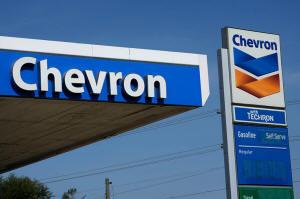
Chevron logos are displayed at a gas station in Columbus, Miss.,
Monday, Oct. 23, 2023.(AP Photo/Rogelio V. Solis, File)
 And any investment in Venezuelan
infrastructure right now would take place in a weakened global
energy market. Crude prices in the U.S. are down 20% compared with
last year. The price for a barrel of benchmark U.S. crude hasn’t
been above $70 since June, and hasn’t touched $80 per barrel since
the summer of 2024.
A barrel of oil cost more than $130 in the leadup to the the U.S.
housing crisis in 2008.
There’s several factors that could impact Venezuelan production,
including how quickly a government transition can take hold and how
fast and willing multinational oil companies are to reenter the
country, wrote John Freeman of Raymond James.
At the opening bell, shares in the energy sector moved broadly
higher, particularly companies with large refinery operations.
Venezuela produces the kind of heavy crude oil that’s needed for
diesel fuel, asphalt and other fuels for heavy equipment. Diesel is
in short supply around the world because of the sanctions on oil
from Venezuela and Russia and because America’s lighter crude oil
can’t easily replace it.
Big refiners like Valero, Marathon Petroleum and Phillips 66 rose
between 5% and 6% at the opening bell.
Oilfield service companies, those that actually go into the field
and do the drilling and upkeep, rose even more sharply. SLB and
Halliburton rose between 7% and 8%.
Major oil exploratory companies including ExxonMobil, Chevron and
ConocoPhillips rose between 2% and 4%.
All contents © copyright 2026 Associated Press. All rights reserved
 |