US allies and adversaries use UN meeting to critique Venezuela
intervention as America defends it
[January 06, 2026]
By FARNOUSH AMIRI and JENNIFER PELTZ
UNITED NATIONS (AP) — Both allies and adversaries of the United States
on Monday used an emergency meeting of the U.N. Security Council to
voice opposition to the audacious U.S. military operation in Venezuela
that captured leader Nicolás Maduro.
Before the U.N.'s most powerful body, countries critiqued — if sometimes
obliquely — President Donald Trump's intervention in the South American
country and his recent comments signaling the possibility of expanding
military action to countries like Colombia and Mexico over drug
trafficking accusations. The Republican president also has reupped his
threat to take over the Danish territory of Greenland for the sake of
U.S. security interests.
Denmark, which has jurisdiction over the mineral-rich island, carefully
denounced U.S. prospects for taking over Greenland without mentioning
its NATO ally by name.
“The inviolability of borders is not up for negotiation,” said Christina
Markus Lassen, Danish ambassador to the U.N.
She also defended Venezuela's sovereignty, saying “no state should seek
to influence political outcomes in Venezuela through the use of threat
of force or through other means inconsistent with international law.”
US allies push back on Venezuela
While French President Emmanuel Macron recently endorsed Maduro's
capture, its U.N. envoy was slightly more critical Monday, saying any
violations of international law by the five permanent members of the
U.N. Security Council, which include the U.S., erodes “the very
foundation of the international order.”
“The military operation that has led to the capture of Maduro runs
counter to the principle of peace dispute resolution and runs counter to
the principle of non-use of force," said Jay Dharmadhikari, deputy
French ambassador to the U.N.
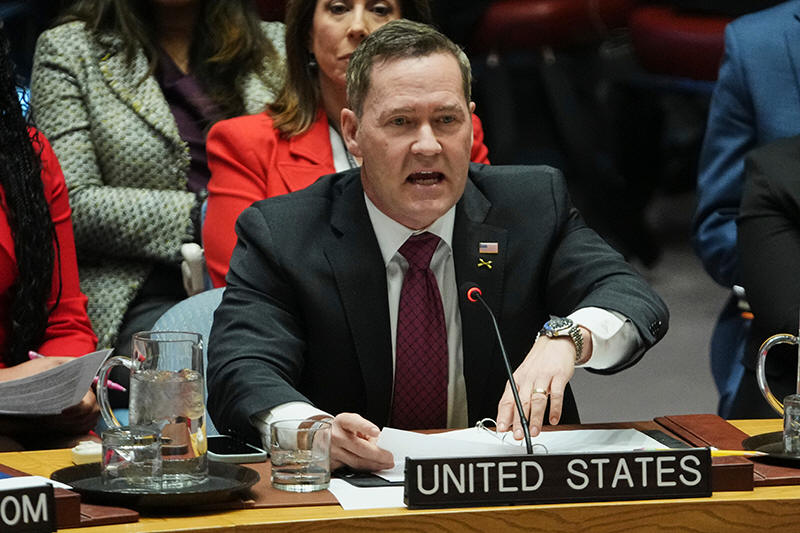
U.S. envoy Mike Waltz defended the operation in Venezuela as a justified
and “surgical law enforcement operation,” calling out the 15-member
council for criticizing the targeting of Maduro.
“If the United Nations in this body confers legitimacy on an
illegitimate narco-terrorist with the same treatment in this charter of
a democratically elected president or head of state, what kind of
organization is this?” said Waltz, who is Trump’s former national
security adviser.
Maduro's 2024 reelection was widely disputed.
U.N. Secretary-General Antonio Guterres said in a statement that he is
“deeply concerned that rules of international law have not been
respected with regard to the 3 January military action.” He said the
“grave” action by the U.S. could set a precedent for how future
relations between nations unfold.
Venezuela calls on the UN to take action
Even with the strong support for Venezuela's sovereignty, its envoy
called on the U.N. to go beyond veiled comments and condemnation.
Ambassador Samuel Moncada urged the Security Council to demand that
Washington release Maduro and his wife.

[to top of second column]
|
United States' Ambassador to the United Nations Michael Waltz
addresses the Security Council Monday, Jan. 5, 2026 at U.N.
headquarters. (AP Photo/Frank Franklin II)
“If the kidnapping of a head of state, the bombing of a sovereign
country and the open threat of further armed action are tolerated or
downplayed, the message sent to the world is a devastating one:
namely that the law is optional, and that force is the true arbiter
of international relations,” Moncada said.
He warned that other countries can’t afford to look away: “Accepting
such a logic would mean to open the door to a deeply unstable
world.”
Neighboring Colombia described the raid as reminiscent of “the worst
interference in our area in the past.”
“Democracy cannot be defended or promoted through violence and
coercion, and it cannot be superseded, either, by economic
interests,” Ambassador Leonor Zalabata said.
China and Russia are expectedly critical
The biggest critics of U.S. foreign policy, China and Russia,
which are also permanent members of the Security Council, called for
the U.N. body to unite in rejecting America turning back to an “era
of lawlessness.”
Maduro, like his predecessor, forged a close relationship with
Russia, while China was the main destination for most Venezuelan
oil.
“We cannot allow the United States to proclaim itself as some kind
of a supreme judge, which alone bears the right to invade any
country, to label culprits, to hand down and to enforce punishments
irrespective of notions of international law, sovereignty and
nonintervention,” Russian ambassador Vassily Nebenzia said.
His own country’s 2022 invasion of Ukraine has drawn widespread
condemnation within the U.N. and from the U.S., although the Trump
administration is engaging with Russia in hopes of brokering an end
to the fighting.

The U.S. seized Maduro and his wife early Saturday from their home
on a military base and put them aboard a U.S. warship to face
prosecution in New York in a Justice Department indictment accusing
them of participating in a narco-terrorism conspiracy. Maduro
declared his innocence during his first appearance in a Manhattan
courthouse Monday.
His stunning removal came after months of the U.S. amassing a
military presence off Venezuela’s coast and blowing up alleged drug
trafficking boats. Trump has insisted that the U.S. would run
Venezuela at least temporarily and tap its vast oil reserves to sell
to other nations.
Secretary of State Marco Rubio, however, says the U.S. would enforce
an oil quarantine that was already in place on sanctioned tankers
and use that leverage to press policy changes in Venezuela.
___
This article has been changed to correct the spelling of Russian
ambassador Vassily Nebenzia's name.
All contents © copyright 2026 Associated Press. All rights reserved |