At CES, auto and tech companies transform cars into proactive companions
[January 07, 2026] By
RIO YAMAT
LAS VEGAS (AP) — In a vision of the near future shared at CES, a girl
slides into the back seat of her parents' car and the cabin instantly
comes alive. The vehicle recognizes her, knows it’s her birthday and
cues up her favorite song without a word spoken.
“Think of the car as having a soul and being an extension of your
family,” Sri Subramanian, Nvidia's global head of generative AI for
automotive, said Tuesday.
Subramanian's example, shared with a CES audience on the show's opening
day in Las Vegas, illustrates the growing sophistication of AI-powered
in-cabin systems and the expanding scope of personal data that smart
vehicles may collect, retain and use to shape the driving experience.
Across the show floor, the car emerged less as a machine and more as a
companion as automakers and tech companies showcased vehicles that can
adapt to drivers and passengers in real time — from tracking heart rates
and emotions to alerting if a baby or young child is accidentally left
in the car.
Bosch debuted its new AI vehicle extension that aims to turn the cabin
into a “proactive companion.” Nvidia, the poster child of the AI boom,
announced Alpamayo, its new vehicle AI initiative designed to help
autonomous cars think through complex driving decisions. CEO Jensen
Huang called it a “ChatGPT moment for physical AI.”
But experts say the push toward a more personalized driving experience
is intensifying questions about how much driver data is being collected.

“The magic of AI should not just mean all privacy and security
protections are off,” said Justin Brookman, director of marketplace
policy at Consumer Reports.
Unlike smartphones or online platforms, cars have only recently become
major repositories of personal data, Brookman said. As a result, the
industry is still trying to establish the “rules of the road” for what
automakers and tech companies are allowed to do with driver data.
That uncertainty is compounded by the uniquely personal nature of cars,
Brookman said. Many people see their vehicles as an extension of
themselves — or even their homes — which he said can make the presence
of cameras, microphones and other monitoring tools feel especially
invasive.
[to top of second column] |
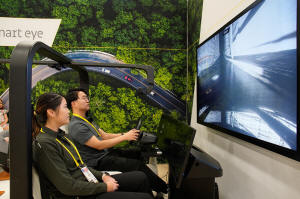
People take part in a simulator for Smart Eye interior sensing AI
technology at the Smart Eye booth during the CES tech show Tuesday,
Jan. 6, 2026, in Las Vegas. (AP Photo/John Locher)
 “Sometimes privacy issues are
difficult for folks to internalize,” he said. “People generally feel
they wish they had more privacy but also don’t necessarily know what
they can do to address it.”
At the same time, Brookman said, many of these technologies offer
real safety benefits for drivers and can be good for the consumer.
On the CES show floor, some of those conveniences were on display at
automotive supplier Gentex’s booth, where attendees sat in a mock
six-seater van in front of large screens demonstrating how closely
the company’s AI-equipped sensors and cameras could monitor a driver
and passengers.
“Are they sleepy? Are they drowsy? Are they not seated properly? Are
they eating, talking on phones? Are they angry? You name it, we can
figure out how to detect that in the cabin,” said Brian Brackenbury,
director of product line management at Gentex.
Brackenbury said it's ultimately up to the car manufacturers to
decide how the vehicle reacts to the data that's collected, which he
said is stored in the car and deleted after the video frames, for
example, have been processed. "
“One of the mantras we have at Gentex is we're not going to do it
just because we can, just because the technology allows it,”
Brackebury said, adding that “data privacy is really important.”
All contents © copyright 2026 Associated Press. All rights reserved
 |