Trump says he wants to ban large investors from buying houses. It's part
of his affordability plan
[January 08, 2026] By
JOSH BOAK
WASHINGTON (AP) — President Donald Trump said Wednesday that he wants to
block large institutional investors from buying houses, saying that a
ban would make it easier for younger families to buy their first homes.
Trump — who has been under pressure to address voters' concerns about
affordability ahead of November midterm elections — is tapping into
long-standing fears that corporate ownership of homes has pushed out
traditional buyers, forcing more people to rent. But his plan does
little to address the overarching challenges for the housing market: a
national shortage of home construction and prices that have climbed
faster than incomes.
“People live in homes, not corporations,” Trump said in a social media
post as he called on Congress to codify his ban.
Last month, Trump pledged in a prime-time address that he would roll out
“some of the most aggressive housing reform plans in American history”
this year. The president said he would discuss housing and affordability
in more detail in two weeks at the World Economic Forum in Davos,
Switzerland, an event known for attracting CEOs, wealthy financiers and
academics with a global focus who often run contrary to Trump's populist
rhetoric.
The president has in the past floated extending the 30-year mortgage to
50 years in order to lower monthly payments, an idea that has been
criticized because it would reduce people's ability to create housing
equity and increase their own wealth.

With Trump's proposed ban, the challenge is that institutional investors
are only a tiny sliver of homebuyers, accounting for just 1% of total
single-family housing stock, according to an August analysis by
researchers at the American Enterprise Institute, a center-right think
tank based in Washington. The analysis defined these investors as owning
100 or more properties.
The analysis notes that institutional ownership varies nationwide,
reaching 4.2% in Atlanta, 2.6% in Dallas and 2.2% in Houston. But these
investors tend not to dominate neighborhoods, even if they're generally
more concentrated in lower- and middle-income communities.
[to top of second column] |

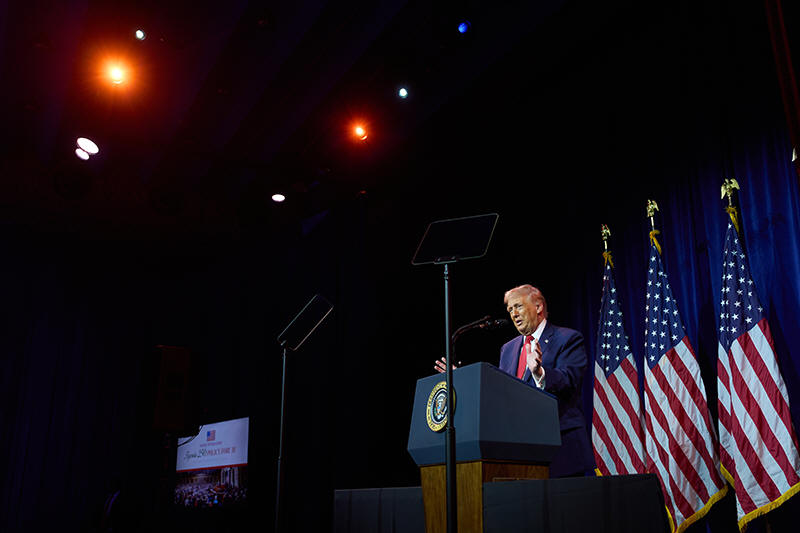
President Donald Trump speaks to House Republican lawmakers during
their annual policy retreat, Tuesday, Jan. 6, 2026, in Washington.
(AP Photo/Evan Vucci)
 Some Democrats have called for
crackdowns on corporate ownership of homes, but Sen. Elizabeth
Warren, D-Mass., told reporters Wednesday that the Trump
administration could cause housing prices to rise by allowing the
real estate companies Compass and Anywhere to merge.
“But he’s feeling the heat because the American people want to see
us lower the cost of housing and it is Democrats who are committed
to getting that done,” Warren said.
The Senate in October passed a bipartisan bill sponsored by Warren
that would create incentives for local governments to streamline
zoning regulations, among other policies, to increase the supply of
housing, but the measure has been held up in the Republican-majority
House.
The larger challenge has been a shortage of new construction, such
that Goldman Sachs in October estimated in October that 3 million to
4 million additional homes beyond the normal construction levels
would need to be built to relieve cost pressures. Mortgage rates
also climbed in the inflation that followed the coronavirus
pandemic, causing monthly payments on home loans to increase
dramatically faster than incomes.
Still, Trump said last month that an increase in new construction
would create a dilemma as it could cause existing home values to
drop and that would come at the expense of many existing homeowners'
net worth.
“I don’t want to knock those numbers down because I want them to
continue to have a big value for their house,” Trump said. “At the
same time, I want to make it possible for young people out there and
other people to buy housing. In a way, they’re at conflict.”
All contents © copyright 2026 Associated Press. All rights reserved |