Mexico becomes crucial fuel supplier to Cuba but pledges no extra
shipments after Maduro toppled
[January 08, 2026] By
MARÍA VERZA
MEXICO CITY (AP) — As the United States prepares to seize control of
Venezuelan oil and the administration of U.S. President Donald Trump
hardens its stance toward Cuba, Mexico has emerged as a key fuel
supplier to Havana.
It’s a role that could further complicate already strained relations
with the Trump administration, even though the Mexican government
insists that exports to the island have not increased.
Mexican President Claudia Sheinbaum acknowledged on Wednesday that “with
the current situation in Venezuela, Mexico has become an important
supplier” of crude oil to Cuba, but asserted that “no more oil is being
sent than has been sent historically; there is no specific shipment.”
She added that those shipments are made via “contracts” or as
“humanitarian aid,” but offered no concrete figures on the number of
barrels exported.
'The blackouts are going to intensify'
Following the 1959 revolution that toppled dictator Fulgencio Batista,
the U.S. imposed a trade embargo on Cuba in response to the
nationalization of American-owned property. Under the embargo — long
denounced by many countries, including Mexico — Cubans have suffered
economic and energy crises, driving hundreds of thousands of Cubans to
migrate, especially to the United States.
Blackouts that last up to eight hours and long lines at gas stations are
routine across Cuba.

José Martínez, a 65-year-old former construction worker and resident of
Old Havana whose power goes out daily, said the upheaval in Venezuela
will impact Cuba.
“The blackouts are going to intensify with all this,” he said, adding
that he believes the U.S. attacked because they want Venezuela's oil.
“They own the world.”
Meanwhile, street vendor Yeison Gálvez, 37, worries about the impact on
transportation: “For as long as I can remember, we’ve depended on
Venezuela for fuel. We’re going to be walking even more."
It's unclear if any country would increase oil shipments to Cuba after
the U.S. attack on Venezuela.
The Mexican government has avoided commenting on its future plans.
Exports to Cuba represent a very small percentage of total exports —
3.3% — but their economic profitability is questionable, and Pemex’s
production continues to decline.
From January to Sept. 30, 2025, Mexico shipped 19,200 barrels per day to
Cuba: 17,200 barrels of crude oil and 2,000 barrels of refined products,
according to the most recent report that state-owned oil company
Petróleos Mexicanos submitted to the U.S. Securities and Exchange
Commission.
Pemex did not immediately respond to a request for data.

[to top of second column] |

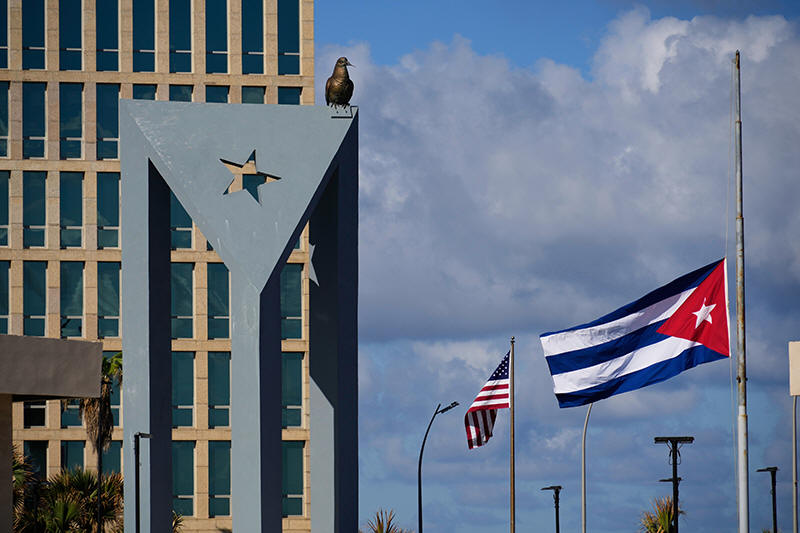
The Cuban flag flies at half-mast at the Anti-Imperialist Tribune
near the U.S. embassy in Havana, Cuba, Monday, Jan. 5, 2026, in
memory of Cubans who died two days before in Caracas, Venezuela
during the capture of Venezuelan President Nicolas Maduro by U.S.
forces. (AP Photo/Ramon Espinosa)
 Jorge Piñón, of the Energy Institute
at the University of Texas at Austin, who tracks shipments using oil
tracking services and satellite technology, shared similar data this
week with The Associated Press for the same period. He had tracked
22,000 barrels per day and said that the figure dropped to 7,000
barrels after U.S. Secretary of State Marco Rubio’s visit to Mexico
City in September 2025.
Meanwhile, in the last three months, Maduro’s government exported an
average of 35,000 barrels a day to Cuba, approximately a quarter of
the island’s total demand, according to Piñón.
The academic saw no likelihood that Mexico would increase its
shipments: “The U.S. government would go bonkers,” he said.
“There will be more pressure from the United States regarding Cuba,”
said Oscar Ocampo of the Mexican Institute for Competitiveness,
adding that oil will predictably be one of the areas under pressure,
a view shared by many experts.
A history of oil shipments
Mexico has historically sent oil to Cuba, especially during periods
of power blackouts and social unrest.
After widespread protests in Cuba in 2021, Mexico sent one of its
largest humanitarian aid shipments, which included 100,000 barrels
of fuel. And in October 2024, it sent more than 400,000 barrels in
just a few days following serious blackouts in Cuba, according to
data provided at the time by Piñón.
“The way this has been done also incentivizes opacity,” Ocampo said,
because since 2023, the shipments have been made via private Pemex
subsidiary, Gasolinas Bienestar, whose financial situation “is not
transparent.”

In its report to the SEC, Pemex states that the shipments to Cuba
were valued at approximately $400 million and were “sales” made
through contracts at market price. But Ocampo says it cannot clearly
be determined whether that was the case or if they were discounted
shipments, with some kind of quid pro quo — perhaps the deployment
of doctors — or as humanitarian aid.
The foreseeable lack of profitability in supplying oil to Cuba comes
as 2025 is set to become the year in which Pemex exported the least
amount of crude oil, “with less than 600,000 barrels per day, when
just a couple of years ago we exported more than 1 million,” Ocampo
said.
___
Associated Press reporters Andrea Rodríguez in Havana and Dánica
Coto in San Juan, Puerto Rico contributed.
All contents © copyright 2026 Associated Press. All rights reserved |