Fatal ICE shooting sparks jurisdiction clash between state and federal
authorities
[January 09, 2026]
By CLAUDIA LAUER
A day after a federal immigration officer fatally shot a woman in
Minneapolis, the case escalated sharply Thursday when federal
authorities blocked state investigators from accessing evidence and
declared that Minnesota has no jurisdiction to investigate the killing.
Legal experts said the dispute highlights a central question raised
repeatedly as federal agents are deployed into cities for immigration
enforcement: whether a federal officer carrying out a federally
authorized operation can be criminally investigated or charged under
state law.
The FBI told Minnesota law enforcement officials they would not be
allowed to participate in the investigation or review key evidence in
the shooting, which killed 37-year-old Renee Good on Wednesday. Local
prosecutors said they were evaluating their legal options as federal
authorities asserted control over the case.
Minnesota Gov. Tim Walz urged federal officials to reconsider, saying
early public statements by Homeland Security Secretary Kristi Noem and
other federal leaders defending the agent risked undermining confidence
in the investigation’s fairness.
Experts say there's narrow precedent for state charges. And sometimes
attempts at those charges have been cut short by claims of immunity
under the Constitution's Supremacy Clause, which protects federal
workers performing federally sanctioned, job-related duties. But that
immunity isn't a blanket protection for all conduct, legal experts said.

What is the standard for immunity?
If charges are brought, the federal agent is likely to argue he is
immune from state prosecution under the Supremacy Clause of the U.S.
Constitution.
“The legal standard basically is that a federal officer is immune from
state prosecution if their actions were authorized by federal law and
necessary and proper to fulfilling their duties,” said Robert Yablon, a
professor at the University of Wisconsin Law School.
Yablon, who is the faculty co-director of the school's State Democracy
Research Initiative, said state prosecutors would have to consider both
state and federal laws to overcome the hurdles of immunity. They would
first need to show a violation of state statutes to bring charges, but
also that the use of force was unconstitutionally excessive under
federal law.
“If the actions violated the Fourth Amendment, you can't say those
actions were exercised under federal law,” he said, referring to the
constitutional protection against unreasonable searches and seizures by
the government.
Hurdles to state charges
The whole endeavor is made more complicated if there is not cooperation
between federal and state authorities to investigate the shooting.
Walz said federal authorities rescinded a cooperation agreement with the
Minnesota Bureau of Criminal Apprehension, and he urged them to reverse
course, warning that Minnesotans were losing confidence in the
investigation’s independence. Noem confirmed the decision, saying: “They
have not been cut out; they don’t have any jurisdiction in this
investigation.”
State officials have been vocal about finding a way to continue their
own parallel investigation.

Minnesota Attorney General Keith Ellison said during an interview on CNN
that the move by federal authorities to not allow state participation
does not mean state officials can't conduct their own investigation.
But local officials in Hennepin County said they'd be in the dark if the
FBI chose not to share their findings. Hennepin County Attorney Mary
Moriarty said in a statement that her office is “exploring all options
to ensure a state level investigation can continue.”
“If the FBI is the sole investigative agency, the state will not receive
the investigative findings, and our community may never learn about its
contents,” she said.
Deputy Attorney General Todd Blanche defended federal agents’ use of
force, saying Thursday that officers often must make split-second
decisions in dangerous and chaotic situations. In a statement posted on
social media, Blanche said the law does not require officers “to gamble
with their lives in the face of a serious threat of harm,” and added
that standard protocols ensure evidence is collected and preserved
following officer-involved shootings.
[to top of second column]
|
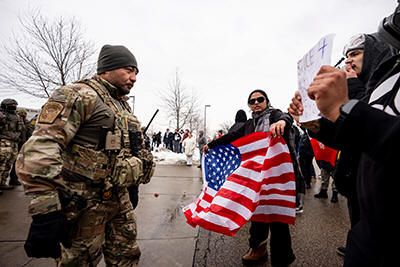
Federal agents and police clash with protesters outside the Bishop
Henry Whipple Federal Building in Minneapolis, Minn. on Thursday,
Jan. 8, 2026. (Christopher Katsarov/The Canadian Press via AP)

In many cases involving use-of-force, investigators examine how the
specific officer was trained, if they followed their training or if
they acted against standard protocol in the situation. It’s unclear
if state investigators will be granted access to training records
and standards or even interviews with other federal agents at the
scene Wednesday, if they continue a separate investigation.
During the prosecution of former Minneapolis police officer Derek
Chauvin in the killing of George Floyd, prosecutors called one of
the department's training officers to testify that Chauvin acted
against department training.
Precedents and other legal issues
Samantha Trepel, the Rule of Law program director at States United
Democracy Center and a former prosecutor with the Justice
Department's civil rights division, wrote a guest article for Just
Security Wednesday in the wake of the fatal shooting. The piece
focused on the Department of Justice silence in the face of violent
tactics being used in immigration enforcement efforts.
Trepel, who participated in the prosecution of officers involved in
Floyd's death, told AP Thursday that the current DOJ lacks the
independence of previous administrations.
“In previous administrations, DOJ conducted independent and thorough
investigations of alleged federal officers’ excessive force. Even
though the feds were investigating feds, they had a track record of
doing this work credibly,” Trepel said. “This included bringing in
expert investigators and civil rights prosecutors from Washington
who didn’t have close relationships and community ties with the
individuals they were investigating.”
Trepel said in a standard federal investigation of alleged unlawful
lethal force, the FBI and DOJ would conduct a thorough investigation
interviewing witnesses, collecting video, reviewing policies and
training, before determining whether an agent committed a
prosecutable federal crime.
“I hope it's happening now, but we have little visibility,” she
said. “The administration can conduct immigration enforcement
humanely and without these brutal tactics and chaos. They can arrest
people who have broken the law and keep the public safe without
sacrificing who we are as Americans.”
Questions about medical aid after the shooting
In other high-profile fatal police shootings, officers have faced
administrative discipline for failing to provide or promptly secure
medical aid after using force.
Video circulating from Wednesday’s shooting shows a man approaching
officers and identifying himself as a physician, asking whether he
could check Good’s pulse and provide aid. An agent tells him to step
back, says emergency medics are on the way, and warns him that he
could be arrested if he does not comply.
Witness video later showed medics unable to reach the scene in their
vehicle, and people carrying Good away. Authorities have not said
whether actions taken after the shooting, including efforts to
provide medical assistance, will be reviewed as part of the federal
investigation.
In other cases, including the 2023 death of Tyre Nichols in Memphis,
Tennessee, failures to render medical aid were cited among the
reasons officers were fired and later charged.
All contents © copyright 2026 Associated Press. All rights reserved
 |