Sluggish hiring closes out a frustrating year for job seekers though
unemployment slips to 4.4%
[January 10, 2026] By
CHRISTOPHER RUGABER
WASHINGTON (AP) — Sluggish December hiring concluded a year of weak
employment gains that have frustrated job seekers even though layoffs
and unemployment remained low.
Employers added just 50,000 jobs last month, nearly unchanged from a
downwardly revised figure of 56,000 in November, the Labor Department
said Friday. The unemployment rate slipped to 4.4%, its first decline
since June, from 4.5% in November, a figure also revised lower.
The data suggests a reluctance by businesses to add workers even as
economic growth has picked up. Many companies hired aggressively after
the pandemic and no longer need to fill more jobs. Others have held back
due to widespread uncertainty caused by President Donald Trump’s
shifting tariff policies, elevated inflation, and the spread of
artificial intelligence, which could alter or even replace some jobs.
Still, economists were encouraged by the lower unemployment rate, which
had risen in the previous four straight reports. Weakening employment
raised alarms at the Federal Reserve, which cut its key interest rate
three times last year.
“The labor market looks to have stabilized, but at a slower pace of
employment growth,” Blerina Uruci, chief economist at T. Rowe Price,
said. "There is no urgency for the Fed to cut rates further, for now."
Some Federal Reserve officials are concerned that inflation hasn't
improved since 2024 and remains above their target of 2% annual growth.
They support keeping rates where they are to combat inflation. Others,
however, have grown worried that hiring has nearly ground to a halt and
have supported lowering borrowing costs to spur spending and growth.

November's job gain was revised slightly lower, from 64,000 to 56,000,
while October's now shows a much steeper drop, with a loss of 173,000
positions, down from previous estimates of a 105,000 decline. The
government revises the jobs figures as it receives more survey responses
from businesses.
Nearly all the jobs added in December were in the health care and
restaurant and hotel industries. Health care added 38,500 jobs, while
restaurants and hotels gained 47,000. Governments — mostly at the state
and local level — added 13,000.
Manufacturing, construction and retail companies all shed jobs.
Retailers cut 25,000 positions, a sign that holiday hiring has been
weaker than previous years. Manufacturers have shed jobs every month
since April, when Trump announced sweeping tariffs intended to boost
manufacturing.
Wall Street and Washington are looking closely at Friday's report as
it's the first clean reading on the labor market in three months. The
government didn’t issue a report in October because of the six-week
government shutdown, and November’s data was distorted by the closure,
which lasted until Nov. 12.
Job gains have been subdued all year, particularly after April’s
“liberation day” tariff announcement by Trump. The economy gained just
584,000 jobs in 2025, sharply lower than that more than 2 million added
in 2024. It’s the smallest annual gain since the COVID-19 pandemic
decimated the job market in 2020. Outside of recessions, it's the
smallest annual increase since 2003.
Still, Trump boasted on social media late Thursday that since January,
all the new jobs have been in the private sector, while government jobs
have declined. Yet his figures included December's jobs numbers as well
as revisions to previous months, which the White House receives Thursday
afternoon, before the figures are publicly released.
Trump's post on Truth Social said that 654,000 jobs were added by
businesses since January, while government jobs declined 181,000, so it
wouldn't have been immediately clear that the post had new information
from December. But new jobs data are generally closely guarded since
they can move financial markets.
The hiring slowdown reflects more than just a reluctance by companies to
add jobs. With an aging population and a sharp drop in immigration, the
economy doesn't need to create as many jobs as it has in the past to
keep the unemployment rate steady. As a result, a gain of 50,000 jobs is
not as clear a sign of weakness as it would have been in previous years.
[to top of second column] |
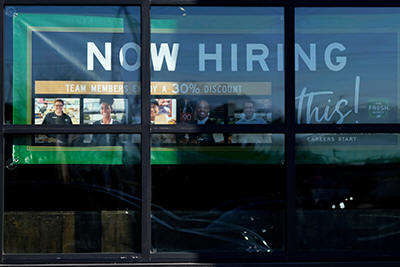
A hiring sign is displayed at a grocery store in Northbrook, Ill.,
Tuesday, Jan. 21, 2025. (AP Photo/Nam Y. Huh)
 And layoffs are still low, a sign
firms aren't rapidly cutting jobs, as typically happens in a
recession. The “low-hire, low-fire” job market does mean workers
have some job security, though it's become harder to find new work.
Ernesto Castro, 44, has applied for hundreds of jobs since leaving
his last in May. Yet the Los Angeles resident has had just three
initial interviews, and only one follow-up, after which he heard
nothing.
With nearly a decade of experience providing customer support for
software companies, Castro expected to find a new job pretty quickly
as in the past.
“It’s been awful,” he said.
He worries that more companies are turning to artificial
intelligence to help clients learn to use new software. He hears ads
from tech companies that urge companies to slash workers like him in
favor of AI. His contacts in the industry say that employees are
increasingly reluctant to switch jobs amid all the uncertainty,
which means fewer open jobs for others.
He is now looking into starting his own software company, and is
also exploring project management roles.
Subdued hiring underscores a key conundrum surrounding the economy
as it enters 2026: Growth has picked up to healthy levels, yet
hiring has weakened noticeably.
Tariff uncertainty has caused some firms to postpone adding jobs.
Steve Heckeroth, CEO of Renewables, Inc., said that tariffs have
forced him to put off hiring in recent months. Renewables is a
startup company based in Santa Rosa, California that has developed a
prototype for a small electric tractor for use mostly on farms. It
already has several hundred advance orders.
Heckeroth said he has had to delay adding workers to build the
tractors as new duties have shifted costs for parts and components
overseas. He had looked at axles and transmissions from India, until
they were hit earlier this year with a 50% tariff. Many electronic
components are from China, which has faced an array of
often-shifting duties.
“It’s delayed us at least six months, the tariffs, just not knowing
what our input prices are going to be,” Heckeroth said.
Most economists expect hiring will accelerate this year amid solid
growth, and Trump's tax cut legislation is expected to produce large
tax refunds this spring. Yet economists acknowledge there are other
possibilities: Weak job gains could drag down future growth. Or the
economy could keep expanding at a healthy clip, while automation and
the spread of artificial intelligence reduces the need for more
jobs.

Productivity, or output per hour worked, a measure of worker
efficiency, has improved in the past three years and jumped nearly
5% in the July-September quarter. That means companies can produce
more without adding jobs. Over time, it should also boost worker
pay.
Even with such sluggish job gains, the economy has continued to
expand, with growth reaching a 4.3% annual rate in last year's
July-September quarter, the best in two years. Strong consumer
spending helped drive the gain. The Federal Reserve Bank of Atlanta
forecasts that growth could slow to a still-solid 2.7% in the final
three months of last year.
All contents © copyright 2026 Associated Press. All rights reserved |