Death toll from protests in Iran hits at least 544, activists say, as
Trump says Iran wants to talk
[January 12, 2026]
By JON GAMBRELL and JULIA NIKHINSON
DUBAI, United Arab Emirates (AP) — U.S. President Donald Trump said
Sunday that Iran proposed negotiations after his threat to strike the
Islamic Republic over its bloody crackdown targeting demonstrators
there, a move coming as activists said the death toll in protests rose
to at least 544.
Trump and his national security team have been weighing a range of
potential responses against Iran including cyberattacks and direct
strikes by the U.S. or Israel, according to two people familiar with
internal White House discussions who were not authorized to comment
publicly and spoke on condition of anonymity.
“The military is looking at it, and we’re looking at some very strong
options,” Trump told reporters on Air Force One on Sunday night. Asked
about Iran’s threats of retaliation, he said: “If they do that, we will
hit them at levels that they’ve never been hit before.”
Trump said that his administration was in talks to set up a meeting with
Tehran, but cautioned that he may have to act first as reports of the
death toll in Iran mount and the government continues to arrest
protesters.
“I think they’re tired of being beat up by the United States,” Trump
said. “Iran wants to negotiate.”
He added: “The meeting is being set up, but we may have to act because
of what’s happening before the meeting. But a meeting is being set up.
Iran called, they want to negotiate.”
There was no immediate acknowledgment from Iran of the offering for a
meeting. The massive ongoing U.S. military deployment to the Caribbean
is a factor that the Pentagon and Trump’s national security planners
must consider. Tehran also warned that the U.S. military and Israel
would be “legitimate targets” if America uses force to protect
demonstrators. Trump meanwhile said the Islamic Republic reached out and
proposed negotiations.

More than 10,600 people also have been detained over the two weeks of
protests, said the U.S.-based Human Rights Activists News Agency, which
has been accurate in previous unrest in recent years and gave the death
toll. It relies on supporters in Iran crosschecking information. It said
496 of the dead were protesters and 48 were with security forces.
With the internet down in Iran and phone lines cut off, gauging the
demonstrations from abroad has grown more difficult. The Associated
Press has been unable to independently assess the toll. Iran's
government has not offered overall casualty figures.
Those abroad fear the information blackout is emboldening hard-liners
within Iran’s security services to launch a bloody crackdown. Protesters
flooded the streets in the country’s capital and its second-largest city
on Saturday night into Sunday morning. Online videos purported to show
more demonstrations Sunday night into Monday, with a Tehran official
acknowledging them in state media.
Defiance in parliament
The threat to strike the U.S. military and Israel came during a
parliamentary speech by Mohammad Baagher Qalibaf, the hard-liner speaker
of the body who has run for the presidency in the past.
He directly threatened Israel, calling it “the occupied territory."
“In the event of an attack on Iran, both the occupied territory and all
American military centers, bases and ships in the region will be our
legitimate targets,” Qalibaf said. “We do not consider ourselves limited
to reacting after the action and will act based on any objective signs
of a threat.”

[to top of second column]
|
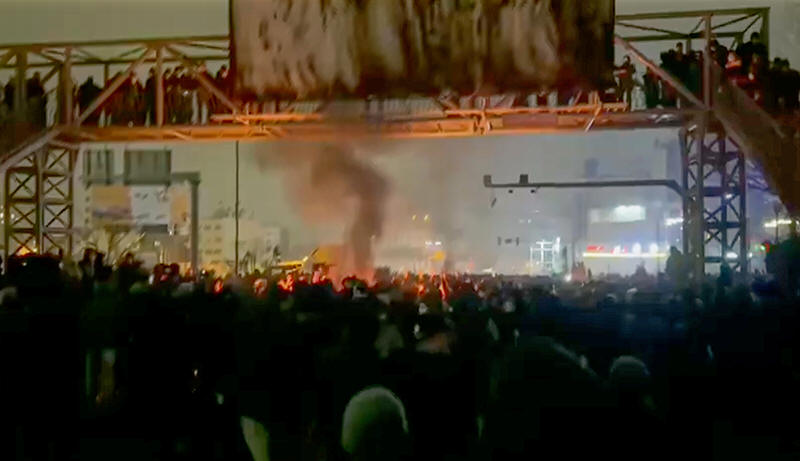
In this frame grab from footage circulating on social media from
Iran shows protesters taking to the streets despite an intensifying
crackdown as the Islamic Republic remains cut off from the rest of
the world in Tehran, Iran, Friday, Jan. 9, 2026.(UGC via AP)

Lawmakers rushed the dais in parliament, shouting: “Death to
America!”
It remains unclear how serious Iran is about launching a strike,
particularly after its air defenses were destroyed during the 12-day
war in June with Israel. Any decision to go to war would rest with
Iran's 86-year-old Supreme Leader Ayatollah Ali Khamenei.
The U.S. military has said in the Mideast it is “postured with
forces that span the full range of combat capability to defend our
forces, our partners and allies and U.S. interests.” Iran targeted
U.S. forces at Al Udeid Air Base in Qatar in June, while the U.S.
Navy's Mideast-based 5th Fleet is stationed in the island kingdom of
Bahrain.
Israel, meanwhile, is “watching closely” the situation between the
U.S. and Iran, said an Israeli official, who spoke on condition of
anonymity due to not being authorized to speak to journalists.
Israeli Prime Minister Benjamin Netanyahu spoke with U.S. Secretary
of State Marco Rubio overnight on topics including Iran, the
official added.
“The people of Israel, the entire world, are in awe of the
tremendous heroism of the citizens of Iran,” said Netanyahu, a
longtime Iran hawk.
At the Vatican, Pope Leo XIV mentioned Iran as a place “where
ongoing tensions continue to claim many lives," adding that “I hope
and pray that dialogue and peace may be patiently nurtured in
pursuit of the common good of the whole of society."
Demonstrations were held in some international capitals in support
of the protesters. A spokesperson said United Nations
Secretary-General Antonio Guterres was “shocked" by reports of
violence against protesters resulting in “scores of deaths” and
called on Iranian authorities to use maximum restraint and restore
communications.
Protests in Tehran and Mashhad
Online videos sent out of Iran, likely using Starlink satellite
transmitters, purportedly showed demonstrators gathering in northern
Tehran's Punak neighborhood. There, it appeared authorities shut off
streets, with protesters waving their lit mobile phones. Others
banged metal while fireworks went off.

In Mashhad, Iran's second-largest city some 725 kilometers (450
miles) northeast of Tehran, footage purported to show protesters
confronting security forces. Protests also appeared to happen in
Kerman, 800 kilometers (500 miles) southeast of Tehran.
Iranian state television on Sunday morning had correspondents appear
on the streets in several cities to show calm areas, with a date
stamp shown on screen. Tehran and Mashhad were not included.
The demonstrations began Dec. 28 over the collapse of the Iranian
rial currency, which trades at over 1.4 million to $1, as the
country’s economy is squeezed by international sanctions in part
levied over its nuclear program. The protests intensified and grew
into calls directly challenging Iran’s theocracy.
___
Nikhinson reported from aboard Air Force One. Associated Press
writers Aamer Madhani and Michelle Price in Washington, and Melanie
Lidman in Tel Aviv, Israel, contributed to this report.
All contents © copyright 2026 Associated Press. All rights reserved |