GOP senator wants budget transparency; Dems describe open process
[January 13, 2026]
By Jim Talamonti | The Center Square
(The Center Square) – As Illinois state senators return to Springfield,
Democrats and Republicans disagree over the level of transparency in the
state’s budget process.
The state Senate’s first meeting of 2026 is scheduled Tuesday afternoon
at the Illinois Capitol.
A reporter asked Illinois Senate President Don Harmon, D-Oak Park, about
lawmakers routinely passing the state budget in the middle of the night
with line items stuffed into a shell bill.
“I fundamentally disagree with your characterization. The budget is a
process that begins in January or February and culminates in May,”
Harmon said.
The Oak Park Democrat said the actual passage of every bill takes about
60 seconds.
“But a budget is a bill that is months in the making and subject to more
public scrutiny than most anything else that we do,” Harmon said.
Last May, Harmon and Illinois House Speaker Emanuel “Chris” Welch,
D-Hillside, sponsored empty budget legislation with two days left in the
General Assembly’s spring session.
The Senate president asked lawmakers to support Senate Bill 2510.
“This is a vehicle bill. There is no content,” Harmon said at the time.
The $55.2 billion Illinois state spending plan for fiscal year 2026 was
signed by Gov. J.B. Pritzker last June. The budget included higher taxes
on phones, tobacco and vaping products, sports betting and short term
hotel rentals.

State Sen. Darby Hills, R-Barrington Hills, said legislators and the
public had little time to review nearly $1 billion in new spending
before the budget passed around 3 a.m.
“So rushing budgets and new taxes or fees put real pressure on families
deciding whether they can choose between groceries or rent or
prescriptions or child care,” Hills told TCS.
The Barrington Hills Republican said the record-high state budget raised
costs for families and small businesses.
“These types of decisions need to be transparent,” Hills said.

[to top of second column]
|
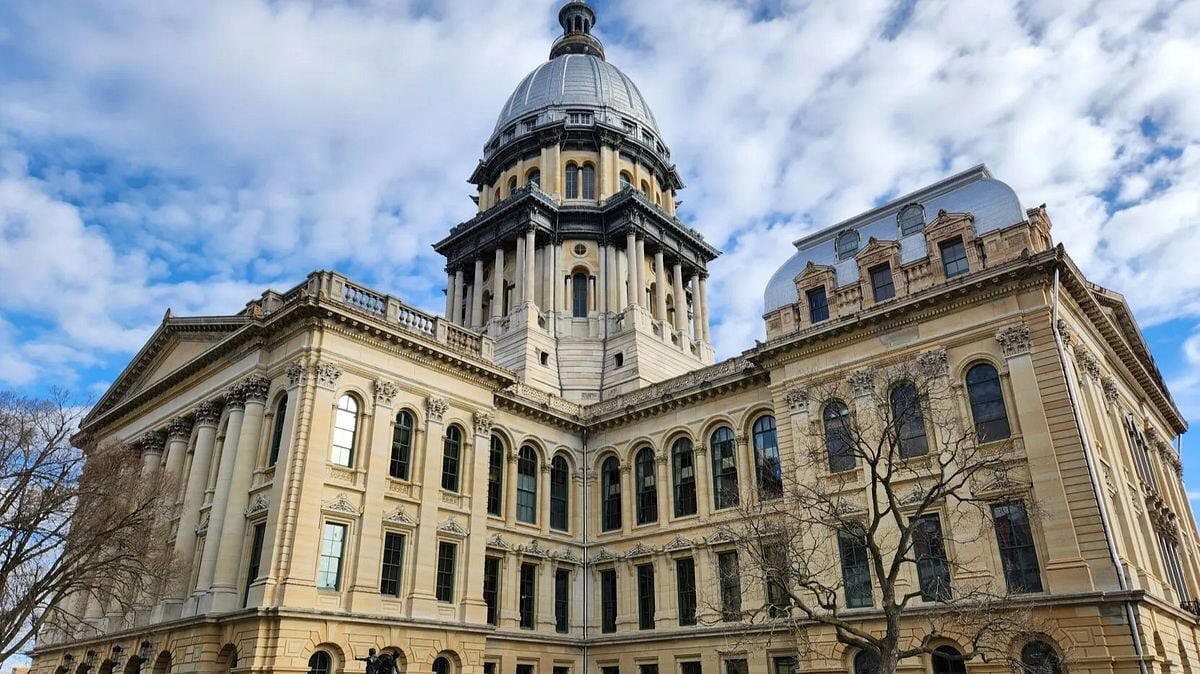
The Illinois State Capitol is shown in Springfield. Photo: Greg
Bishop / The Center Square

Last June, several Republican state legislators filed a lawsuit in
Sangamon County Circuit Court laying out how the final language of
the 3,300 page budget bill was filed with just 30 hours before the
legislature was set to adjourn.
The lawsuit against Harmon and Welch was brought by state Sen.
Andrew Chesney, R-Freeport, state Reps. Chris Miller, R-Oakland,
Blaine Wilhour, R-Beecher City, Adam Niemerg, R-Dieterich, Jed
Davis, R-Yorkville, David Friess, R-Red Bud, and Brad Halbrook,
R-Shelbyville.
When asked about the state budget passing during the middle of the
night, with line items added to a shell bill, state Sen. Bill
Cunningham, D-Chicago, said lawmakers spend dozens or even hundreds
of hours in budget hearings.
“Anyone is welcome to come and testify. The committee chairs will
call anyone to the witness table who fills out a witness slip, so I
think we do have an open process,” Cunningham told The Center
Square.
Cunningham said the biggest challenge for states will be reduced
federal funding.
“We’re probably looking any anywhere between $1 billion to $2
billion in cuts from the federal government. That’s going to create
a real problem for us and for every state in the country,”
Cunningham said.
Hills emphasized her support for Senate Bill 1699, which requires
public accounting of state spending on noncitizen programs.
“This bill that I’m cosponsoring gives taxpayers transparency so
they can see how their dollars are being spent and to ensure that
government is being held accountable,” Hills explained.
SB 1699, the Noncitizen Population Spending Transparency Act,
provides that the Illinois Department of Human Services collaborate
with relevant state agencies to prepare an annual report identifying
all state spending on services and resources for noncitizen and
asylum-seeking populations.
Greg Bishop contributed to this story.
All contents © copyright 2026 Associated Press. All rights reserved |