2025 home sales stuck at 30-year low with prices high and mortgages
onerous
[January 15, 2026] By
ALEX VEIGA
The U.S. housing market slump dragged into its fourth year in 2025 as
sales remained stuck at a 30-year low with rising home prices and
elevated mortgage rates keeping many prospective home shoppers out of
the market.
Sales of previously occupied U.S. homes totaled 4.06 million last year,
essentially flat versus 2024 when sales sank to the lowest level since
1995, the National Association of Realtors said Wednesday. Without
rounding the figures, sales last year were slightly lower than in 2024.
All told, existing U.S. home sales have declined on annual basis since
2022.
The median national home price for 2025 rose 1.7% to $414,400, the NAR
said.
Sales have been stuck close to a 4-million annual pace now going back to
2023. That’s well short of the 5.2-million annual pace that’s
historically been the norm.
“2025 was another tough year for homebuyers, marked by record-high home
prices and historically low home sales,” said Lawrence Yun, NAR’s chief
economist. “However, in the fourth quarter, conditions began improving,
with lower mortgage rates and slower home price growth."

The U.S. housing market has been in a sales slump dating back to 2022,
when mortgage rates began to climb from pandemic-era lows. The
combination of higher mortgage rates, years of skyrocketing home prices
and a chronic shortage of homes nationally following more than a decade
of below-average home construction have left many aspiring homeowners
priced out of the market.
In recent weeks, the Trump administration has floated proposals aimed at
easing the affordability crisis, including a 50-year mortgage, a ban on
large investors buying houses and a bid to lower mortgage rates by
spending $200 billion to buy mortgage bonds. Yet some economists believe
the proposals would likely have a minimal impact.
The average rate on a 30-year mortgage was around 7% a year ago and
remained elevated for much of the year until late summer, when mortgage
rates began to ease. The average rate closed out the year at 6.15%, its
lowest level since October 2024, according to Freddie Mac.
That recent pullback in mortgage rates helped drive existing U.S. home
sales in December to a seasonally adjusted annual rate of 4.35 million
units, a 5.1% increase from November and the fastest sales pace in
nearly three years, NAR said.
That topped the 4.14 million sales pace economists expected, according
to FactSet.
Home prices also ticked higher in December. The median sales price rose
to $405,400, a 0.4% increase from December 2024. That's an all-time high
for December and the 30th consecutive month with an annual increase in
the median sales price, NAR said.
[to top of second column] |
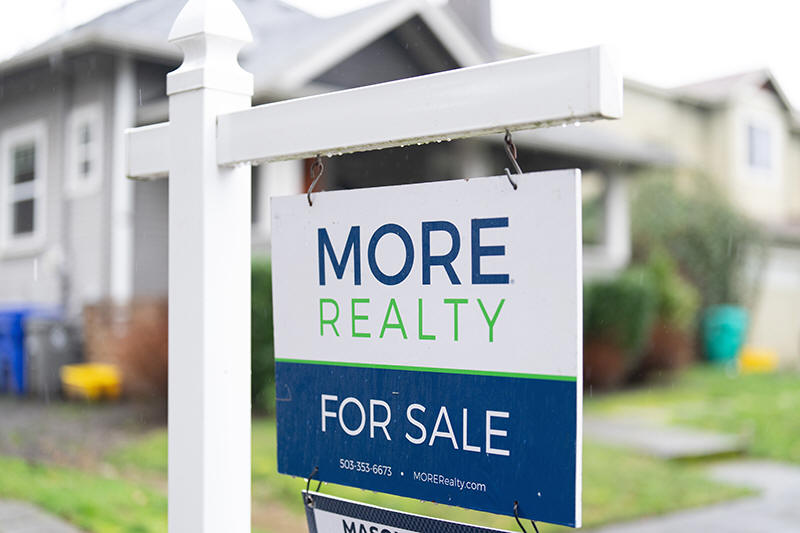
A "For Sale" sign is seen on Tuesday, Jan. 6, 2026, in Portland,
Ore. (AP Photo/Jenny Kane)
 Affordability remains a challenge
for many aspiring homeowners, especially first-time buyers who don’t
have equity from an existing home to put toward a new home purchase.
Uncertainty over the economy and job market are also keeping many
would-be buyers on the sidelines.
The sales slowdown means more homes are staying on the market
longer.
There were 1.18 million unsold homes at the end of December, a 3.5%
increase from a year earlier, NAR said. That's still well short of
the roughly 2 million homes for sale that was typical before the
COVID-19 pandemic.
December's month-end inventory translates to a 3.3-month supply at
the current sales pace. Traditionally, a 5- to 6-month supply is
considered a balanced market between buyers and sellers.
Yun is forecasting that existing U.S. home sales will jump 14% this
year. That’s more optimistic than several other housing economist
forecasts, which range from a 1.7% to 9% increase.
Economists generally expect mortgage rates to ease further this
year, though most recent forecasts show the average rate on a
30-year mortgage remaining above 6%, about twice what it was six
years ago.
Rates would have to drop considerably for homeowners, who bought or
refinanced when mortgage rates hit rock bottom earlier this decade,
to take on a new loan at a far higher rate. So far, those homeowners
have been more unwilling to sell.
Nearly 69% of U.S. homes with an outstanding mortgage have a
fixed-rate of 5% or lower, and slightly more than half have a rate
at or below 4%, according to Realtor.com.

Still, with mortgage rates at their lowest level in 15 months and
home price growth slowing, that could help drive more home sales
heading into the spring homebuying season.
“There’s quite sizeable pent-up demand, and the only way to get that
pent-up demand back to the market is we need more inventory and we
need better affordability," Yun said.
All contents © copyright 2026 Associated Press. All rights reserved |