FBI searches a Washington Post reporter's home as part of a classified
documents investigation
[January 15, 2026]
By ALANNA DURKIN RICHER and ERIC TUCKER
WASHINGTON (AP) — FBI agents searched a Washington Post reporter’s home
on Wednesday as part of a leak investigation into a Pentagon contractor
accused of taking home classified information, the Justice Department
said.
Hannah Natanson, who has been covering President Donald Trump’s
transformation of the federal government, had a phone, two laptops and a
Garmin watch seized in the search of her Virginia home, the Post
reported. Natanson has reported extensively on the federal workforce and
recently published a piece describing how she gained hundreds of new
sources — leading one colleague to call her “the federal government
whisperer.”
While classified documents investigations aren't unusual, the search of
a reporter's home marks an escalation in the government's efforts to
crack down on leaks. The Post was told that Natanson and the newspaper
are not targets of the probe, executive editor Matt Murray said in an
email to colleagues.
“Nonetheless, this extraordinary, aggressive action is deeply concerning
and raises profound questions and concern around the constitutional
protections for our work," Murray wrote. “The Washington Post has a long
history of zealous support for robust press freedoms. The entire
institution stands by those freedoms and our work.”
Attorney General Pam Bondi said that the search was done at the request
of the Defense Department and that the journalist was “obtaining and
reporting classified and illegally leaked information from a Pentagon
contractor.”

“Leaking classified information puts America’s national security and the
safety of our military heroes in serious jeopardy,” White House press
secretary Karoline Leavitt said in a post on X. “President Trump has
zero tolerance for it and will continue to aggressively crack down on
these illegal acts moving forward.”
The warrant says the search was related to an investigation into a
system engineer and information technology specialist for a government
contractor in Maryland who authorities allege took home classified
materials, the Post reported. The worker, Aurelio Perez-Lugones, was
charged earlier this month with unlawful retention of national defense
information, according to court papers. He has not been charged with
sharing classified information, and he has not been accused in court
papers with leaking.
Perez-Lugones, who held a top secret security clearance, is accused of
printing classified and sensitive reports at work. In a search of his
Maryland home and car this month, authorities found documents marked
“SECRET,” including one in a lunchbox, according to court papers.
An FBI spokesperson declined to comment on Wednesday. The Washington
Post said Wednesday that it was monitoring and reviewing the situation.
An email seeking comment was sent to lawyers for Perez-Lugones, who is
expected to appear in court on Thursday for a detention hearing.
[to top of second column]
|

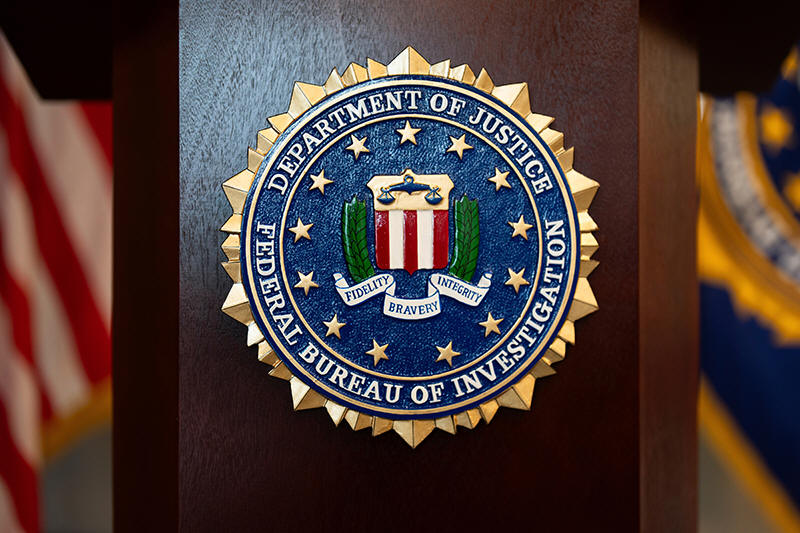
An FBI seal is displayed on a podium before a news conference
at the field office in Portland, Ore., Jan. 16, 2025. (AP
Photo/Jenny Kane, File)

First Amendment groups expressed alarm at the search, saying it
could chill investigative journalism that holds government officials
to account.
“Physical searches of reporters’ devices, homes, and belongings are
some of the most invasive investigative steps law enforcement can
take,” Reporters Committee for Freedom of the Press president Bruce
Brown said. “While we won’t know the government’s arguments about
overcoming these very steep hurdles until the affidavit is made
public, this is a tremendous escalation in the administration’s
intrusions into the independence of the press.”
The Justice Department over the years has developed, and revised,
internal policies governing how it will respond to news media leaks.
In April, Bondi rescinded a policy from President Joe Biden’s
Democratic administration that protected journalists from having
their phone records secretly seized during leak investigations — a
practice long decried by news organizations and press freedom
groups.
The moves again gave prosecutors the authority to use subpoenas,
court orders and search warrants to hunt for government officials
who make “unauthorized disclosures” to journalists. A memo she
issued said members of the press are “presumptively entitled to
advance notice of such investigative activities,” and subpoenas are
to be “narrowly drawn.” Warrants must also include “protocols
designed to limit the scope of intrusion into potentially protected
materials or newsgathering activities,” the memo states.
The aggressive posture with regard to The Washington Post stands in
contrast to the Justice Department’s approach to the disclosure of
sensitive military information via a Signal chat last spring
involving senior Trump administration officials. A reporter was
mistakenly added to that chat. Bondi indicated publicly at the time
that she was disinclined to open an investigation, saying she was
confident that the episode had been a mistake.
Bondi also repeated Trump administration talking points that the
highly sensitive information in the chat was not classified, though
current and former U.S. officials have said the posting of the
launch times of aircraft and the times that bombs would be released
before those pilots were even in the air would have been classified.
___
Associated Press reporter David Bauder in New York City contributed.
All contents © copyright 2026 Associated Press. All rights reserved
 |