Iran signals plans for fast trials and executions while promising
retaliation against US, Israel
[January 15, 2026]
By JON GAMBRELL and FARNOUSH AMIRI
DUBAI, United Arab Emirates (AP) — Iranian officials signaled Wednesday
that fast trials and executions lay ahead for suspects detained in
nationwide protests, while the Islamic Republic promised retaliation if
the U.S. or Israel intervenes in the domestic unrest.
The threats emerged as some personnel at a key U.S. military base in
Qatar were advised to evacuate, even as President Donald Trump made a
series of vague statements that left unclear what American action, if
any, would take place against Iran.
Iran shut its airspace to commercial flights early Thursday morning for
several hours, without explanation. The notice to pilots said the
closure was estimated to end at 7:30 a.m. Flight-tracking website
FlightRadar24.com show aircraft flying around Iran from its north and
south.
In comments to reporters, Trump said he had been told that plans for
executions in Iran have stopped, without providing many details. The
shift comes a day after Trump told protesters in Iran that “help is on
the way” and that his administration would “act accordingly” to respond
to the Islamic Republic's deadly crackdown.
“We’ve been told that the killing in Iran is stopping — it’s stopped —
it’s stopping,” Trump said at the White House while signing executive
orders and legislation. “And there’s no plan for executions, or an
execution, or executions — so I’ve been told that on good authority.”
Iranian Foreign Minister Abbas Araghchi also sought to tone down the
rhetoric, urging the U.S. to find a solution through negotiation.
Asked by Fox News what he would say to Trump, Araghchi said: “My message
is: Between war and diplomacy, diplomacy is a better way, although we
don’t have any positive experience from the United States. But still
diplomacy is much better than war."

The change in tone by the U.S. and Iran came hours after the chief of
the Iranian judiciary said the government must act quickly to punish the
thousands who have been detained.
Activists warned that hangings of detainees could come soon. The
security forces' crackdown on the demonstrations has killed at least
2,615, the U.S.-based Human Rights Activists News Agency reported. The
death toll exceeds that of any other round of protest or unrest in Iran
in decades and recalls the chaos surrounding the country’s 1979 Islamic
Revolution.
Currency collapse sparked demonstrations
The demonstrations began Dec. 28 over the collapse of the Iranian rial
currency, as the country’s economy is squeezed by international
sanctions levied in part over its nuclear program.
Trump has repeatedly warned about potential U.S. military action over
the killing of peaceful protesters, just months after American forces
bombed Iranian nuclear sites during the 12-day Iran-Israel war in June.
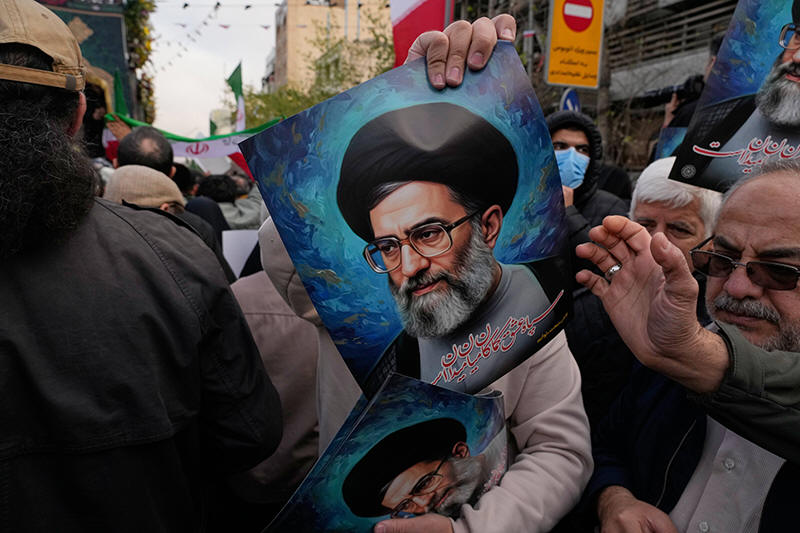
In other developments Wednesday, a mass funeral was held for some 100
security force members killed in the demonstrations. Tens of thousands
of mourners attended, holding Iranian flags and photos of Ayatollah Ali
Khamenei. The caskets, draped in Iranian flags, were stacked at least
three high. Red and white roses and framed photographs of the dead
covered them.
People elsewhere remained fearful in the streets. Plainclothes security
forces still milled around some neighborhoods, though anti-riot police
and members of the paramilitary Revolutionary Guard's all-volunteer
Basij force appeared to have been sent back to their barracks.
“We are very frightened because of these sounds (of gunfire) and
protests,” said a mother of two shopping for fruits and vegetables, who
spoke on condition of anonymity for fear of reprisals. “We have heard
many are killed and many are injured. Now peace has been restored, but
schools are closed, and I’m scared to send my children to school again.”
Ahmadreza Tavakoli, 36, told The Associated Press he witnessed one
demonstration in Tehran and was shocked by the use of firearms by
authorities.

[to top of second column]
|
A man hands out posters of the Iranian Supreme Leader Ayatollah Ali
Khamenei during a funeral ceremony for a group of security forces,
who were killed during anti-government protests, in Tehran, Iran,
Wednesday, Jan. 14, 2026. (AP Photo/Vahid Salemi)

“People were out to express themselves and protest, but quickly it
turned into a war zone,” Tavakoli said. “The people do not have
guns. Only the security forces have guns.”
‘We have to do it quickly’
Earlier Wednesday, Gholamhossein Mohseni-Ejei, Iran’s judiciary
chief, said the government should press ahead with rapid trials and
executions.
“If we want to do a job, we should do it now. If we want to do
something, we have to do it quickly,” he said in a video shared by
Iranian state television online. “If it becomes late, two months,
three months later, it doesn’t have the same effect. If we want to
do something, we have to do that fast.”
The comments stand as a direct challenge to Trump, who warned Iran
about executions in an interview with CBS aired Tuesday.
“If they do such a thing, we will take very strong action,” Trump
said.
“We don’t want to see what’s happening in Iran happen. And you know,
if they want to have protests, that’s one thing. When they start
killing thousands of people, and now you’re telling me about hanging
— we’ll see how that works out for them. It’s not going to work out
good.”
One Arab Gulf diplomat told the AP that major Mideast governments
had been discouraging the Trump administration from launching a war
with Iran, fearing “unprecedented consequences” for the region that
could explode into a “full-blown war.” The diplomat spoke on
condition of anonymity because he wasn't authorized to speak to
journalists.
Satellite internet service offer
Iran’s government cut off the country from the internet and
international telephone calls on Jan. 8.
Activists said Wednesday that Starlink was offering free service in
Iran. The satellite internet service has been key in getting around
the internet shutdown. Iran began allowing people to call out
internationally on Tuesday via mobile phones, but calls from people
outside the country into Iran remain blocked.

“We can confirm that the free subscription for Starlink terminals is
fully functional,” said Mehdi Yahyanejad, a Los Angeles-based
activist who has helped get the units into Iran. “We tested it using
a newly activated Starlink terminal inside Iran.”
Starlink itself did not immediately acknowledge the decision.
Security service personnel apparently were searching for Starlink
dishes, as people in northern Tehran reported authorities raiding
apartment buildings with satellite dishes. While satellite
television dishes are illegal, many in the capital have them in
homes, and officials broadly gave up on enforcing the law in recent
years.
Death toll continues to rise
The Human Rights Activists News Agency said 2,615 of the dead were
protesters and 153 were government-affiliated. Thirteen children
were killed, along with 14 civilians it said were not taking part in
protests.
More than 18,400 people have been detained, the group said.
Gauging the demonstrations from abroad has grown more difficult, and
the AP has been unable to independently assess the toll given the
communications being disrupted in the country.
___
Amiri reported from New York. Associated Press writers Melanie
Lidman in Jerusalem and Samy Magdy in Cairo contributed to this
report.
All contents © copyright 2026 Associated Press. All rights reserved |