Illinois wage inequities improve slightly, persist despite transparency
efforts: report
[January 16, 2026]
By Jenna Schweikert
Wage inequities persist in Illinois’ workforce, although data suggests
the state, on average, is doing better than others, according to a new
report from the University of Illinois.
The gender wage gap appears to have moderately improved from 2021 to
2023, the period studied in the report, although racial wage gaps
stagnated, researchers’ analysis of Department of Labor data suggests.
The widest gaps for both categories are in lower-wage and craft
occupations.
Private employers with 100 or more Illinois-based employees are mandated
to submit biannual reports with wage and demographic data to the
department under a 2021 amendment to Illinois’ 2003 Equal Pay Act.
This report is based on the first three years of data, 2021-2023, and
includes information on 3.2 million employees at over 4,000 firms.
Findings show that women earn about 91-93 cents for every dollar earned
by their male counterparts, while Black and Hispanic workers each earn
6-10% less than comparable white workers.
A regional analysis also showed smaller gender wage gaps in Cook County,
but wider disparities in the downstate region.
Illinois appears to be performing better than the national median,
according to the researchers’ seminar presentation on Wednesday, Jan.
14. But they warned that methodological differences make comparison
difficult.
The law also doesn’t require government agencies and Illinois businesses
with fewer than 50 employees to report, which could affect the results.

“If we expand the reporting coverage, we’re going to include a lot of
smaller businesses that could potentially widen the gap. That’s one of
our hypotheses,” Dr. Tingting Zhang, a contributing researcher said at
the seminar. Zhang is an Assistant Professor at the University of
Illinois’ School of Labor and Employment Relations.
Recommendations
The researchers issued recommendations for further study, including
establishing interagency data coordination and expanding reporting
coverage to get a complete picture of wage equity in Illinois.
“If you want to have policy that’s going to be impactful, here’s a way
to get better data and the overall outcome. If you’re thinking about
fairness, if you’re thinking about equity, you’re thinking about
employers who attract and retain quality employees, then expanding the
data set would be a good idea,” Dr. Robert Bruno, director of the U of
I’s Project for Middle Class Renewal said.
[to top of second column]
|

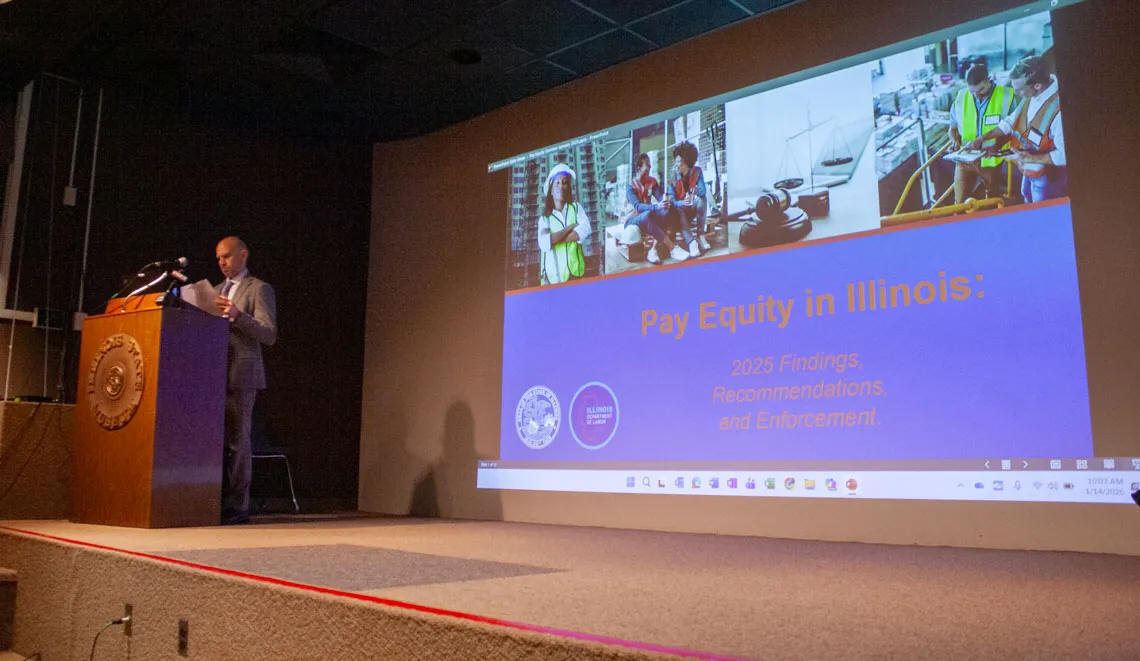
Jason Keller, assistant director of the Illinois Department of
Labor, speaks at a seminar about recent findings of a report on pay
equity in Illinois. The report is the first released since a 2021
amendment to the Equal Pay Act required certain business owners to
report wage and demographic data. (Capitol News Illinois photo by
Jenna Schweikert)

Bruno said it would ultimately be up to the DOL to “figure out the
logistics” of expanding the scope of the law to collect better data. But
he added, “we stand ready to help with doing that based on other
research.”
Expanding the mandated reporting coverage would require another
amendment to the law, due to the language within the current
legislation, but the DOL does coordinate the enforcement of the EPA.
“We do not want to be punitive. We’d rather bring you into compliance
than be punitive under the law,” Jason Keller, assistant director of the
labor department, said. “We can’t provide legal advice, but we will do
our best to tell you where our boundaries are and what we can advise and
what we can’t, so we encourage employers to reach out to us.”
Zhang and Bruno also recommended developing self-audit and public
dashboard tools for employer use, targeting enforcement at the most
disparate industries, and streamlining reporting guidance to address
recurring report issues like inconsistent job titles and implausible
wages and hours.
“Illinois’ EPA (Equal Pay Act) reporting system offers a unique and
valuable lens through which to study pay disparities within individual
workplaces, yielding insights that are not available through broader
labor market surveys,” the report states. “Continued progress will
require refinements to data collection, broader employer participation,
and expanded access to self-assessment tools.”
Capitol News Illinois is
a nonprofit, nonpartisan news service that distributes state government
coverage to hundreds of news outlets statewide. It is funded primarily
by the Illinois Press Foundation and the Robert R. McCormick Foundation.
 |