Netanyahu says the announced start of Gaza ceasefire's next phase is a
'declarative move'
[January 16, 2026]
By WAFAA SHURAFA and SAM METZ
DEIR AL-BALAH, Gaza Strip (AP) — Israeli strikes in Gaza on Thursday
killed nine people, including three women, a day after the U.S.
announced that the fragile ceasefire would advance to its second phase.
Israeli Prime Minister Benjamin Netanyahu called the ceasefire
announcement largely symbolic, raising questions about how its more
challenging elements will be carried out.
Speaking with the parents of the last Israeli hostage whose remains are
still in Gaza, Netanyahu late Wednesday said the governing committee of
Palestinians announced as part of the second phase was merely a
“declarative move,” rather than the sign of progress described by U.S.
envoy Steve Witkoff.
Israeli police officer Ran Gvili's parents had earlier pressed Netanyahu
not to advance the ceasefire until their son's remains were returned,
Israel’s Hostage and Missing Families Forum said Wednesday.
Netanyahu told Gvili’s parents that his return remained a top priority.
The announcement of the ceasefire's second phase marked a significant
step forward but left many questions unanswered.
Those include the makeup of the proposed, apolitical governing committee
of Palestinian experts and an international “Board of Peace."
The committee's composition was coordinated with Israel, said an Israeli
official speaking on the condition of anonymity.

Questions also include the timing of deployment of international forces
and the reopening of Gaza’s southern Rafah border crossing, as well as
concrete details about disarming Hamas and rebuilding Gaza.
In an interview on Wednesday with the West Bank-based Radio Basma, Ali
Shaath, the engineer and former Palestinian Authority official slated to
head the committee, said he anticipated reconstruction and recovery to
take roughly three years. He said it would start with immediate needs
like shelter.
“If I bring bulldozers, and push the rubble into the sea, and make new
islands (in the sea), new land, it is a win for Gaza and (we) get rid of
the rubble," Shaath, a Gaza native, said.
Progress announced but hardship endures
Palestinians in Gaza who spoke to The Associated Press questioned what
moving into phase two would actually change on the ground, pointing to
ongoing bloodshed and challenges securing basic necessities.
More than 450 people have been killed since Israel and Hamas agreed to
halt fighting in October, Gaza's Health Ministry said Thursday.
Nine people were killed Thursday in several strikes, according to local
hospitals. The first strike killed two men, while three women and a man
were killed in the second strike, according to Al-Aqsa Martyrs Hospital.
Later, two people were killed and five injured when a strike hit a
house, according to Al-Awda Hospital in Nuseirat. In addition, one
person was killed in Gaza City, Shifa Hospital said.
Israeli military officials did not immediately respond to a message
seeking comment on the strikes.
Separately, the military said that it had killed someone Thursday who
had approached troops near the so-called Yellow Line — which divides the
Israeli-held part of Gaza from the rest — and posed an imminent threat.

[to top of second column]
|
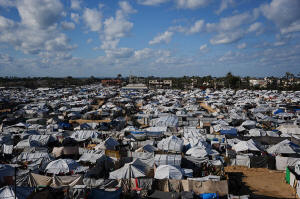
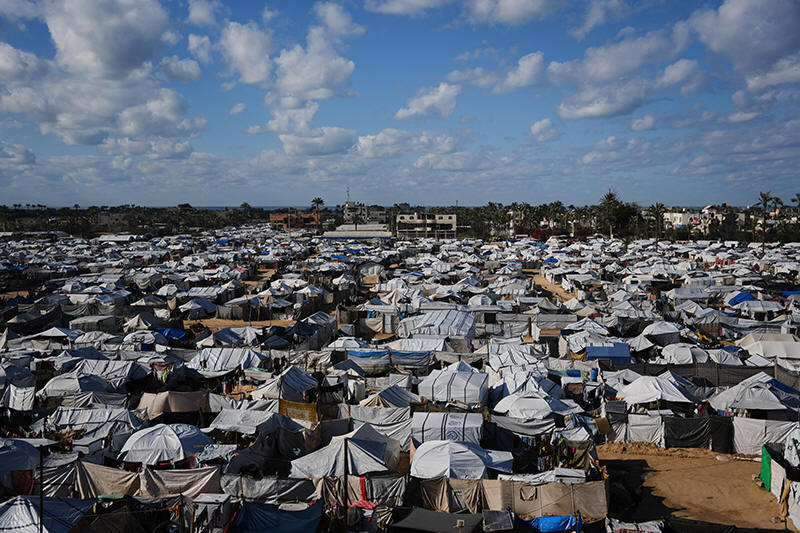
A tent camp for displaced Palestinians stretches across Deir al-Balah,
in the central Gaza Strip, Thursday, Jan. 15, 2026. (AP Photo/Abdel
Kareem Hana)

“We see on the ground that the war has not stopped, the bloodshed
has not stopped, and our suffering in the tents has not ended,” said
Samed Abu Rawagh, a man displaced to southern Gaza from Jabaliya.
The casualties since the October ceasefire, which UNICEF said
include more than 100 children, are among the 71,441 Palestinians
killed since the start of Israel's offensive, according to the
ministry, which does not say how many were fighters or civilians.
The ministry is part of the Hamas-run government and staffed by
medical professionals. The U.N. and independent experts consider it
the most reliable source on war casualties. Israel disputes its
figures but has not provided its own.
Hamza Abu Shahab, a man from eastern Khan Younis in southern Gaza,
said he was waiting for tangible changes, such as easier access to
food, fuel and medical care, rather than promises.
“We were happy with this news, but we ask God that it is not just
empty words,” he told the AP in Khan Younis. “We need this news to
be real, because in the second phase we will be able to return to
our homes and our areas … God willing, it won’t just be empty
promises."
Gaza’s population of more than 2 million people has struggled to
keep cold weather and storms at bay while facing shortages of
humanitarian aid and a lack of more substantial temporary housing,
which is badly needed during the winter months.
This is the third winter since the war between Israel and Hamas
started on Oct. 7, 2023, when militants stormed into southern Israel
and killed around 1,200 people and abducted 251 others.
Challenges lie ahead
The second phase of the ceasefire will confront thornier issues than
the first, including disarming Hamas and transitioning to a new
governance structure after nearly two decades of the group's rule in
the strip.

The U.N. has estimated reconstruction will cost over $50 billion.
This process is expected to take years and little money has been
pledged so far.
Hamas has said it will dissolve its existing government to make way
for the committee announced as part of the ceasefire's second phase.
But it has not made clear what will happen to its military arm or
the scores of Hamas-affiliated civil servants and the civilian
police.
Bassem Naim, a member of the group's political bureau, said Thursday
that Hamas welcomed the announcement of the committee as a step
toward establishing an independent Palestinian state, but did not
elaborate on the issues in question. He said on X that “the ball is
now in the court” of the United States and international mediators
to allow it to operate.
Israel has insisted Hamas must lay down its weapons, while the
groups’ leaders have rejected calls to surrender despite two years
of war, saying Palestinians have “the right to resist.”
___
Metz reported from Jerusalem. Josef Federman and Melanie Lidman
contributed reporting from Jerusalem.
All contents © copyright 2026 Associated Press. All rights reserved |