Stocks edge a bit below their latest records on Wall Street
[January 17, 2026] By
DAMIAN J. TROISE
NEW YORK (AP) — Stocks edged a bit lower on Wall Street Friday as the
first week of corporate earnings season ended with markets trading near
record levels.
The wobbly day for stocks closed out a week of similar movements for
major indexes amid profit reports from banks and updates on inflation.
The S&P 500 fell 4.46 points, or 0.1%, to 6,940.01. It is sitting just
below its record, which was set on Monday. The Dow Jones Industrial
Average fell 83.11 points, or 0.2%, to 49,359.33. The Nasdaq composite
fell 14.63 points, or 0.1%, to 23,515.39. Each index notched weekly
losses.
Smaller company stocks fared better. The Russell 2000 eked out a 0.1%,
while also notching a 2% gain for the week.
Technology stocks were the strongest forces behind the market's moves
throughout most of the day. Several big technology stocks made strong
gains and helped offset losses elsewhere.
Broadcom rose 2.5% and Micron Technology rose 7.8%. The semiconductor
companies are among several Big Tech companies with outsized valuations
that often push the market higher or lower.
A handful of regional U.S. banks reported their earnings following mixed
reports from their larger peers. Pittsburgh’s PNC jumped 3.8% after it
beat Wall Street’s fourth-quarter targets, but Regions Financial fell
2.6% after reporting results that missed forecasts.
Outside of the banking sector, transport company J.B. Hunt Transport
Services fell 1% after reporting mixed quarterly financial results.

The latest round of earnings updates from companies could help give Wall
Street a better sense of how consumers are spending their money and how
businesses are operating amid economic concerns brought on by inflation
and tariffs. Results from the technology sector are being scrutinized by
investors trying to figure out whether the high stock prices fueled by
the craze around artificial intelligence are justified.
“Despite the strong start to 2026, we would not be surprised if markets
experience volatility in the coming weeks as fourth quarter earnings
progress and the threat of escalating geopolitical tensions remains,”
wrote Doug Beath, global equity strategist at Wells Fargo Investment
Institute, in a note to investors.
Wall Street will have a broader mix of earnings to review next week,
coming from airlines, industrial companies, and technology companies.
United Airlines, 3M, and Intel are all scheduled to release their
quarterly earnings results next week.

[to top of second column] |

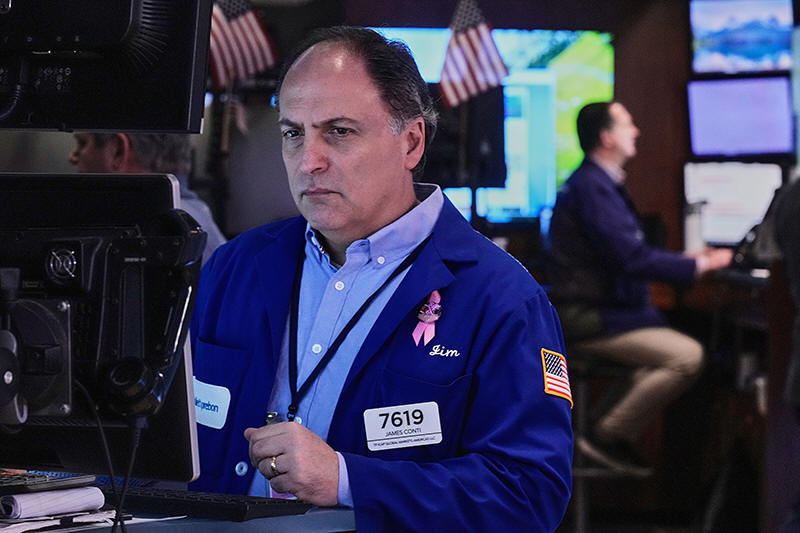
Trader James Conti works on the floor of the New York Stock
Exchange, Friday, Jan. 16, 2026. (AP Photo/Richard Drew)
 Crude oil prices rose after dropping
sharply on Thursday. The price of U.S. crude oil rose 0.4% to $59.44
and the price of Brent crude, the international standard, rose 0.6%
to $64.13. Oil prices have been volatile amid widespread protests in
Iran against that country’s leadership and President Donald Trump's
warnings that the U.S. “will come to their rescue.”
Gold prices, which have also been volatile this week, fell. Prices
for the precious metal, often viewed as a safe haven amid economic
and geopolitical uncertainty, fell 0.6%, but are still up more than
5% so far in January.
Treasury yields moved higher in the bond market. The yield on the
10-year Treasury rose to 4.23% from 4.17% late Thursday. The
two-year Treasury yield, which more closely tracks expectations for
what the Federal Reserve will do, rose to 3.60% from 3.57% late
Thursday.
The Fed's next policy meeting on interest rates is in two weeks, and
Wall Street is betting that it will maintain its current benchmark
interest rate. The central bank is trying to balance a slowing jobs
market with stubbornly high inflation. Updates on inflation this
week showed that prices remain above the Fed's 2% goal.
The U.S. central bank will get one more update on inflation next
week when the government releases the personal consumption
expenditures price index, or PCE. It is the Fed's preferred measure
for inflation.
European markets fell, and markets in Asia were mixed. Taiwan's
benchmark index rose 1.9% after its government signed a trade deal
with the U.S. China, which claims the self-governed island as its
own territory, protested the agreement.
The deal with Taiwan comes amid an ongoing trade war between the
U.S. and much of the world. Uncertainty over tariffs have raised
concerns about inflation and economic damage because of higher costs
for businesses and consumers.
Canada is the latest to shift its partnerships because of the
uncertainty. It has agreed to cut its 100% tariff on Chinese
electric cars in return for lower tariffs on Canadian farm products
as part of a break with the U.S. Tesla fell 0.2% and Rivian fell
2.3%.
All contents © copyright 2026 Associated Press. All rights reserved |