US futures and other world shares sink on worries over Trump's push to
claim Greenland
[January 20, 2026] By
YURI KAGEYAMA
TOKYO (AP) — U.S. futures fell sharply and European markets shed more
than 1% on tensions driven by the Trump administration’s new tariff
threats over Greenland.
France's CAC 40 slipped 1.2% to 8,014.42, while Germany's DAX lost 1.5%
to 24,581.44. Britain's FTSE 100 shed 1.3% to 10,068.04.
The future for the S&P 500 sank 1.8% while that for the Dow Jones
Industrial Average dropped 1.6%.
Trump said Saturday that he would charge a 10% import tax starting in
February on goods from Denmark, Norway, Sweden, France, Germany, the
United Kingdom, the Netherlands and Finland because of their opposition
to American control of Greenland.
Trump's threats have sparked outrage and a flurry of diplomatic activity
across Europe, as leaders consider possible countermeasures, including
retaliatory tariffs and the first-ever use of the European Union’s
anti-coercion instrument.
Meanwhile, U.S. Treasury Secretary Scott Bessent, speaking on the
sidelines of the World Economic Forum annual meeting in Davos,
Switzerland, asserted that America’s relations with Europe remain
strong. He urged trading partners to “take a deep breath” and let
tensions driven by the tariff threats over Greenland “play out.”
In Asian trading, Tokyo’s benchmark Nikkei 225 lost 1.1% to 52,991.10
after Prime Minister Sanae Takaichi called a snap election for Feb. 8.

Yields on long-term Japanese government bonds surged after Takaichi
indicated Monday she planned to dissolve parliament and hold an
election, aiming to capitalize on her strong public opinion ratings. She
also has proposed temporarily suspending the food tax.
Expectations that Takaichi will take a renewed electoral mandate to
raise government spending have revived worries over Japan's national
finances, pushing yields sharply higher, while prices of such
investments have fallen as investors sold their holdings. The yield on
the 40-year government bond surged to a record 4% on Tuesday, while
yields on other long-term bonds also have been surging to decades-high
levels.
[to top of second column] |
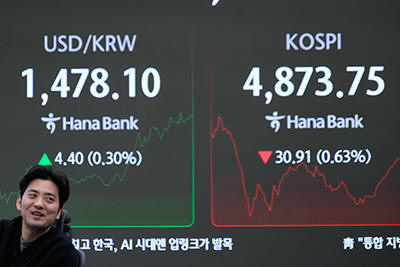
A currency trader reacts near a screen showing the Korea Composite
Stock Price Index (KOSPI) and the foreign exchange rate between U.S.
dollar and South Korean won, left, at the foreign exchange dealing
room of the Hana Bank headquarters in Seoul, South Korea, Tuesday,
Jan. 20, 2026. (AP Photo/Ahn Young-joon)
 Chinese markets also declined. Hong
Kong’s Hang Seng gave up 0.3% to 26,487.51, while the Shanghai
Composite ended nearly unchanged at 4,113.65.
In South Korea, the Kospi dropped 0.4% to 4,885.75, while
Australia's S&P/ASX 200 lost 0.7% to 8,815.90.
Taiwan's Taiex gained 0.4% and the Sensex in India declined 0.8%.
“Geopolitical events will remain in focus today, particularly any
talks that may take place in Davos,” said Michael Brown, a senior
research strategist at Pepperstone, referring to the World Economic
Forum.
This week will bring more corporate earnings in the U.S. and an
update on inflation preferred by the Federal Reserve for making
policy decisions.
The U.S. Federal Reserve’s next policy meeting is in two weeks. It's
expected to keep its benchmark interest rate unchanged, as it
strives to balance a slowing jobs market with inflation, which
remains above the Fed’s 2% goal. The Bank of Japan has a monetary
policy board meeting ending later this week.
In other dealings early Tuesday, U.S. benchmark crude oil lost 49
cents to $58.95 per barrel. Brent crude, the international standard,
shed 33 cents to $63.61 a barrel.
The U.S. dollar fell to 157.83 Japanese yen from 158.09 yen. The
euro rose to $1.1716 from $1.1645.
____
AP Business Writer Elaine Kurtenbach contributed to this report.
All contents © copyright 2026 Associated Press. All rights reserved
 |