Death toll in Spanish train collision rises to 40 as authorities fear
more bodies could be found
[January 20, 2026]
By IAIN SULLIVAN, JOSEPH WILSON and SUMAN NAISHADHAM
ADAMUZ, Spain (AP) — Regional Spanish officials said Monday that at
least 40 people are confirmed dead in a high-speed rail collision the
previous night in the country's south when the tail end of a train
jumped the track, causing another train speeding past in the opposite
direction to derail.
Juanma Moreno, the president of Andalusia, the southern Spanish region
where the accident happened, confirmed the new death toll in an
afternoon press conference. Efforts to recover the bodies from the two
wrecked train cars continued, he added.
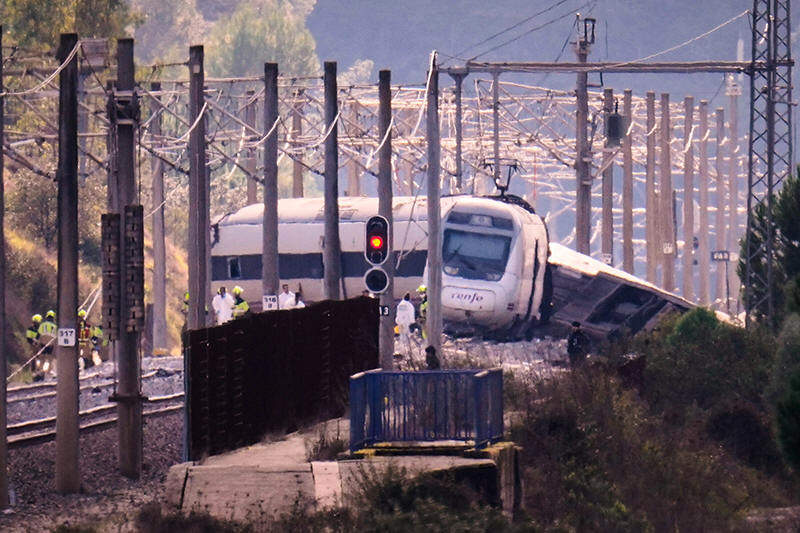
The impact tossed the second train's lead carriages off the track,
sending them plummeting down a 4-meter (13-foot) slope. Some bodies were
found hundreds of meters (feet) from the crash site, Moreno said earlier
in the day, describing the wreckage as a “mass of twisted metal" with
bodies likely still to be found inside.
Authorities are also focusing on attending hundreds of distraught family
members and have asked for them to provide DNA samples to help identify
victims.
The crash took place Sunday at 7:45 p.m. when the tail end of a train
carrying 289 passengers on the route from Malaga to the capital, Madrid,
went off the rails. It slammed into an incoming train traveling from
Madrid to Huelva, another southern Spanish city, according to rail
operator Adif.
The head of the second train, which was carrying nearly 200 passengers,
took the brunt of the impact, Spanish Transport Minister Óscar Puente
said. That collision knocked its first two carriages off the track.
Puente said that it appeared the largest number of the deaths occurred
in those carriages.
Authorities said all the survivors had been rescued in the early
morning.

Three days of mourning for a nation in shock
The accident shook a nation which leads Europe in high-speed train
mileage and takes pride in a network that is considered at the cutting
edge of rail transport.
Spanish Prime Minister Pedro Sánchez declared three days of national
mourning for the victims of the crash.
“Today is a day of pain for all of Spain,” Sánchez said on a visit to
Adamuz, a village near the accident site, where many locals helped
emergency services handle the influx of distraught and hurt passengers
overnight.
Twisted metal after a violent impact
Moreno, the regional leader, said Monday morning that emergency services
were still searching for bodies.
“Here at ground zero, when you look at this mass of twisted iron, you
see the violence of the impact,” Moreno said. “The impact was so
incredibly violent that we have found bodies hundreds of meters away.”
Video released by the Civil Guard showed the worst-hit carriages
shredded open, train seats cast on the gravel packing under the tracks.
One carriage lay on its side, bent around a large concrete pillar, with
debris scattered around the area.
Passengers reported climbing out of smashed windows, with some using
emergency hammers to break the glass.
Andalusia’s regional emergency services said 41 people remained
hospitalized, 12 of whom were in intensive care units. Another 81
passengers were discharged by late Monday afternoon, authorities said.
Train services Monday between Madrid and cities in Andalusia were
canceled, causing large disruptions. Spanish airline Iberia added
flights to Seville and another two to Malaga to help stranded travelers.
Some bus companies also reinforced their services in the south.
Officials call accident ‘strange’
Transport Minister Puente early Monday said the cause of the crash was
unknown.
He called it “a truly strange” incident because it happened on a flat
stretch of track that had been renovated in May. He also said the train
that jumped the track was less than 4 years old. That train belonged to
the Italian-owned company Iryo, while the second train was part of
Spain’s public train company, Renfe.

[to top of second column]
|
Emergency crews work at the site of a train collision in Adamuz,
southern Spain, Monday, Jan. 19, 2026. (AP Photo/Manu Fernandez)

According to Puente, the back part of the first train derailed and
crashed into the head of the other train. An investigation into the
cause could take a month, he said.
The Spanish Union of Railway Drivers told The Associated Press that
in August, it sent a letter asking Spain’s national railway operator
to investigate flaws on train lines across the country and to reduce
speeds at certain points until the tracks were fully repaired. Those
recommendations were made for high-speed train lines, including the
one where Sunday's accident took place, the union said.
Álvaro Fernández, the president of Renfe, told Spanish public radio
RNE that both trains were well under the speed limit of 250 kph (155
mph); one was going 205 kph (127 mph), the other 210 kph (130 mph).
He also said that “human error could be ruled out.”
The incident “must be related to the moving equipment of Iryo or the
infrastructure,” he said.
Iryo issued a statement on Monday saying that its train was
manufactured in 2022 and passed its latest safety check on Jan. 15.
Identifying the victims
The Civil Guard opened an office in Cordoba, the nearest city to the
crash, as well as Madrid, Malaga, Huelva and Seville for family
members of the missing to seek help and leave DNA samples.
“There were moments when we had to remove the dead to get to the
living,” Francisco Carmona, firefighter chief of Cordoba, told Onda
Cero radio.
A sports center in Adamuz, a town in the province of Cordoba, about
370 kilometers (about 230 miles) south of Madrid, was turned into a
makeshift hospital. The Spanish Red Cross set up a help center
offering assistance to emergency services and people seeking
information.
“The scene was horrific. It was terrible,” Adamuz Mayor Rafael
Moreno told AP and other reporters. “People asking and begging for
help. Those leaving the wreckage. Images that will always stay in my
mind.”
One passenger had been treated in a local hospital along with her
sister before she returned to Adamuz with hopes of finding her lost
dog. She was limping and had a small bandage on her cheek, as seen
by an AP reporter.

First deadly accident for Spain's high-speed trains
Spain has spent decades investing heavily in high-speed trains and
currently has the largest rail network in Europe for trains moving
over 250 kph (155 mph), with more than 3,900 kilometers (2,400
miles) of track, according to the International Union of Railways.
The network is a popular, competitively priced and safe mode of
transport. Renfe said more than 25 million passengers took one of
its high-speed trains in 2024.
Iryo became the first private competitor in high-speed to Renfe in
Spain in 2022.
Sunday's accident was the first with deaths on a high-speed train
since Spain's high-speed rail network opened its first line in 1992.
Spain’s worst train accident this century occurred in 2013, when 80
people died after a train derailed in the country’s northwest. An
investigation concluded the train was traveling 179 kph (111 mph) on
a stretch with an 80 kph (50 mph) speed limit when it left the
tracks. That stretch of track was not high speed.
___
Wilson reported from Barcelona, Spain, and Naishadham from Madrid.
Video-journalist Alicia León in Adamuz and AP journalists Barry
Hatton in Lisbon, Portugal, and Teresa Medrano in Madrid
contributed.
All contents © copyright 2026 Associated Press. All rights reserved |