Death toll rises to 10 in gangsters' attacks on Guatemalan police as
state of emergency is declared
[January 20, 2026]
By SONIA PÉREZ D.
GUATEMALA CITY (AP) — The death toll from suspected gangsters’ attacks
on Guatemalan police rose to 10 on Monday, as Guatemalans saw heavier
security in the streets and curtailed rights after Congress approved
President Bernardo Arévalo's emergency declaration.
The violence started Saturday when inmates seized control of three
prisons in apparently coordinated riots, taking 43 guards hostage. The
gangs were demanding privileges for their members and leaders, according
to authorities. Shortly after police liberated one prison Sunday
morning, suspected gang members attacked police across the capital.
Officials said late Monday a tenth police officer died following the
attacks.
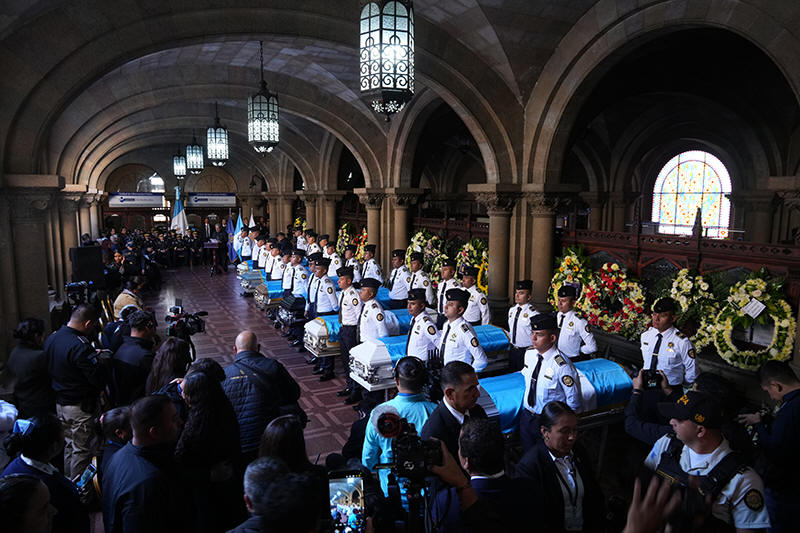
Police honored the fallen officers in a ceremony Monday, where
flag-draped coffins sat in the Interior Ministry.
“Today it pains me to give each one of the families this flag, symbol of
the nation that will not forget the sacrifice and commitment of their
police fallen in the fulfillment of their duty,” Arévalo said Monday.
Outside the Interior Ministry, José Antonio Revolorio, 72, father of
officer José Efraín Revolorio Barrera, 25, said, “I hope that the
criminals who did this to my son will one day pay for it, that the law
will go after them. And that this doesn’t end here, because my son was
an honest man, competent at his work.”
Meanwhile, the government gazette published Monday Arévalo’s declaration
of a 30-day state of emergency, saying there were “coordinated actions
by self-named maras or gangs against state security forces, including
armed attacks against civilian authorities.”

Among the rights that the declaration limits are freedom of action and
demonstrations. It also allows police to arrest people without a
judicial order if they are suspected gang members. Security forces could
also prohibit the movement of vehicles in certain places or subject them
to searches.
The unicameral Congress approved the state of emergency with minor
changes Monday night on a vote of 149 in favor to 1 against, with 10
absent or on approved leave of absence. However, it had gone into effect
Sunday.
Traffic in the capital Monday appeared lighter than usual.
[to top of second column]
|
The wake for police officers killed while retaking control of three
prisons is held at the Interior Ministry in Guatemala City, Monday,
Jan. 19, 2026. (AP Photo/Moises Castillo)

“This situation is a shame. It affects people psychologically: they
don't want to go out,” said Óscar López, a 68-year-old radio
technician who had a doctor's appointment. “I agree with the
president imposing the state of emergency because it doesn't stop
the violence, but it relaxes people.”
Ileana Melgar, 64, said she was afraid of missing her appointment to
renew her identification Monday. “But I was afraid to go out, I
called my friend to go with me. You don't know if they will also
stop (public) transportation and we can't get back home.”
The U.S. Embassy in Guatemala had instructed U.S. government
personnel to shelter in place Sunday. That was lifted later in the
day, but they were “advised to maintain a high level of caution when
traveling.”
On Monday, the embassy condemned the attacks on police. “These
terrorists, as well as those who cooperate with them or are linked
to them, have no place in our hemisphere. The security of the
Guatemalan people and the stability of our hemisphere must prevail.
We reaffirm our support for Guatemala’s security forces to curb the
violence.”
In October, the Congress reformed laws to declare members of the
Barrio 18 and Mara Salvatrucha gangs terrorists. The changes
lengthened prison sentences for gang members who commit crimes.
The United States government also declared those gangs foreign
terrorist organizations last year.
As a safety precaution, school was suspended nationwide Monday.
__
AP journalist Emmanuel Andrés contributed to this report.
All contents © copyright 2026 Associated Press. All rights reserved |