US futures climb and gold hits another record as markets steady ahead of
Trump's speech at Davos
[January 21, 2026] By
CHAN HO-HIM
HONG KONG (AP) — U.S. futures were higher and world shares traded mixed
Wednesday ahead of U.S. President Donald Trump’s speech to the World
Economic Forum in Davos, Switzerland.
Markets have appeared to steady somewhat after gyrating following
Trump’s threats to slap higher tariffs on eight European countries over
their opposition to his push for U.S. control of Greenland.
Gold prices crossed the $4,800 mark for the first time, gaining 2.2% as
money flowed into assets considered to be safe havens at times of
uncertainty.
Bouncing back from steep losses Tuesday, the future for the S&P 500 rose
0.4% and that for the Dow Jones Industrial Average was up 0.2%.
Germany’s DAX shed 0.4% to 24,607.57 and the CAC 40 in Paris slipped
0.2% to 8,050.40. Britain’s FTSE 100 was nearly unchanged at 10,124.24.
Traders were waiting for Trump’s planned speech to world leaders, elites
and billionaires gathered in Davos. Trump told reporters he planned to
highlight his administration’s accomplishments during his address.
U.S. Commerce Secretary Howard Lutnick, who spoke on a panel on Tuesday,
said the U.S. message was that “globalization has failed.”
Trump’s Air Force One returned to Washington after its crew identified
“a minor electrical issue” while he was on his way to Davos. He boarded
another aircraft and resumed his trip.

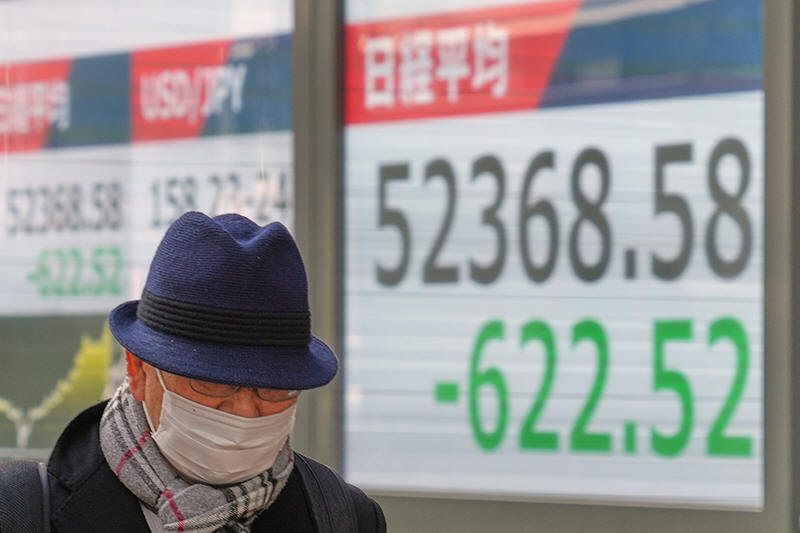
In Asian trading, Tokyo’s Nikkei 225 slipped 0.4% to 52,774.64. Markets
in Japan have been riled both by geopolitical uncertainty and by
domestic issues.
Japanese Prime Minister Sanae Takaichi has called a snap election for
Feb. 8, sending yields of long-term government bonds to record levels.
The assumption is that Takaichi, who is capitalizing on strong public
support ratings to try to consolidate a majority for her Liberal
Democratic Party, will cut taxes and boost spending, adding to the
challenges Japan faces in handling its massive government debt.
The yield on the 40-year Japanese government bond was trading at 4.061%
early Wednesday, down from the all-time high of 4.22% that it hit on
Tuesday.
[to top of second column] |
A person walks in front of an electronic stock board showing Japan's
Nikkei index at a securities firm Wednesday, Jan. 21, 2026, in
Tokyo. (AP Photo/Eugene Hoshiko)
 South Korea’s Kospi gained 0.5% to
4,909.93.
Hong Kong’s Hang Seng rebounded to add 0.4% to 26,585.06. The
Shanghai Composite index edged 0.1% higher, to 4,116.94.
In Australia, the S&P/ASX 200 gave back 0.4% to 8,782.90.
Taiwan’s Taiex fell 1.6% and India’s Sensex lost 0.4%.
Trump has said he will impose 10% tariffs on Denmark, Norway,
Sweden, Germany, France, the United Kingdom, the Netherlands and
Finland beginning in February. That would be on top of a 15% tariff
specified by a trade agreement with the European Union that has yet
to be ratified.
European leaders have hit back as Washington’s relations with its
Western allies sour, considering countermeasures, including perhaps
slow-walking ratification of the trade agreement or ordering
retaliatory tariffs, analysts say.
On Tuesday, the S&P 500 fell 2.1%, the steepest drop for the
benchmark index since October. The Dow industrials dropped 1.8% and
the Nasdaq composite fell 2.4%.
The Federal Reserve is set to meet next week for a policy meeting,
and Wall Street is betting it will hold steady its benchmark
interest rate. Japan’s central bank will wrap up its first monetary
policy meeting of 2026 on Friday.
In other dealings early Wednesday, U.S. benchmark crude oil lost 71
cents to $59.65 per barrel. Brent crude, the international standard,
shed 88 cents to $64.04 per barrel.
The U.S. dollar dropped to 157.94 Japanese yen from 158.16 yen. The
euro fell to $1.1708 from $1.1726.
All contents © copyright 2026 Associated Press. All rights reserved
 |