China meets initial soybean purchase goal, but Trump's shifting trade
policy could disrupt deal
[January 21, 2026] By
JOSH FUNK
China has fulfilled its initial commitment to buy 12 million metric tons
of soybeans from the U.S., but it's not clear if the trade agreement
announced in October can withstand President Donald Trump's
ever-shifting trade policy as American farmers are still dealing with
high production costs.
Earlier this month, Trump said he would impose 25% tariffs on any
country that buys from Iran, which would include China. Then last
weekend he threatened to impose 10% tariffs on eight of America's
closest allies in Europe if they continue to oppose his efforts to
acquire Greenland.
So the administration's trade policy continues to change quickly, and
Iowa State University agricultural economist Chad Hart said that could
undermine the trade agreement with China and jeopardize the commitment
by the world's largest soybean buyer to purchase 25 million metric tons
of American soybeans in each of the next three years.
“Those new tariffs — what does that mean for this agreement? Does it
throw it out? Is it still binding? That’s sort of the game here now,"
Hart said.
Beijing paused any purchase of U.S. soybeans last summer during its
trade war with Washington but agreed to resume buying from American
soybean farmers after Trump and Chinese leader Xi Jinping met in South
Korea and agreed to a truce.

Treasury Secretary Scott Bessent announced the purchasing milestone
China has met in an interview with Maria Bartiromo on Fox Business on
Tuesday from the sidelines of a major economic forum in Davos,
Switzerland, where Bessent met with his Chinese counterpart, Vice
President He Lifeng. Bessent said China remains committed.
“He told me that just this week they completed their soybean purchases,
and we’re looking forward to next year’s 25 million tons,” Bessent said.
“They did everything they said they were going to do.”
Last fall, preliminary data from the Department of Agriculture cast
doubts on whether China would live up to the agreement because it was
slow to begin purchasing American soybeans and there is a lag before the
purchases show up in the official numbers.

[to top of second column] |
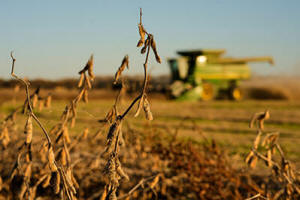
Austin Rohlfing harvests soybeans on his family's field, Nov. 5,
2025, near Boonville, Mo. (AP Photo/Charlie Riedel, File)
 On Tuesday, the USDA data showed
that China had bought more than 8 million tons of U.S. soybeans by
Jan. 8, and its daily reports indicated that China placed several
more orders since then, ranging from 132,000 tons to more than
300,000 tons.
China has shifted much of its soybean purchases over to Brazil and
Argentina in recent years to diversify its sources and find the
cheapest deals. Last year, Brazilian beans accounted for more than
70% of China’s imports, while the U.S. share was down to 21%, World
Bank data shows.
Trump is planning to send roughly $12 billion in aid to U.S. farmers
to help them withstand the trade war, but farmers say the aid won’t
solve all their problems as they continue to deal with the soaring
costs of fertilizer, seeds and labor that make it hard to turn a
profit right now. Soybean farmers will get $30.88 per acre while
corn farmers will receive $44.36 per acre. Another crop hit hard
when China stopped buying was sorghum, and those farmers will get
$48.11 per acre. The amounts are based on a USDA formula on the cost
of production.
That and uncertainty about trade markets and how much farmers will
receive for their crops has even some of the most optimistic farmers
worried, said Cory Walters, who is an associate professor in the
University of Nebraska-Lincoln's Department of Agricultural
Economics. Soybean prices jumped up above $11.50 per bushel after
the agreement was announced, but the price has since fallen to about
$10.56 per bushel on Tuesday. So prices are close to where they were
a year ago and aren’t high enough to cover most farmers’ costs.
“Everything is changing -- the land rental market, the fertilizer
market, the seed market and it’s all pinching the farmer when they
go to do their cash flows. The ability to make a decision is tougher
now because of all the uncertainty in the market,” Walters said.
All contents © copyright 2026 Associated Press. All rights reserved |