House Republicans begin push to hold the Clintons in contempt of
Congress over the Epstein probe
[January 21, 2026]
By STEPHEN GROVES and MATT BROWN
WASHINGTON (AP) — House Republicans are starting a push Wednesday to
hold former President Bill Clinton and former Secretary of State Hillary
Clinton in contempt of Congress over the Jeffrey Epstein investigation,
opening the prospect of the House using one of its most powerful
punishments against a former president for the first time.
The contempt proceedings are an initial step toward a criminal
prosecution by the Department of Justice that, if successful, could send
the Clintons to prison.
Still, ahead of a meeting Wednesday by the House Oversight Committee to
prepare the charges, there were signs of a thaw. The Clintons, both
Democrats, appeared to be searching for an off-ramp to testify, and
passage of contempt charges through the full House was far from
guaranteed, requiring a majority vote — something Republicans
increasingly struggle to achieve.
The repercussions of contempt charges loomed large, given the
possibility of a substantial fine and even incarceration. While the
charges have historically been used only as a last resort, lawmakers in
recent years have been more willing to reach for the option. The
Oversight Committee chair, Rep, James Comer of Kentucky, initiated the
contempt proceedings after the Clintons refused for months to fulfill a
House Oversight Committee subpoena for their testimony in the panel's
Epstein probe.

The clash was the latest turn in the unpredictable Epstein saga, as
Congress investigates how he was able to sexually abuse dozens of
teenage girls for years. Epstein killed himself in 2019 in a New York
jail cell while awaiting trial. The public release of case files has
shown details of the connections between Epstein and both Bill Clinton
and Donald Trump, among many other high-powered men.
Clinton, Trump and many others connected to Epstein have not been
accused of wrongdoing. Yet lawmakers are wrestling over who receives the
most scrutiny.
“They’re not above the law. We’ve issued subpoenas in good faith,” Comer
told The Associated Press on the eve of the contempt proceedings. “For
five months we’ve worked with them. And time’s up.”
Comer rejected an offer Tuesday from an attorney for the Clintons to
have Comer and the ranking Democrat on the committee, Rep. Robert
Garcia, interview Bill Clinton in New York, along with staff.
How the Clintons have responded
The Clintons released a scathing letter last week criticizing Comer for
seeking their testimony at a time when the Department of Justice is
running a month behind a congressionally mandated deadline to release
its complete case files on Epstein.
Behind the scenes, however, a longtime attorney for the Clintons, David
Kendall, has tried to negotiate an agreement. Kendall raised the
prospect of having the Clintons testify last Christmas and Christmas
Eve, according to the committee's account of the negotiations.
The Clintons have also argued that the subpoenas are invalid because
they don't serve any legislative purpose and say that they did not know
about Epstein's abuse. They have offered the committee written
declarations about their interactions with Epstein.

[to top of second column]
|
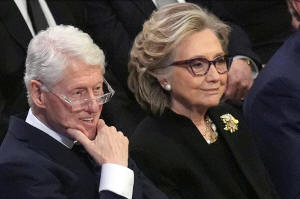
Former President Bill Clinton and former Secretary of State Hillary
Clinton listen during the state funeral for former President Jimmy
Carter at Washington National Cathedral in Washington, Jan. 9, 2025.
(AP Photo/Jacquelyn Martin, File)

"We have tried to give you the little information we have. We’ve
done so because Mr. Epstein’s crimes were horrific,” the Clintons
wrote in a letter to Comer last week.
How contempt proceedings have been used
Contempt of Congress proceedings are rare, used when lawmakers are
trying to force testimony for high-profile investigations, such as
the infamous inquiry during the 1940s into alleged Communist
sympathizers in Hollywood or the impeachment proceedings of
President Richard Nixon.
Most recently, Trump's advisers Peter Navarro and Steve Bannon were
convicted of contempt charges for defying subpoenas from a House
panel investigating the Jan. 6, 2021, riot by a mob of the
Republican president's supporters at the Capitol. Both men spent
months in prison.
The Jan. 6 committee also subpoenaed Trump in its inquiry, but
Trump's lawyers resisted the subpoena, citing decades of legal
precedent they said shielded ex-presidents from being ordered to
appear before Congress. The committee ultimately withdrew its
subpoena.
No former president has ever been successfully forced to appear
before Congress, although some have voluntarily appeared.
The Democrats' response
Democrats have largely been focused on advancing the investigation
into Epstein rather than mounting an all-out defense of the
Clintons, who led their party for decades. They've said Bill Clinton
should inform the committee if he has any pertinent information
about Epstein's abuses.

A wealthy financier, Epstein donated to Bill Clinton’s 1992
presidential campaign and Hillary Clinton’s joint fundraising
committee ahead of her 2000 Senate campaign in New York.
Democrats embraced the call for full transparency on Epstein after
Trump’s return to the White House, particularly after Attorney
General Pam Bondi stumbled on her promise to release the entirety of
the unredacted Epstein files to the public. The backlash scrambled
traditional ideological lines, leading Republicans to side with
Democrats demanding further investigation.
The pressure eventually resulted in a bipartisan subpoena from the
committee that ordered the Justice Department and Epstein estate to
release files related to Epstein. Republicans quickly moved to
include the Clintons in the subpoena.
Comer indicated Tuesday that he would insist that the subpoena be
fulfilled by a transcribed deposition of Bill Clinton.
“You have to have a transcript in an investigation,” he said. “So no
transcript, no deal.”
All contents © copyright 2026 Associated Press. All rights reserved |