US stocks recover half of the prior day's plunge after Trump calls off
Greenland-related tariffs
[January 22, 2026] By
STAN CHOE
NEW YORK (AP) — The U.S. stock market bounced back from its worst day
since October on Wednesday after President Donald Trump said he reached
the framework for a deal about Greenland, an island he’s long coveted,
and won’t impose tariffs he had threatened on several European
countries.
The S&P 500 rallied 1.2% after Trump said the deal, “if consummated,
will be a great one for the United States of America” and its allies in
the North Atlantic region. The announcement triggered an immediate move
higher in the stock market, which found solace earlier in the day after
Trump ratcheted down his rhetoric and told business and government
leaders in Europe that he would not use force to take “the piece of
ice.”
The de-escalation in tensions helped the S&P 500 recover just over half
of its 2.1% drop from the day before and pull closer to its all-time
high set earlier this month. The Dow Jones Industrial Average jumped 588
points, or 1.2%, and the Nasdaq composite climbed 1.2%.
Treasury yields also eased in the bond market in another signal of
reduced worries among investors. Besides the progress on Greenland, they
also got help from a calming of yields in Japan’s jumpy bond market. The
value of the U.S. dollar, meanwhile, clawed back some of its declines
against other currencies after sliding the day before.

Trump himself acknowledged how the U.S. stock market sold off on Tuesday
because of his desire for Greenland, but he called it “peanuts compared
to what it’s gone up” in the first year of his second term and said it
would go up further in the future.
Trump has a history of making big threats that send financial markets
sliding, only to pull back later and reach deals that are seen as less
bad for the economy or for inflation than his initial suggestion.
On one hand, the pattern has given rise to the “TACO” acronym suggesting
“Trump Always Chickens Out” if financial markets react strongly enough.
On the other, Trump has ultimately struck deals that outsiders may have
earlier considered unlikely, ones that he’s crowed about later. The most
obvious example is Trump’s announcement of high tariffs on “Liberation
Day,” which eventually led to trade deals with many of the world’s major
economies.
Helping to lead the U.S. stock market Wednesday was Halliburton. The oil
field services company rose 4.1% after reporting a stronger profit for
the latest quarter than analysts expected.
United Airlines climbed 2.2% after likewise reporting a better profit
for the final three months of 2025 than analysts expected. CEO Scott
Kirby said that the airline’s strong momentum in revenue is continuing
into 2026.
They helped offset a 2.2% drop for Netflix. The streamer sank even
though it reported a stronger profit than expected. Investors focused
instead on its slowing subscriber growth and its lower-than-expected
forecast for profit in the current quarter.
[to top of second column] |
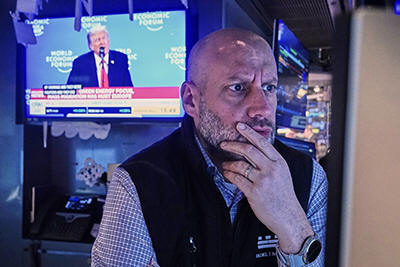
Specialist Meric Greenbaum works at his post on the floor of the New
York Stock Exchange, as a television shows President Donald Trump
speaking at the World Economic Forum, Wednesday, Jan. 21, 2026. (AP
Photo/Richard Drew)
 Kraft Heinz sank 5.7% after
Berkshire Hathaway warned investors that it may be interested in
selling its 325 million shares in the food giant that former CEO
Warren Buffett helped create in 2015.
Berkshire took a $3.76 billion write-down on its Kraft-Heinz stake
last summer. Buffett said last fall that he was disappointed in
Kraft Heinz’ plan to split the company in two, and Berkshire’s two
representatives resigned from the Kraft board last spring.
All told, the S&P 500 rose 78.76 points to 6,875.62. The Dow Jones
Industrial Average climbed 588.64 to 49,077.23, and the Nasdaq
composite gained 270.50 to 23,224.82.
In the bond market, the yield on the 10-year Treasury eased to 4.25%
from 4.30% late Tuesday. That’s almost all the way back to the 4.24%
level where it was at on Friday.
That was before Trump threatened to impose 10% tariffs on Denmark,
Norway, Sweden, Germany, France, the United Kingdom, the Netherlands
and Finland for opposing U.S. control of Greenland. That would have
been on top of a 15% tariff specified by a trade agreement with the
European Union that has yet to be ratified.
In stock markets abroad, indexes were mixed in mostly modest
movements across Europe and Asia.
Japan’s Nikkei 225 slipped 0.4%.
The country’s prime minister, Sanae Takaichi, has called a snap
election for Feb. 8, which had sent yields of long-term government
bonds to record levels and raised worries across global financial
markets. The expectation is that Takaichi, who is capitalizing on
strong public support ratings, will cut taxes and boost spending and
increase the government’s already heavy load of debt.
After surging as high as 4.22% on Tuesday, the yield on the 40-year
Japanese government bond pulled back to 4.05% Wednesday.
___
AP Business Writers Chan Ho-him and Matt Ott contributed.
All contents © copyright 2026 Associated Press. All rights reserved
 |