Immigration officers assert sweeping power to enter homes without a
judge's warrant, memo says
[January 22, 2026]
By REBECCA SANTANA
WASHINGTON (AP) — Federal immigration officers are asserting sweeping
power to forcibly enter people’s homes without a judge’s warrant,
according to an internal Immigration and Customs Enforcement memo
obtained by The Associated Press, marking a sharp reversal of
longstanding guidance meant to respect constitutional limits on
government searches.
The memo authorizes ICE officers to use force to enter a residence based
solely on a more narrow administrative warrant to arrest someone with a
final order of removal, a move that advocates say collides with Fourth
Amendment protections and upends years of advice given to immigrant
communities.
The shift comes as the Trump administration dramatically expands
immigration arrests nationwide, deploying thousands of officers under a
mass deportation campaign that is already reshaping enforcement tactics
in cities such as Minneapolis.
For years, immigrant advocates, legal aid groups and local governments
have urged people not to open their doors to immigration agents unless
they are shown a warrant signed by a judge. That guidance is rooted in
Supreme Court rulings that generally prohibit law enforcement from
entering a home without judicial approval. The ICE directive directly
undercuts that advice at a time when arrests are accelerating under the
administration’s immigration crackdown.
The memo itself has not been widely shared within the agency, according
to a whistleblower complaint, but its contents have been used to train
new ICE officers who are being deployed into cities and towns to
implement the president’s immigration crackdown. New ICE hires and those
still in training are being told to follow the memo’s guidance instead
of written training materials that actually contradict the memo,
according to the whistleblower disclosure.

It is unclear how broadly the directive has been applied in immigration
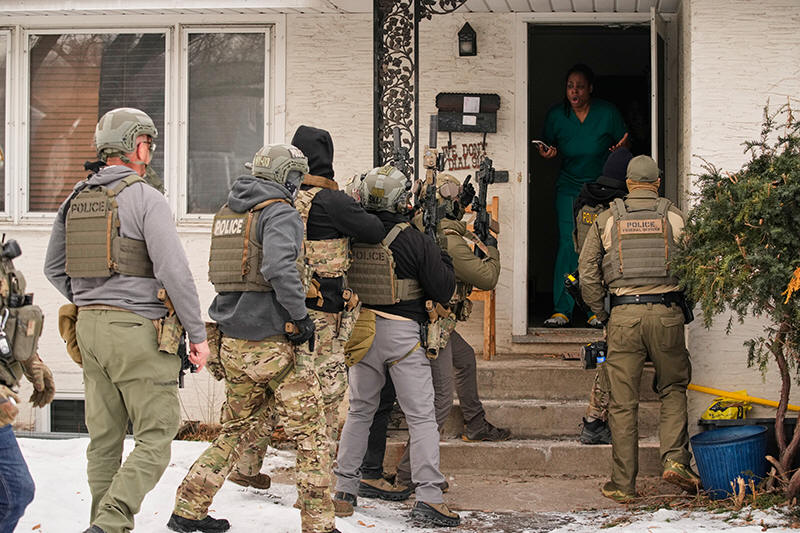
enforcement operations. The Associated Press witnessed ICE officers
ramming through the front door of the home of a Liberian man, Garrison
Gibson, with a deportation order from 2023 in Minneapolis on Jan. 11,
wearing heavy tactical gear and with their rifles drawn.
Documents reviewed by The AP revealed that the agents only had an
administrative warrant — meaning there was no judge who authorized the
raid on private property.
The change is almost certain to meet legal challenges and stiff
criticism from advocacy groups and immigrant-friendly state and local
governments that have spent years successfully urging people not to open
their doors unless ICE shows them a warrant signed by a judge.
The Associated Press obtained the memo and whistleblower complaint from
an official in Congress, who shared it on condition of anonymity to
discuss sensitive documents. The AP verified the authenticity of the
accounts in the complaint.
The memo, signed by the acting director of ICE, Todd Lyons, and dated
May 12, 2025, says: “Although the U.S. Department of Homeland Security
(DHS) has not historically relied on administrative warrants alone to
arrest aliens subject to final orders of removal in their place of
residence, the DHS Office of the General Counsel has recently determined
that the U.S. Constitution, the Immigration and Nationality Act, and the
immigration regulations do not prohibit relying on administrative
warrants for this purpose.”
The memo does not detail how that determination was made nor what its
legal repercussions might be.
Homeland Security spokeswoman Tricia McLaughlin said in an e-mailed
statement to the AP that everyone the department serves with an
administrative warrant has already had “full due process and a final
order of removal.”
She said the officers issuing those warrants have also found probable
cause for the person’s arrest. She said the Supreme Court and Congress
have “recognized the propriety of administrative warrants in cases of
immigration enforcement,” without elaborating. McLaughlin did not
respond to questions about whether ICE officers entered a person’s home
since the memo was issued, relying solely on an administrative warrant
and if so, how often.
Recent arrests shine a light on tactics
Whistleblower Aid, a nonprofit legal organization that assists workers
exposing wrongdoings, said in the whistleblower complaint obtained by
The Associated Press that it represents two anonymous U.S. government
officials “disclosing a secretive — and seemingly unconstitutional —
policy directive.”

[to top of second column]
|
Teyana Gibson Brown, second from right, wife of Garrison Gibson,
reacts after a federal immigration officer used a battering ram to
break down a door before arresting Garrison Gibson, Sunday, Jan. 11,
2026, in Minneapolis. (AP Photo/John Locher)

A wave of recent high-profile arrests, many unfolding at private
homes and businesses and captured on video, has placed a spotlight
on immigration arrest tactics, including officers’ use of proper
warrants.
Most immigration arrests are carried out under administrative
warrants, internal documents issued by immigration authorities that
authorize the arrest of a specific individual but do not permit
officers to forcibly enter private homes or other non-public spaces
without consent. Only warrants signed by judges carry that
authority.
All law enforcement operations — including those conducted by ICE
and Customs and Border Protection — are governed by the Fourth
Amendment of the Constitution, which protects all people in the
country from unreasonable searches and seizures.
People can legally refuse federal immigration agents entry into
private property if the agents only have an administrative warrant,
with some limited exceptions.
Memo shown to ‘select’ officials
The memo says ICE officers can forcibly enter homes and arrest
immigrants using just a signed administrative warrant known as an
I-205 if they have a final order of removal issued by an immigration
judge, the Board of Immigration Appeals or a district judge or
magistrate judge.
The memo says officers must first knock on the door and share who
they are and why they’re at the residence. They’re limited in the
hours they can go into the home — after 6 a.m. and before 10 p.m.
The people inside must be given a “reasonable chance to act
lawfully.” But if that doesn’t work, the memo says, they can use
force to go in.
“Should the alien refuse admittance, ICE officers and agents should
use only a necessary and reasonable amount of force to enter the
alien’s residence, following proper notification of the officer or
agent’s authority and intent to enter,” the memo reads.
The memo is addressed to all ICE personnel. But it has been shown
only to “select DHS officials” who then shared it with some
employees who were told to read it and return it, Whistleblower Aid
wrote in the disclosure.
One of the two whistleblowers was allowed to view the memo only in
the presence of a supervisor and then had to give it back. That
person was not allowed to take notes. A whistleblower was able to
access the document and lawfully disclose it to Congress,
Whistleblower Aid said.
Although the memo was issued in May, David Kligerman, senior vice
president and special counsel at Whistleblower Aid, said it took
time for its clients to find a “safe and legal path to disclose it
to lawmakers and the American people.”

Memo says ICE officers are told to rely solely on administrative
warrants
ICE has been rapidly hiring thousands of new deportation officers to
carry out the president’s mass deportation agenda. They’re trained
at the Federal Law Enforcement Training Center in Brunswick,
Georgia.
During a visit there by The Associated Press in August, ICE
officials said repeatedly that new officers were being trained to
follow the Fourth Amendment.
But according to the whistleblowers’ account, newly hired ICE
officers are being told they can rely solely on administrative
warrants to enter homes to make arrests, even though that conflicts
with written Homeland Security training materials.
Lindsay Nash, a law professor at Yeshiva University’s Cardozo School
of Law in New York, said the memo “flies in the face” of what the
Fourth Amendment protects against and what ICE itself has
historically said are its authorities.
She said there's an “enormous potential for overreach, for mistakes
and we've seen that those can happen with very, very serious
consequences.”
All contents © copyright 2026 Associated Press. All rights reserved |