US government warns it will take action if Haitian politicians
destabilize country
[January 22, 2026]
By DÁNICA COTO
SAN JUAN, Puerto Rico (AP) — The U.S. warned the transitional council in
charge of Haiti against making changes to the troubled country’s
government on Wednesday, as pressure mounts for the unelected body to
move toward elections for the first time in a decade.
In a statement posted on X, the U.S. Embassy in Haiti wrote that “The
United States would consider that any person who supports such a
destabilizing initiative, which favors the gangs, would be acting
against the interests of the United States, the region, and the Haitian
people, and will take appropriate measures accordingly."
The U.S. Embassy added that such a maneuver would undermine efforts to
establish “a minimal level of security and stability” in Haiti, where
gang violence is surging and poverty deepening.
The statement came as some members of the council are at odds with
Haitian Prime Minister Alix Didier Fils-Aimé, although it wasn’t
immediately clear why. The council met behind closed doors earlier
Wednesday.
A spokesman for the prime minister’s office said late Wednesday that he
could not comment on the situation. The council’s seven members with
voting powers did not return messages for comment.
Unelected council was put in charge to quell chaos
It's the latest episode in years of political chaos that erupted after
Haiti's last elected president, Jovenel Moïse, was slain at his home in
July 2021.

The council has been one of the country's top authorities since April
2024, when it was created with the help of Caribbean leaders after
powerful gangs seized control of Haiti’s main international airport and
targeted key state infrastructure in a series of unprecedented attacks
that eventually led former Prime Minister Ariel Henry to resign.
The council was charged with selecting Haiti’s prime minister in a bid
to quickly bring some stability to the beleaguered country.
Fils-Aimé is the third person chosen by the council. A businessman and
former head of Haiti's Chamber of Commerce and Industry, he was
appointed in November 2025 after the council fired previous leader Garry
Conille.
The council is supposed to step down by Feb. 7, but it’s unclear if that
will happen. Critics say some council members are trying to stay in
power longer, and many fear the move could unleash a fresh round of
violent protests.
The Feb. 7 deadline was approved in early 2024 on the assumption that
Haiti would have held general elections to elect a new president. Gang
violence has prevented officials from holding elections so far, although
they are tentatively set for August, with a runoff to be held in
December.
UN Security Council meets to discuss Haiti
A new U.N. report released Wednesday noted that “national stakeholders
remain divided over the transitional governance architecture that is to
lead the country to elections.”
[to top of second column]
|
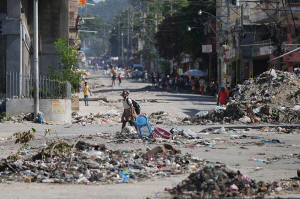
A youth crosses a street littered with garbage in downtown in
Port-au-Prince, Haiti, Tuesday, Jan. 20, 2026. (AP Photo/Odelyn
Joseph)

Earlier on Wednesday, the U.N. Security Council met to discuss the
unraveling situation in Haiti.
“Haiti has entered a critical phase in its process of restoring
democratic institutions,” said Carlos Ruiz-Massieu, special
representative of the U.N. Secretary General in Haiti. “Let’s be
clear: the time for political maneuvering is over.”
Panamanian Ambassador Eloy Alfaro de Alba noted at the meeting that
Haiti is at a “critical juncture,” with only 18 days left for the
transitional presidential council’s mandate to end.
“The persistent nature of violence … remains of utmost concern,” he
said.
Several U.N. Security Council members noted that Haiti needs to
quickly move toward a democratic transition as gangs continue to
seize control of more territory.
“There’s a need to approach this deadline with a sense of
responsibility … to sustain continuity of state and avoid any
disruptions that may undermine the operation of national
institutions,” said Ericq Pierre, permanent representative of Haiti
to the United Nations.
Gangs control an estimated 90% of Port-au-Prince, Haiti’s capital,
and they have seized swaths of land in the country’s central region.
More than 8,100 killings were reported across Haiti from January to
November last year, “with figures likely underreported owing to
limited access to gang-controlled areas,” according to the U.N.
report.
Haiti’s National Police has been trying to quell gang violence with
help from a U.N.-backed mission led by Kenyan police that remains
understaffed and underfunded.
The mission is transitioning into a so-called “gang suppression
force” that would have the power to arrest suspected gang members.
Haiti’s government also has been working with a private military
contractor to launch drone strikes targeting suspected gang members,
but which have also killed civilians. The strikes killed more than
970 people from March to December last year, including 39 civilians,
16 of them children, according to the Office of the United Nations
High Commissioner for Human Rights.
All contents © copyright 2026 Associated Press. All rights reserved
 |