US futures slip and world shares are mixed as Japan keeps its key
interest rate unchanged
[January 23, 2026] By
ELAINE KURTENBACH
European shares were mixed after Asian markets advanced Friday as calm
was restored after a tumultuous week.
U.S. futures turned lower, with the contracts for the S&P 500 and the
Dow industrials down 0.1%.
Germany's DAX was little changed at 24,852.07, while the CAC 40 in Paris
lost 0.2% to 8,129.68. Britain's FTSE 100 edged 0.1% higher.
In Asian trading, Tokyo's Nikkei 225 picked up 0.3% to 53,846.87 after
the Bank of Japan kept its key interest rate unchanged, as expected. The
central bank just raised the policy rate to 0.75% in December. Wrapping
up its policy meeting, it also slightly upgraded its estimates for
future inflation and economic growth.
The Japanese yen rose against the U.S. dollar, which was trading at
158.15 yen, up from 158.42 yen.
“With underlying inflation price pressures remaining firm, we expect the
Bank of Japan to resume its tightening cycle in the coming months,”
Abhijit Surya of Capital Economics said in a commentary.

Chinese markets also saw moderate gains. The Hang Seng in Hong Kong
added 0.5% to 26,749.51, while the Shanghai Composite index was up 0.3%,
at 4,136.16.
South Korea's Kospi climbed 0.8% to 4,990.07. The benchmark had topped
5,000 for the first time on Thursday but fell back later in the day.
In Australia, the S&P/ASX 200 edged 0.1% higher to 8,860.10.
Taiwan's Taiex jumped 0.7% and the Sensex in India fell 0.9%.
On Thursday, the S&P 500 climbed 0.5%, extending its rally after U.S.
President Donald Trump called off tariffs on European countries that he
said opposed his calls for U.S. control of Greenland.
The Dow Jones Industrial Average rose 0.6% and the Nasdaq composite
gained 0.9% to 23,436.02.
Details were sparse about a deal on Greenland that Trump said he reached
with the head of NATO, leaving investors wary of what’s to come. It's
not signed yet.
It was the latest example of Trump making a big, initial threat, only to
pull back after a dramatic reaction in financial markets. The pattern
has led to the “TACO” acronym, suggesting that “Trump Always Chickens
Out” if markets react strongly enough. Tuesday’s drop for the U.S. stock
market was the worst since October and large enough that Trump, who
often takes credit when Wall Street is doing well, acknowledged “the
dip.”
[to top of second column] |
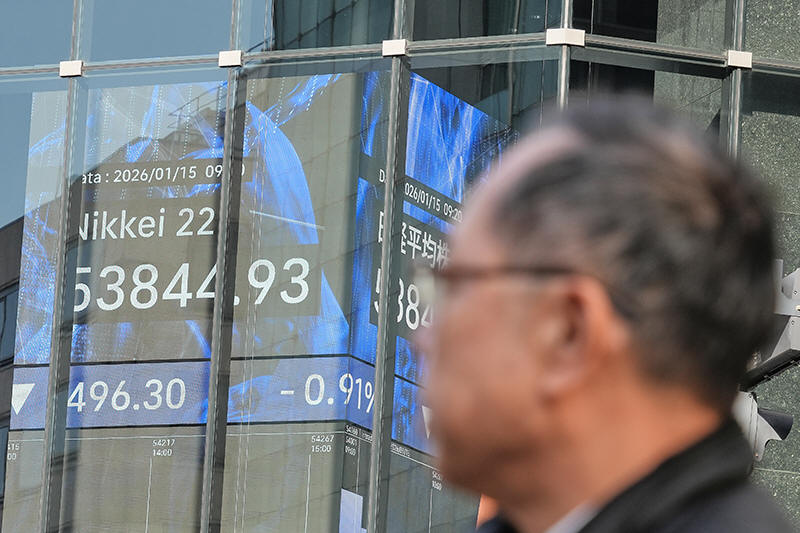
A person walks in front of an electronic stock board showing Japan's
Nikkei index at a securities firm Thursday, Jan. 15, 2026, in Tokyo.
(AP Photo/Eugene Hoshiko)
 JPMorgan Chase rose 0.5% after a
lawsuit filed by Trump against the bank caused minor ripples for its
stock. Trump accused JPMorgan Chase of closing his accounts for
political reasons after he left office in 2021.
Treasury yields held relatively steady, suggesting foreign investors
weren’t rushing out of the U.S. bond market.
Yields got some support from reports on the U.S. economy’s strength
that came in better than expected. One said fewer U.S. workers
applied for unemployment benefits last week than economists expected
in a potential signal that the pace of layoffs remains low. A second
suggested the U.S. economy grew at a faster rate during the summer
than the government initially estimated.
A third said that inflation in November was close to economists’
expectations, while spending by U.S. consumers was a touch better
than expected.
Global markets have calmed following an easing of long-term Japanese
government bonds, which had spiked early in the week on worries that
Japan’s Prime Minister Sanae Takaichi might make moves that would
add heavily to the government’s already big debt.
The 40-year Japanese government bond yield slipped back after
hitting a record of more than 4%. It was trading at 3.947% early
Friday.

In other dealings early Friday, the price of gold rose 0.1%,
remaining close to the $5,000 level. Silver gained 1.6%. Prices of
such precious metals often rise when investors are looking for
something safer to own in times of uncertainty.
U.S. benchmark crude oil added 69 cents to $60.05 per barrel, while
Brent crude, the international standard, was up 71 cents at $64.77
per barrel.
The euro slipped to $1.1741 from $1.1755.
All contents © copyright 2026 Associated Press. All rights reserved |