What to know about FDA's review of new Zyn advertising proposal
[January 23, 2026]
By MATTHEW PERRONE
WASHINGTON (AP) — Americans who smoke may soon be hearing a lot more
about Zyn, the flavored nicotine pouches that have generated billions in
sales while going viral on social media.
The Food and Drug Administration convened a public meeting Thursday to
consider whether Philip Morris International should be allowed to
advertise its pouches as a less-harmful alternative for adults who smoke
cigarettes.
Government documents and presentations made at the meeting suggest FDA
regulators are leaning toward approving the company's request.
But a panel of independent experts asked pointed questions about the
company's research, the risks of underage use and whether the new
marketing language would really steer smokers away from cigarettes.
Nevertheless, they said the proposed risk statement is likely accurate.
“There are very few things that are legally available and worse for you
than cigarettes, so it’s a pretty low bar to be safer than cigarettes,”
said Lisa Postow, a panel member and scientist at the National Heart,
Lung and Blood Institute.
The FDA is not bound to follow the panel's guidance and will make the
final decision on whether to approve the marketing claims. There is no
deadline for a decision.
Zyn contains nicotine powder and comes in 10 flavors, including mint,
coffee and citrus. Nicotine pouches have been a rare source of growth in
the tobacco industry, where companies have struggled to replace
shrinking revenue from cigarettes, chewing tobacco and other legacy
products.
Here's what to know about Zyn's review before the FDA:

Why is FDA reviewing Zyn now?
Philip Morris asked the agency to approve new marketing language for Zyn,
emphasizing its relative health benefits when compared with cigarettes.
Specifically, the company wants to say that using Zyn reduces the risk
of “mouth cancer, heart disease, lung cancer, stroke” and other
smoking-related diseases. Adding that language to Zyn promotional
materials would further cement the brand in the U.S., where it dominates
sales of nicotine pouches.
Last January, the FDA authorized Zyn to remain on the market after years
of federal review, saying company data showed the small pouches are less
harmful than cigarettes and other traditional tobacco products. Zyn was
the first nicotine pouch to win FDA authorization.
If FDA signs off on the “reduced risk” claims, Philip Morris would be
able to use the language in ads, mailing materials and online posts.
“Adults who smoke need accurate information about different tobacco
products and the relative risks associated with them,” said Keagan
Lenihan, a Philip Morris vice president.
What’s the evidence?
FDA scientists appeared to back the company's proposal, saying “the
totality of the evidence” supports the statement that Zyn reduces the
risk of various smoking-related illnesses.
But the outside experts noted that Philip Morris did not conduct
long-term studies of Zyn users or whether reading messages about lower
risks led more smokers to switch.
[to top of second column]
|

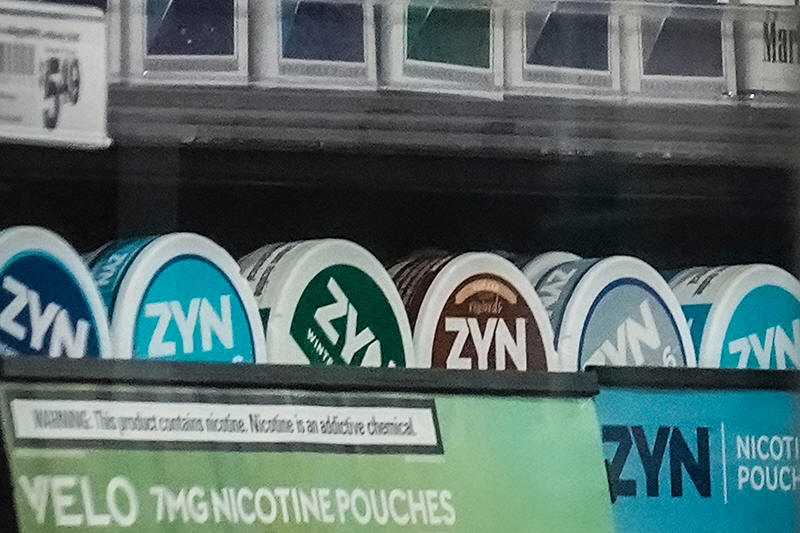
Containers of Zyn, a smokeless nicotine pouch, are displayed for
sale among other nicotine and tobacco products at a newsstand on
Feb. 23, 2024, in New York. (AP Photo/Bebeto Matthews, File)
 “Whether or not the claim is going
to accelerate that switching, there is no data here to answer that
question,” said Cristine Delnevo of the Rutgers Institute for
Nicotine and Tobacco Studies, who led the panel.
Philip Morris already sells a similar oral tobacco product, snus, a
type of tobacco pouch popular in Sweden and other Scandinavian
countries. Studies in those countries have consistently shown lower
rates of lung cancer, mouth cancer and related diseases among snus
users when compared with smokers.
The FDA approved a reduced-risk claim for the company's snus in 2019
and panelists noted that there has been little uptake of those
products by U.S. smokers. But Philip Morris executives said the
language could have an impact over time.
“The more you communicate to adult smokers with this type of claim
it will hopefully only increase switching to Zyn,” Lenihan said.
What about underage use?
In addition to considering potential benefits for smokers, the FDA
is required to review the potential harms to young people and
nonsmokers.
Representatives from anti-tobacco groups pointed to worrying signs:
Videos from “Zynfluencers” and other young people using the pouches
have racked up tens of millions of views on social media platforms
in recent years.
Andrew Tardiff of the Campaign for Tobacco-Free Kids noted that
Philip Morris did not test how its marketing messages might
influence teenagers.
“Zyn has features that enhance its appeal to young people. It’s sold
in a variety of flavors. It’s easy to conceal. And it can be used
discretely,” Tardiff said, citing similarities to Juul, the
e-cigarette widely blamed for sparking the recent trend in teenage
vaping.
Tardiff and other speakers also said that teenagers could be
attracted by a Zyn rewards program that allows purchasers to accrue
points that can be exchanged for electronics, gift cards and
apparel.
Despite such factors, FDA staffers note that teenage use of nicotine
pouches remains relatively low at 2.4% of high school students,
according 2024 federal survey data.
How popular is Zyn?
Less than 1% of U.S. adults use nicotine pouches, but the products
make up the fastest-growing segment of the tobacco market.
Within the category, Zyn is the overwhelming U.S. leader. Last year,
it had more than $3.24 billion in sales, or more than two-thirds of
the market, according to Nielsen data analyzed by Goldman Sachs.
All contents © copyright 2026 Associated Press. All rights reserved |