Illinois to withhold nearly $500M in spending, citing federal
uncertainty
[January 23, 2026]
By Ben Szalinski
SPRINGFIELD – Gov. JB Pritzker’s office plans to hold back nearly $500
million in spending for the current fiscal year as the state faces
constant uncertainty over the economy and federal funding.
The reserves make up less than 1% of the state’s budget and largely
focus on cost savings such as forgoing hiring in certain agencies for
the rest of the fiscal year, which ends June 30.
Pritzker had directed agencies to “identify immediate spending
reductions, including efficiencies that will result in reduced spending”
in a September executive order.
Alexis Sturm, Pritzker’s budget director, said in a memo to the state’s
agency directors that the reserves aim to provide cushion for
challenging budget years ahead.
“We expect that most agencies will not see their funding requests
fulfilled – and continued fiscal management in Fiscal Year 2026 will
help ensure the ability of the State Agencies to face the challenges
expected over the next few years,” Sturm said in the letter.
“Prioritizing and limiting hiring and other operational expenditures
will be key.”
In total, the reserves target $482 million in fiscal year 2026.
While Pritzker’s September order directed the agencies to identify ways
to reserve 4% of fiscal year 2026 General Fund appropriations, those
announced Thursday amounted to less than 1% of the $55.1 billion budget.
A senior administration official told Capitol News Illinois the 4% goal
was designed to be a target for agencies, rather than a mandate. The
official stressed that the agencies cannot cut spending as the funds are
appropriated by the legislature, but agencies can keep funds in reserve.

The executive order was specifically in response to the One Big
Beautiful Bill Act, officially known as H.R. 1, that President Donald
Trump signed last July. The law made significant changes to tax
policies, health care coverage and how much funding states will receive
from the federal government for social service programs. Pritzker’s
budget office estimated in October the law will ultimately cost Illinois
billions in the coming years.
What’s changing
Most of the reserves were earmarked for health care and human services.
The Department of Healthcare and Family Services will forgo transferring
$200 million to the Healthcare Provider Relief Fund because the fund
will have enough to make it through the fiscal year without the
additional money, the official said.
Pritzker’s administration also does not plan to release $29.5 million in
funding for higher education that was already reserved in the budget.
The budget called for increasing spending for higher education by 1%,
while giving the governor authority to release an additional 2% should
the state’s financial picture become less cloudy.
[to top of second column]
|

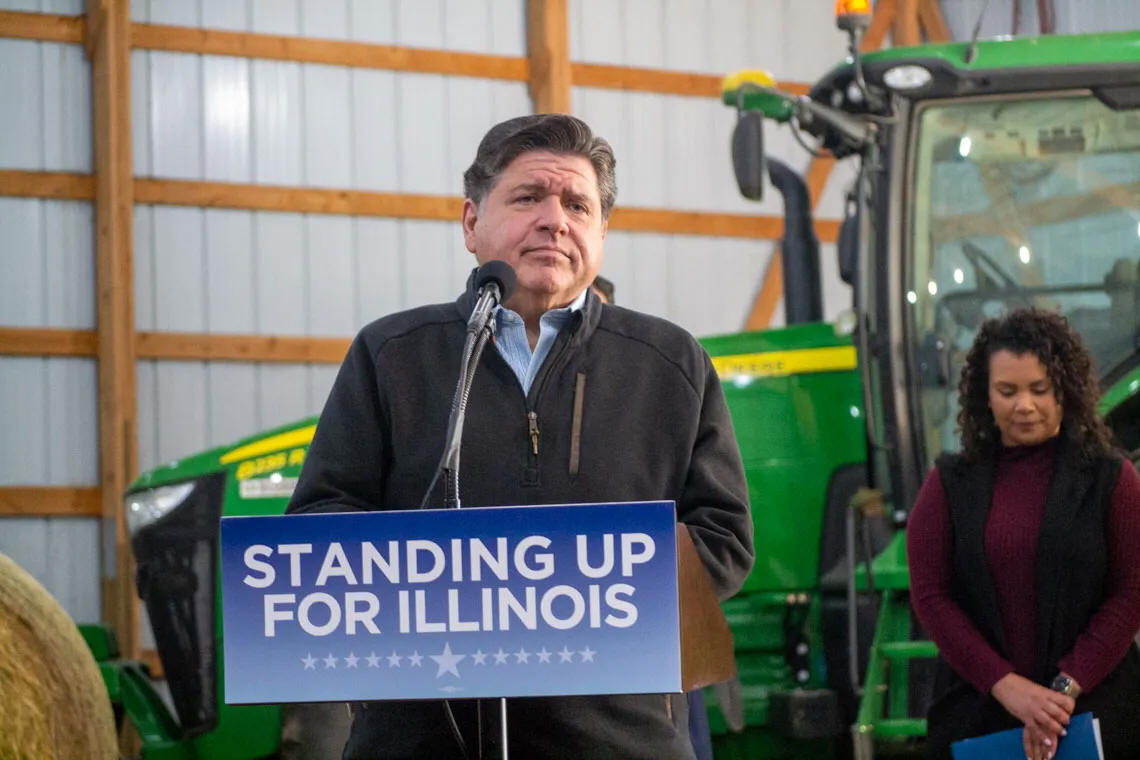
Gov. JB Pritzker listens to a question from a reporter during a news
conference at a farm in Central Illinois on Oct. 29, 2025. (Capitol
News Illinois photo by Jerry Nowicki)

Advocates have called on the governor to release that funding, citing
financial issues some state universities are facing.
Sturm’s memo noted another $10.3 million in reserves through grant
reductions and other measures at the Department of Commerce and Economic
Opportunity, as well as environment and culture agencies like the
Department of Agriculture and the Illinois Arts Council.
The state will also reduce operational expenses by limiting overtime and
travel expenses and leaving vacancies unfilled at certain agencies.
Another $50 million would come from group health insurance savings.
Major spending areas such as K-12 education and pensions were not
subject to the September executive order or the recently announced
reserves.
State of finances
Pritzker is set to deliver his budget address on Feb. 18, and the senior
administration official said lawmakers should not be surprised to hear a
conservative approach to budgeting and an emphasis on tough choices.
In October, Pritzker’s budget office projected a $2.2 billion deficit
for the upcoming fiscal year 2027. Sturm said the financial outlook “has
not changed significantly since last fall.”
A report published in early January by the legislature’s Commission on
Government Forecasting and Accountability found state revenue is up
nearly 5%, or $1.2 billion, through the first six months of FY26
compared to the same period in FY25.
Sales tax revenue was up 1%, an indicator of consumer confidence in the
economy.
The official told Capitol News Illinois people should not read COGFA’s
report as a sign the state is out of the woods, because the budget was
crafted with a conservative revenue estimate.
The official said Pritzker’s administration expects the financial
situation could worsen, particularly as parts H.R. 1 take effect and the
economy remains volatile.
Capitol News Illinois is
a nonprofit, nonpartisan news service that distributes state government
coverage to hundreds of news outlets statewide. It is funded primarily
by the Illinois Press Foundation and the Robert R. McCormick Foundation.
 |