Immigrants often don't open the door to ICE, but that may no longer stop
officers
[January 23, 2026]
By JULIE WATSON and AMY TAXIN
SAN DIEGO (AP) — Since coming to the United States 30 years ago from
Mexico, Fernando Perez said U.S. immigration officers have stopped by
his home numerous times, but he has never once answered the door.
“There are rules and I know them,” said Perez, speaking in a mix of
English and Spanish in a Home Depot parking lot where he has routinely
sought work as a day laborer from contractors and people renovating
their homes.
Over the decades it has become common knowledge in immigrant communities
across the country to not open the door for federal immigration officers
unless they show a warrant signed by a judge. The Supreme Court has long
held that the Constitution’s Fourth Amendment against unreasonable
search and seizure prohibits the government’s forced entry into
someone’s home.
As a result, immigration officers have been forced to adapt by making
arrests in public, which often requires long hours of surveillance
outside homes as they wait to nab someone walking to the street.
But an internal Immigration and Customs Enforcement memo obtained by The
Associated Press states immigration officers can forcibly enter people’s
homes without a judge’s warrant, marking a dramatic shift that could
upend the legal advice given to immigrants for decades.
The shift comes as President Donald Trump's administration dramatically
expands immigration arrests nationwide under a mass deportation campaign
that is already reshaping enforcement tactics in cities such as
Minneapolis.
Perez said officers in the past would knock, wait and then move on.

“But if they are going to start coming into my home, where I am paying
the rent — they are not paying the rent — that's the last straw,” he
said.
Most immigration arrests have been carried out under administrative
warrants, documents issued by immigration authorities that authorize an
arrest. Traditionally they do not permit officers to enter private
spaces without consent. Only warrants signed by independent judges have
carried that authority.
It is unclear how broadly the memo's directive has been applied in
immigration enforcement operations. AP witnessed ICE officers ramming
through the front door of a Liberian man's home in Minneapolis on Jan.
11 with only an administrative warrant, wearing heavy tactical gear and
with their rifles drawn.
Democratic U.S. Sen. Richard Blumenthal of Connecticut is demanding
congressional hearings on the ICE memo and calling on Homeland Security
Secretary Kristi Noem for an explanation.
“Every American should be terrified by this secret ICE policy
authorizing its agents to kick down your door and storm into your home,”
Blumenthal said in a news release.
Supreme Court Justice John Paul Stevens wrote for the court in 1980 that
the “physical entry of the home is the chief evil against which the
wording of the Fourth Amendment is directed.”
The waiting game
For years, people have managed to evade arrest by skipping work and
outings for days until agents move on. A senior ICE official once
likened the surveillance experience to watching paint dry.

In July, the AP observed as immigration officers saw a Russian man enter
his home in Irvine, California. They gave up when he didn’t leave after
three hours. They waited longer for a Mexican man who never emerged from
his house in nearby El Monte, though they caught up with him two days
later at a convenience store.
ICE has tried what the agency called “knock and talks” to get people to
answer the door by casually asking residents to step outside to answer a
few questions, according to a 2020 lawsuit in which a federal judge
found the practice illegal. In one case, they told a woman they were
probation officers looking for her brother.
More often, immigration officers simply play the waiting game — a pace
that is not conducive to Trump fulfilling his promise of mass
deportations.
[to top of second column]
|
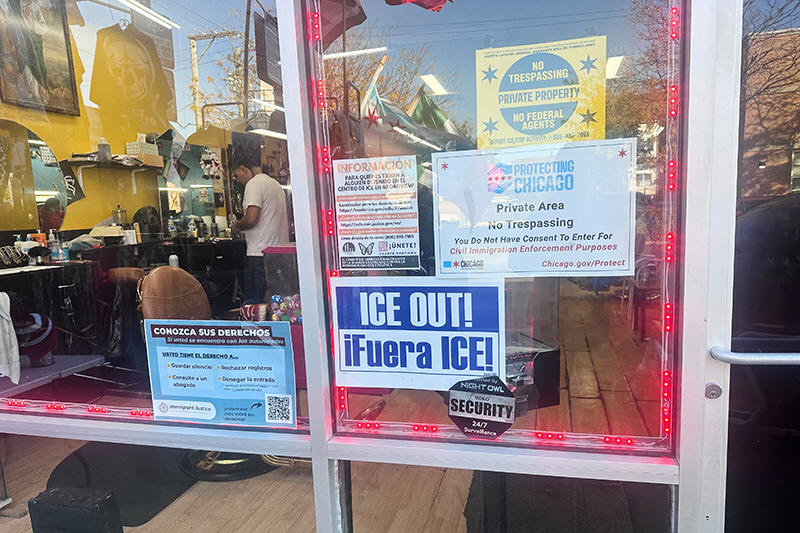
A sign reads "ICE OUT" and informs people of their rights outside a
barbershop on Tuesday, October, 28, 2025 in Chicago. (AP
Photo/Elliot Spagat)

Not answering the door is a key part of know-your-rights trainings
Since shortly after ICE was created in 2003, advocacy groups and
immigrant-friendly state and local governments have diligently spread
the word that people should not open their doors for immigration
officers unless they can show a warrant signed by a judge.
They’ve held know-your-rights trainings for communities, passed out
flyers and posted videos on social media to teach immigrants how to
protect themselves.
Ahilan Arulanantham, co-faculty director of the UCLA Law School’s Center
for Immigration Law and Policy who has held such trainings, called the
memo “quite disturbing.”
“Know-your-rights trainings have included that information for decades
and even people who are only minimally aware of their rights learn that
because it’s sort of the first and foundational elements of Fourth
Amendment law,” he said. “They know to ask officers to slide the warrant
under the door so they can see if it was signed by a judge or is an
administrative warrant.”
In the predominantly Latino city of Santa Ana, where ICE agents were
seen roaming the streets in recent days, several residents who did not
want to give their names said they were well aware of that right. Jesus
Delgado, a father of three, said the local elementary school sent out
information to parents about what to do if ICE comes to your door.
“They send us bulletins, to not answer the door, to not answer any
questions,” he said.
Another man said he learned that from TikTok.
Trump’s border czar Tom Homan has been highly critical of groups
providing the information.
“They call it ‘know-your-rights,'” he said last year on CNN. "I call it
‘how to escape arrest.’”

Experts warn barging into homes could put all at risk
The memo says immigration officers can forcibly enter homes and arrest
immigrants using solely a warrant signed by an immigration official if
they have a final order of removal.
Officers must first knock on the door and share who they are and why
they’re at the residence, and they can only go into the home after 6
a.m. and before 10 p.m. The people inside must be given a “reasonable
chance to act lawfully.” But if that doesn’t work, the memo says, they
can use force to go in.
Law enforcement and legal experts warn if more immigration officers
barge into homes, everyone could be put at greater risk.
With stand-your-ground laws, people in many states have the right to
shoot intruders, which could lead to officers being shot, or agents
opening fire on someone coming at them with a baseball bat or other item
they grab in the heat of a moment, Arulanantham said. ICE records often
contain wrong addresses, which could further lead to confrontations and
agents busting into homes of U.S. citizens.
Arulanantham said agents' aggressive tactics have been building since
the Supreme Court lifted a lower court's order in September that barred
federal agents in the Los Angeles area from indiscriminately stopping
people because of their race, language, job or location.
“This would just be another step down that path,” he said. “Obviously it
will be more significant because it suggests you're not safe even in
your own house.”
_____
Associated Press writers Elliot Spagat in San Diego and Rebecca Santana
in Washington contributed to this report. Taxin reported from Santa Ana,
Calif.
All contents © copyright 2026 Associated Press. All rights reserved |