Workplace rights agency scraps anti-harassment guidance, citing Trump's
orders
[January 23, 2026]
By CLAIRE SAVAGE and LEAH ASKARINAM
WASHINGTON (AP) — The federal agency in charge of enforcing workplace
anti-discrimination laws on Thursday voted to rescind its own guidance
on how to guard against harassment at work, marking another major shift
in U.S. civil rights enforcement under President Donald Trump's second
administration.
The U.S. Equal Employment Opportunity Commission's newly-established
Republican majority voted to rescind the 190-page document designed to
serve as a resource for compliance with Title VII of the Civil Rights
Act of 1964, including how to protect transgender workers. Chair Andrea
Lucas and recently-installed Commissioner Brittany Panuccio cited
Trump's executive order issued last year — in which he decreed there are
two immutable sexes, male and female — as one of the reasons for
revoking the document.
Lucas emphasized at the beginning of Thursday's meeting that the
commission's decision to rescind the guidance “will not leave a void
where employers are free to harass wherever they see fit, leaving a
trail of victims in their wake," citing several recent examples of
settled harassment cases. And Panuccio said that private sector
resources on anti-harassment law would fill in any gaps.
But critics argue that all workers will now be more vulnerable to
harassment without the EEOC guidance. Kalpana Kotagal, the lone Democrat
on the commission, likened it to “throwing out the baby with the
bathwater.” She voted against getting rid of it.
“At the height of the #MeToo movement, millions bravely came forward to
share their stories, exposing harassment as an abuse of power,” Kotagal
said. “The EEOC rose to the occasion by promulgating the guidance being
rescinded today, which strives to make workplaces safer for everyone.”

The EEOC received more than 35,000 harassment complaints in fiscal year
2024.
The agency updated its guidance on workplace harassment in April 2024
under President Joe Biden for the first time in 25 years following a
2020 Supreme Court ruling that gay, lesbian and transgender people are
protected from employment discrimination. Lucas voted against the
guidance at that time, citing her opposition to language warning
employers against deliberately misgendering transgender employees or
refusing them access to bathrooms corresponding with their gender
identity.
“It is neither harassment nor discrimination for a business to draw
distinctions between the sexes in providing single-sex bathrooms or
other similar facilities which implicate these significant privacy and
safety interests,” Lucas wrote in a 2024 statement dissenting to the
guidance.
[to top of second column]
|
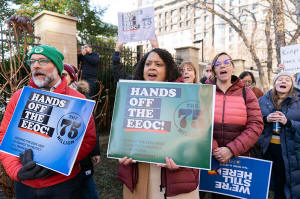
Members of the 75 Million coalition rally outside of the Equal
Employment Opportunity Commission (EEOC) agency's headquarters
Thursday, Jan. 22, 2026, in Washington, opposing the Equal
Employment Opportunity Commission's move to rescind its 2024
Enforcement Guidance on Harassment in the Workplace. (AP Photo/Jose
Luis Magana)

The agency under Lucas’s leadership has been aggressively paring
back protections for transgender workers, dropping lawsuits on their
behalf as well as requiring heightened scrutiny for incoming
complaints related to gender identity.
Workers' groups have voiced strong opposition to removing the EEOC's
harassment guidance. Led by the National Women’s Law Center, more
than 80 organizations signed a letter urging Lucas to preserve it.
A few dozen protesters clustered outside the EEOC building on
Thursday morning before the meeting, holding signs demanding “hands
off the EEOC” and waving flags bearing the blue-and-yellow equality
logo for LGBTQ+ rights group Human Rights Campaign.
“The fact that they’re taking this majorly in-depth guidance that is
so worker-centered and they’re just chucking it all is such a slap
in the face,” said Kate Miceli, a protester who previously worked at
the Women’s Bureau at the Department of Labor.
A group of 12 former EEOC and Department of Labor officials said
withdrawing the whole document deprives “employers of a clear
blueprint for creating and maintaining a harassment-free workplace
and complying with anti-discrimination laws.” The group, called EEO
Leaders, in a Jan. 20 statement also criticized the chair for
depriving the public of the chance to weigh in on the decision by
foregoing a notice and comment period.
The agency received more than 38,000 comments and public opinions
during the yearslong process of developing the 2024 guidance.
________
The Associated Press’ women in the workforce and state government
coverage receives financial support from Pivotal Ventures. AP is
solely responsible for all content. Find AP’s standards for working
with philanthropies, a list of supporters and funded coverage areas
at AP.org.
All contents © copyright 2026 Associated Press. All rights reserved
 |