Illinois higher education board seeks 4.6% budget increase for next
fiscal year
[January 24, 2026]
By Peter Hancock
SPRINGFIELD — The board that governs higher education in Illinois voted
Wednesday to request $2.7 billion in general revenue funding next year,
an increase of $121.6 million, or 4.6%, over the amount lawmakers
approved for the current fiscal year.
But that request came at the same time Gov. JB Pritzker announced he was
reducing this year’s higher education budget by $30.5 million. That
included an announcement that he would not release $29.5 million in
higher education funding that lawmakers gave him the power to hold in
reserve last May when they approved the current-year budget.
The move is part of an overall $481.6 million reduction in state agency
spending authority Pritzker ordered to address what he called “ongoing
economic uncertainty driven by the Trump administration.”
“We expect that most agencies will not see their funding requests
fulfilled – and continued fiscal management in Fiscal Year 2026 will
help ensure the ability of the State Agencies to face the challenges
expected over the next few years,” the governor’s budget director,
Alexis Sturm, said in a letter announcing the reductions.
Both the budget request and Pritzker’s announcement came as
disappointing news to union officials who have been urging the IBHE to
pressure the administration into releasing the funds that have been held
back this year.

“The Illinois Board of Higher Education has failed students and working
families once again,” University Professionals of Illinois president
John Miller said in a statement. “At a time when Illinois students and
families are struggling desperately to afford a university education,
the Board’s FY 27 budget recommendation today guarantees even higher
tuition and fees and more student debt.”
But IBHE officials defended the request, saying it calls for investments
to make higher education affordable for students in Illinois while
recognizing the fiscal constraints facing the state.
“The Board has approved a recommended budget for fiscal year 2027 that
takes into account the state’s fiscal projections, the fiscal realities
of our institutions and our students and families along with the work
needed to close equity gaps,” IBHE chairman Pranav Kothari said in a
statement. “Even in tight budget years, we must continue to prioritize
higher education in Illinois.”
Budget request highlights
Overall, IBHE’s budget request includes a $39.6 million, or 3%, general
funds increase in operating funds for state universities and a $10.1
million increase, or 2.4%, for community colleges.
The proposed budget calls for a $50 million increase in the Monetary
Award Program, or MAP grants, the state’s primary need-based student
financial aid program. That would bring total MAP funding next year to
$771.6 million.
It also calls for a $5 million increase in AIM HIGH grant funding, which
would bring that program’s total funding to $55 million. AIM HIGH is a
scholarship program that is both need- and merit-based.
According to IBHE, during the 2024-25 academic year, nearly 80% of
Illinois students who qualified for Pell grants — the federal
government’s primary need-based financial aid program — were able to
attend public universities tuition- and fee-free as a result of recent
funding increases to the MAP and AIM HIGH grant programs.
[to top of second column]
|
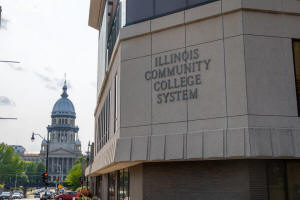
The Illinois Community College Board offices sits blocks away from
the state Capitol. (Capitol News Illinois file photo by Andrew
Adams)

“Increased investments to the MAP and AIM HIGH grant programs throughout
the last several fiscal years have made our public institutions more
affordable for students, and this budget recommends increased investment
in both programs.” IBHE Executive Director Ginger Ostro said in a
statement.
Equity issues
Within the proposed budget for state universities, IBHE is requesting a
$38.3 million increase in general operating funds, or about 3% over this
year’s approved funding.
But the board is also recommending, as it has the last few years, that
money be distributed under a formula that would prioritize institutions
that serve more low- and moderate-income students who qualify for
federal Pell grants.
How Illinois distributes its funding among the state’s 12 public
universities has been a subject of strenuous debate in recent years.
Last year, the Illinois Commission on Equitable Public University
Funding proposed legislation to overhaul the state’s higher education
funding system and replace it with a formula similar to the
Evidence-Based Funding formula used for K-12 education.
That new formula would establish adequacy targets for each institution
and give priority in new funding to those schools that are furthest away
from their adequacy target.
Lawmakers held hearings on that proposal during the 2025 session. And
while IBHE took no official position on it, the bill stalled in a Senate
committee, mainly due to opposition from the state’s largest
institution, the University of Illinois Urbana-Champaign.
Robin Steans, executive director of the education advocacy group Advance
Illinois and a vocal advocate of the funding overhaul, said in an
interview that IBHE’s proposal to distribute new money according to a
formula based on student demographics would be a significant step in the
right direction.
Steans said IBHE has not taken an official position on the Adequate and
Equitable Funding proposal.
“But I think they are speaking with their feet that they believe that we
need to be on a path, and that that path needs to include equity,” she
said. IBHE’s budget proposal will be forwarded to Pritzker and the
General Assembly for consideration as they put together a state budget
for the upcoming fiscal year. Pritzker is scheduled to deliver his
overall budget plan to lawmakers on Wednesday, Feb. 18.
Capitol News Illinois is
a nonprofit, nonpartisan news service that distributes state government
coverage to hundreds of news outlets statewide. It is funded primarily
by the Illinois Press Foundation and the Robert R. McCormick Foundation.
 |