Illinois saw no fatal expressway shootings last year
[January 24, 2026]
By Rebecka Pieder and Medill Illinois News Bureau
SPRINGFIELD — For the first time in at least a decade, there were no
fatal interstate highway shootings in Illinois last year, Illinois State
Police announced. The number of these shootings dropped significantly
for the fourth year in a row in 2025, police said.
This development marks a dramatic reversal from 2021, when the number of
expressway shootings spiked at 310. Since then, incidents have dropped
80% to 61 shootings last year.
Of the 89 shootings in 2024, 12 were fatal. In 2025, the number of
shootings decreased by 31%, with no fatalities, police said.
Expanded use of technology, including the deployment of automated
license plate readers on highways, has been central to the decline.
The license plate readers monitor state highways and collect millions of
data points, including images, time, date, and location of passing
vehicles. Police cross-reference that data against databases of stolen
vehicles and those connected to crimes.
Despite success in lowering the number of shootings and finding
criminals on the state highways, the technology has also drawn critics
and a lawsuit accusing the ISP of creating “a system of dragnet
surveillance.”
Expansion of camera program
Last year, lawmakers allocated $7 million in new funding for the
technology, as well as $2.5 million reappropriated from a previous year.
The state has installed at least 588 ALPRs across Illinois, with higher
concentrations in areas where ISP has identified elevated rates of
violent crime and threats to public safety.

A shift in mindset from traffic to trafficking has been key to reducing
highway violence, ISP Director Brendan Kelly said in an interview.
The agency has focused more on combating drug trafficking, gun
trafficking and human trafficking, while placing greater emphasis on
deterring violent crime and vehicular hijackings, he said.
“Allocating our personnel in a focused way was the foundation but also
augmenting the hard work of our people with technology like license
plate readers,” Kelly said.
In 2023, the agency used evidence gathered from license plate readers in
every expressway homicide case for which the agency filed criminal
charges in Cook County, Kelly said.
The license plate reader system alerts troopers in real time when
cameras spot a vehicle reported stolen or connected to a violent crime.
State police can then decide whether to pull the vehicle over
immediately or use aerial surveillance to follow it until conditions are
safer for an arrest.
Kelly said the coordination between license plate readers and ISP’s air
operations allows police to apprehend suspects without posing undue risk
to the public or officers. The technology also helps identify potential
witnesses and other circumstantial evidence based on time and location
data.
State Sen. Christopher Belt, D-Swansea, chair of the Senate Public
Safety & Infrastructure Committee, called the decline in shootings “the
perfect intersection of exemplary police work and technology.”
Concerns about surveillance
But the expansion of surveillance technology has also resulted in some
pushback. A lawsuit filed by the libertarian legal group Liberty Justice
Center in May 2024 challenged the ALPR program and asserted that the
constant surveillance of the ALPRs infringed on the rights of two Cook
County residents.

[to top of second column]
|
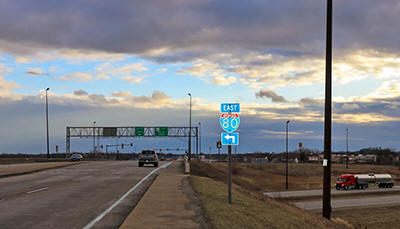
Illinois saw a decline in highway shootings and no fatalities in
2025. (Jacques Abou-Rizk, Medill Illinois News Bureau)
While the case was dismissed in 2025, plaintiffs are appealing to the
7th Circuit Court of Appeals. A ruling is expected later this year,
which could lead to the possibility of a further appeal to the U.S.
Supreme Court.
The ACLU of Illinois, though not involved in the lawsuit, has also
expressed concern about the license plate readers.
“These are very powerful surveillance tools,” said Ed Yohnka, director
of communications and public policy at ACLU of Illinois. “The ability to
place these around a community and essentially track someone is a very
powerful thing.”
Yohnka said the group has reservations about the expanding surveillance
network and the lack of clear restrictions on data storage duration,
storage methods and who has access to the information.
Last year, Illinois Secretary of State Alexi Giannoulias’ office said it
unearthed two instances of license plate reader data being shared in
violation of Illinois law. State law requires that police departments
and other license plate camera operators obtain a written declaration
from all out-of-state law enforcement agencies saying they will not use
license plate reader data to enforce abortion restrictions or
immigration enforcement.
Giannoulias alleged that police tech company Flock Safety illegally
shared data with federal border enforcement and that the Forest Park
Police Department improperly shared information with border enforcement
via Motorola Solutions technology.
“License plate reading cameras serve as powerful surveillance
technology, and as Secretary of State, I’m committed to ensuring that
everyone involved in data sharing is following the law and protecting
Illinoisans’ right to privacy,” Giannoulias said in a statement at the
time.
Kelly also noted ISP’s license plate reader data cannot be used for
immigration enforcement under the Illinois Trust Act.
The Motorola system has strict restrictions on data usage, and any law
enforcement agencies that receive shared data are contractually required
to abide by state requirements, he said.
History of the program
The ALPR program was initially launched in 2020 in response to
expressway shootings, and expanded in 2022 to combat a range of serious
offenses. These include vehicular hijacking, aggravated vehicular
hijacking, terrorism, motor vehicle theft, and any forcible felony.
ALPRs are not meant to be used for speeding or routine traffic
enforcement.

House Bill 3339, sponsored by Rep. Thaddeus Jones, D-Calumet City, which
was signed into law last year, broadens the definition of forcible
felony to include human trafficking and involuntary servitude.
“Currently, there is a plan to maintain and identify potential locations
for additional license plate readers,” Kelly said. “(We’re) updating our
air fleet and continuing to hire Illinois State Police officers.”
Rebecka Pieder is a student in the Medill Illinois
News Bureau, a program at the Medill School of Journalism that
provides local news outlets with state legislature and government
coverage.
Capitol News Illinois is a nonprofit, nonpartisan
news service that distributes state government coverage to hundreds
of news outlets statewide. It is funded primarily by the Illinois
Press Foundation and the Robert R. McCormick Foundation. |