Global shares mostly dip as the yen rises against the U.S. dollar
[January 26, 2026] By
YURI KAGEYAMA
TOKYO (AP) — Global shares mostly declined Monday, as in Asia Japan's
benchmark took a tumble after the yen surged against the U.S. dollar.
France's CAC 40 dipped nearly 0.2% in early trading to 8,127.93, while
the German DAX added less than 0.1% to 24,881.34. Britain's FTSE 100
edged down less than 0.1% to 10,138.76.
U.S. futures edged were little changed amid persisting uncertainty over
U.S. tariff policies, among other issues. The futures for the S&P 500
rose less than 0.1%, while Dow futures was virtually unchanged.
Earlier in the global day in Asia, Japan's benchmark Nikkei 225 dropped
1.8% to finish at 52,885.25 on selling of big exporters like Toyota
Motor Corp., whose shares fell 4.1%.
A weak currency is generally favorable for Japanese exporters because it
helps elevate the value of their overseas earnings. In recent months,
the dollar has gained against the yen. It fell sharply in the past few
days after officials in both Japan and the U.S. indicated they were
prepared to intervene to support the yen.
Although finance officials did not directly confirm such intervention
was in the works, they confirmed they were in close coordination with
the U.S. on currency fluctuations.
“Intervention chatter did the trick. Since Friday, the yen has staged a
sharp rebound on expectations that Japanese authorities — possibly with
U.S. coordination — would step in.” said Ipek Ozkardeskaya, a senior
analyst at Swissquote.

The dollar slipped to 153.88 Japanese yen from 155.01 yen. It had been
trading around 158 yen last week.
The euro fell to $1.1851 from $1.1858.
Elsewhere in Asia, South Korea’s Kospi dipped 0.8% to 4,949.59.
Hong Kong’s Hang Seng inched up less than 0.1% to 26,765.52, after
vacillating earlier in the day, while the Shanghai Composite fell nearly
0.1% to 4,132.60.
[to top of second column] |
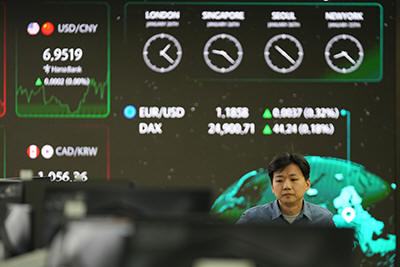
A dealer walks past near the screens showing the foreign exchange
rates at a dealing room of Hana Bank in Seoul, South Korea, Monday,
Jan. 26, 2026. (AP Photo/Lee Jin-man)
 Markets were closed in Australia,
New Zealand, India and Indonesia.
Markets are also closely watching earnings reports that are expected
in the weeks ahead from various global companies, some of which
might show the negative effects from recent U.S. tariff policies.
In the latest such development, a threat by U.S. President Donald
Trump to impose a 100% tariff on goods from Canada was countered by
Canadian Prime Minister Mark Carney. Trump had warned he might hike
tariffs if Canada signed a free trade deal with China. Carney said
Canada had no plans for such a deal.
In 2024, Canada mirrored the United States by putting a 100% tariff
on electric vehicles from Beijing and a 25% tariff on steel and
aluminum. China had responded by imposing 100% import taxes on
Canadian canola oil and meal and 25% on pork and seafood.
Breaking with the United States this month during a visit to China,
Carney cut its 100% tariff on Chinese electric cars in return for
lower tariffs on those Canadian products.
In other dealings Monday, benchmark U.S. crude rose 43 cents to
$61.50 a barrel. Brent crude, the international standard, edged up
48 cents to $65.55 a barrel.
Gold gained 2% to over $5,100 an ounce, while silver jumped 5.5% to
$109.81 per ounce. The value of precious metals has surged in recent
months as investors sought relatively safe places to invest.
All contents © copyright 2026 Associated Press. All rights reserved |