Providers say feds’ new rural health care grants to Illinois won’t cover
Medicaid cuts
[January 27, 2026]
By Nikoel Hytrek and UIS Public Affairs Reporting (PAR)
Illinois will receive $193 million for each of the next five years to
expand health care access for the approximately 1.9 million people in
rural areas — or about $101 annually for every rural Illinoisan.
The money comes from the $50 billion federal Rural Healthcare
Transformation Program fund, which Congress created to offset federal
Medicaid spending cuts included in the One Big Beautiful Bill Act, or
H.R. 1, that passed last summer.
But health care organizations said the money will not be enough to
compensate for Medicaid cuts.
“These funds are good, and we’re going to put them to good use, but it’s
not a solution,” said Jordan Powell, senior vice president of health
policy and finance for the Illinois Health and Hospital Association.
“It’s not going to mitigate the impact of the significant Medicaid cuts
that are coming our way.”
The Illinois Department of Healthcare and Family Services said between
190,000 to 360,000 Medicaid recipients are at risk of losing coverage in
Illinois because of new work requirements.
H.R. 1 also imposes a tighter cap on how much money states can raise for
their Medicaid programs through provider taxes. The new limits will be
phased in, starting in fiscal year 2028, and could reduce total Medicaid
funding in Illinois by $4.5 billion a year by fiscal year 2031.
“Long term, we know a number of HR 1 provisions will have a devastating
impact on healthcare in our state and present significant challenges
with respect to maintaining equitable access to high-quality healthcare
coverage for all Illinois residents,” the department said in a
statement.

Illinois has 85 small and rural hospitals that serve as hubs for access
to care for people who can’t travel long distances. Nearly 30% operate
at a deficit, though, and most of the patients they serve are on
Medicare or Medicaid, according to the Health and Hospital Association.
Powell described the new federal money as a bandage, not a permanent
solution for the cuts Illinois hospitals will face. As Medicaid
reimbursement decreases, he said, hospitals could be forced to reduce
services like obstetrics, cut staff, or close entirely.
Rural population is only a small part of grant consideration
The amount each state received ranged from $147 million for New Jersey
to $281 million for Texas, and rural population appeared to be only a
small factor in the equation.
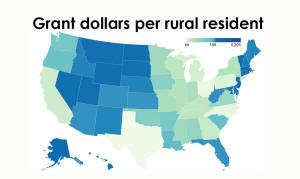
That means states like Texas, with the largest rural population in the
country, got far less per rural resident than states like Rhode Island,
which has the smallest. Texas received $66 per rural resident and Rhode
Island, with a total award of $156 million, received $6,305 per rural
resident.
Half of the total $50 billion was awarded to states equally, but the
other half was awarded based on specific factors such as a state’s
current or planned policies for rural health care and proposed ideas
that align with federal Make America Healthy Again priorities.
Among its neighbors, Illinois has the second-lowest award amount.
Michigan, with its $173 million award, is the only state with less.
In the Midwest, Michigan’s rural population is slightly larger than
Illinois’, but it received only $83 per person compared to Illinois’
$101. Iowa, with fewer rural residents than Illinois, got $139 per rural
person.

[to top of second column]
|
(Capitol News Illinois graphic made via Datawrapper with KFF data)

Illinois’ Priorities
When filling out the application to the federal government, Illinois’
HFS consulted provider associations, rural hospitals, community health
centers, community mental health centers, universities and community
colleges, legislators and vendors.
According to the department, the state’s application focused on:
Increasing the number of health care workers in rural areas with
education, scholarships, training and incentive programs.
Removing the barriers that rural residents face to getting health care
by investing in mobile and telehealth services.
Changing the way rural health care systems run by creating regional
partnerships.
The federal government indicated a preference for “transforming
systems,” not just supporting ongoing operating expenses.
HFS said the hospital transformation grants will be a good tool for
expanding its existing Healthcare Transformation Collaboratives to rural
areas. The state launched the collaborative effort in 2021 to improve
health care outcomes and reduce disparities across the state. It
involves providers sharing resources to meet the health needs of
multiple communities and expand access to services like preventative and
specialty care.
“Team-based care, in partnership with hospitals and primary care
practices, looks to improve access to care for rural residents by
building out infrastructure and technology in order to increase access
to specialty services, transform healthcare delivery, and overcome known
geographic barriers for these communities,” the agency said in an
emailed statement.
Powell said increasing the workforce and cybersecurity at hospitals are
some of the top priorities. After that, he said, expanding rural
broadband internet and upgrading electronic health records are
important.
“Workforce and technology were two of the main things that we heard from
our members,” he said. “I think the state wants to emphasize better
partnerships and collaboration between providers.”

‘Not a long-term fix’
Despite allowing rural hospitals and health systems to make needed
improvements, Powell said he still doesn’t think the money will be
enough to make up for losing Medicaid payments.
“It’s kind of like supplemental funding that’s going to help them
survive just a little bit longer,” he said. “I would actually say a
significant portion of them are facing slim to negative margins, as is.
And so this is funding that, again, will maintain some stability and
viability for these organizations. But it’s not a long-term fix.”
Capitol News Illinois is
a nonprofit, nonpartisan news service that distributes state government
coverage to hundreds of news outlets statewide. It is funded primarily
by the Illinois Press Foundation and the Robert R. McCormick
Foundation. |