Iran-backed militias in Iraq and Yemen threaten new attacks as US
aircraft carrier arrives
[January 27, 2026]
By JON GAMBRELL
DUBAI, United Arab Emirates (AP) — Two Iranian-backed militias in the
Mideast are signaling their willingness to launch new attacks, likely
trying to back Iran, as officials acknowledged the arrival of a U.S.
aircraft carrier to the region Monday. President Donald Trump ordered
the carriers to move to the Middle East as he threatened military action
over its crackdown on nationwide protests.
Yemen's Iranian-backed Houthi rebels on Monday hinted they were ready to
resume attacks on shipping in the Red Sea. That came just after Iraq's
Kataib Hezbollah paramilitary group, long supported by Iran's
paramilitary Revolutionary Guard, issued a direct threat late Sunday
toward any attack targeting Iran, warning a “total war” in the region
would be a result.
The statements came as the entire region is mired in a tense waiting
game to see if Trump will strike. Both the Houthis and Kataib Hezbollah
sat out from Israel's 12-day war on Iran in June that saw the United
States bomb Iranian nuclear sites. The hesitancy to get involved shows
the disarray still affecting Iran's self-described “Axis of Resistance”
after facing attacks from Israel during its war on Hamas in the Gaza
Strip.
US carrier arrives in region
The threats came as the aircraft carrier USS Abraham Lincoln and other
guided missile destroyers in its strike group arrived in the region to
“promote regional security and stability,” U.S. Central Command said
Monday on social media.
Trump has said the ships are being moved “just in case” he decides to
take action against Iran. He has already laid out two red lines for
attack — the killing of peaceful protesters and Tehran conducting mass
executions of those it has arrested in a massive crackdown over the
demonstrations.

A senior Iranian military official who spoke anonymously on Iran's State
TV dismissed the American threat as “an exaggeration” and noted that
Iran had increased its military presence in response. The official added
that the Lincoln's presence was not a deterrent but an accessible
target.
Threats from Iraq, Yemen, while Hezbollah stays mum
Iran projected its power across the Mideast through the “Axis of
Resistance,” a network of proxy militant groups in Gaza, Lebanon, Yemen,
Syria, and Iraq, and other places. It was also seen as a defensive
buffer, intended to keep conflict away from Iranian borders. But it has
collapsed after Israel targeted Hamas, Hezbollah in Lebanon and others
during the Gaza war. Meanwhile, rebels in 2024 overthrew Syria’s Bashar
Assad after a yearslong, bloody war in which Iran backed his rule.
The Lebanese militant group Hezbollah, one of Iran's staunchest allies,
refused to say how it planned to react in the case of a possible attack.
“During the past two months, several parties have asked me a clear and
frank question: If Israel and America go to war against Iran, will
Hezbollah intervene or not?” Hezbollah leader Sheikh Naim Kassem said
via a video address to thousands of supporters gathered in Beirut's
southern suburbs for a rally backing Iran.
He said the group is preparing for “possible aggression and is
determined to defend” against it. But as to how it would act, he said,
“these details will be determined by the battle and we will determine
them according to the interests that are present.”

Iraqi and Yemenite militant groups were much more forthright in their
threats, which were interpreted as support for Iran. A short video by
the Houthis included images of a ship on fire, with the caption: “Soon.”
It later aired footage Monday from its January 2024 attack in the Gulf
of Aden on the Marshall Islands-flagged tanker Marlin Luanda, one of
over 100 ships attacked as part of a campaign the Houthis said pressured
Israel over its war against Hamas in the Gaza Strip.
The Houthis halted their fire after a ceasefire in Gaza, though they've
repeatedly warned they could resume fire if needed.
Meanwhile, Ahmad “Abu Hussein” al-Hamidawi of Kataib Hezbollah issued
his own threat in a statement.
[to top of second column]
|
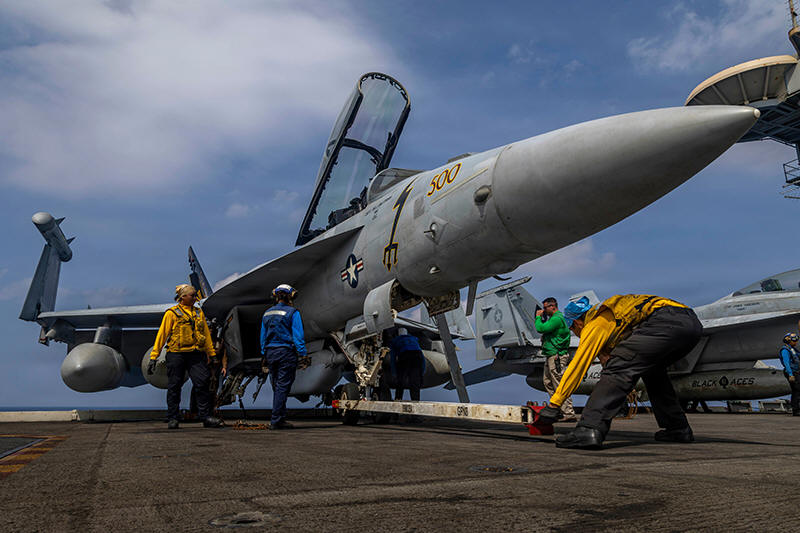
This photo provided by the U.S. Navy shows sailors preparing a
Boeing EA-18G Growler on the flight deck of the Nimitz-class
aircraft carrier USS Abraham Lincoln in the Indian Ocean on Jan. 21,
2026. (Mass Communication Specialist Seaman Daniel Kimmelman/U.S.
Navy via AP)

“We affirm to the enemies that the war on the (Islamic) Republic
will not be a picnic; rather, you will taste the bitterest forms of
death, and nothing will remain of you in our region,” he said.
The United Arab Emirates announced on Monday that it would not allow
its airspace, territory or territorial waters to be used for
military action against Iran. The UAE said it would stress dialogue
and diplomatic resolutions.
Iran warns America not to attack
Iranian Defense Ministry spokesperson Gen. Reza Talaei-Nik renewed
warnings Monday to both Israel and the U.S., saying any attack would
“be met with a response that is more painful and more decisive than
in the past.” Iranian state television quoted Talaei-Nik as saying
that threats required Iran “to maintain full and comprehensive
preparedness.”
Foreign Ministry spokesman Esmail Baghaei separately told
journalists: “Regional countries fully know that any security breach
in the region will not affect Iran only. The lack of security is
contagious.”
Iran over the weekend unveiled a new banner in Tehran's Enghelab
Square threatening the Lincoln, showing an aircraft carrier strewn
with bodies and streaked with blood with the warning: “If you sow
the wind, you will reap the whirlwind.” However, Iran is still
reeling from the 12-day war in June in which its air defense systems
were broadly destroyed, top military leaders killed, and its nuclear
enrichment sites bombed by the U.S.
As a sign of concern over its airspace, Iran issued a notice to
pilots Sunday that banned small private aircraft from flying in the
country, with carve-outs for the oil industry and emergency medical
flights.
Many Western airlines have started to avoid Iranian airspace
entirely due to the tensions, though Gulf Arab carriers flying to
Moscow still rely on the route. Iranian air defense troops in 2020
shot down a Ukrainian commercial airliner, killing 176 people on
board.

Death toll rises from protest crackdown
The protests in Iran began on Dec. 28, sparked by the fall of the
Iranian currency, the rial, and quickly spread across the country.
They were met by a violent crackdown by Iran’s theocracy, the scale
of which is only starting to become clear as the country has faced
more than two-week internet blackout — the most comprehensive in its
history.
The U.S.-based Human Rights Activists News Agency on Monday put the
death toll at 5,973, with the number expected to increase. It says
more than 41,813 people have been arrested.
The group’s figures have been accurate in previous unrest and rely
on a network of activists in Iran to verify deaths. That death toll
exceeds that of any other round of protest or unrest there in
decades, and recalls the chaos surrounding Iran’s 1979 Islamic
Revolution. The Associated Press has not been able to independently
verify the toll.
Iran’s government has put the death toll at a far lower 3,117,
saying 2,427 were civilians and security forces, and labeled the
rest “terrorists.” In the past, Iran’s theocracy has undercounted or
not reported fatalities from unrest.
___
Associated Press writer Abby Sewell in Beirut contributed to this
report.
All contents © copyright 2026 Associated Press. All rights reserved
 |