Israel recovers remains of the last hostage in Gaza. Ceasefire moves
into tricky new phase
[January 27, 2026]
By JULIA FRANKEL and SAMY MAGDY
JERUSALEM (AP) — Israel brought home the remains of the last hostage in
Gaza on Monday, closing a painful chapter for the country and clearing
the way for the next and more challenging phase of its ceasefire with
Hamas.
The next step is likely to be the reopening of Gaza’s border with Egypt,
enabling Palestinians to travel in both directions and eventually
allowing more aid to enter the territory devastated by two years of war.
The ceasefire's second phase also calls for deploying an international
security force, disarming Hamas, pulling back Israeli soldiers and
rebuilding Gaza.
The remains of police officer Ran Gvili were found in a cemetery in
northern Gaza.
Prime Minister Benjamin Netanyahu called it “an incredible achievement”
for Israel and its soldiers. He said Gvili, who was killed during the
Hamas-led attack on Oct. 7, 2023, that sparked the war, was among the
first to be taken into Gaza.
Dozens of people, including relatives, military officials and friends
from Gvili's police unit, received his coffin at an army post on the
Israeli side of the border with Gaza.
Many more Israelis lined nearby roads to pay their respects as a convoy
carrying the coffin made its way to Tel Aviv, where it arrived Monday
night.
“You should see the honor you’re receiving here,” Gvili’s father, Itzik,
said, kissing his son’s coffin, which was draped in an Israeli flag.
“The entire police is here with you, the entire army is with you, the
entire people. I’m proud of you.”

The return of all remaining hostages, living or dead, had been a key
part of the Gaza ceasefire’s first phase. Hamas said it now has met
those terms.
Netanyahu’s office said Sunday that once the search for Gvili was
finished, Israel would open the Rafah crossing between Gaza and Egypt,
which Palestinians see as their lifeline to the world. It has been
largely shut since May 2024, except for a short period early last year.
The ceasefire's next phase will confront thornier issues, including
transitioning to a new governance structure in Gaza and disarming Hamas,
which has ruled the territory for nearly two decades.
“The next phase is disarming Hamas and demilitarizing the Gaza Strip.
The next phase is not reconstruction,” Netanyahu said Monday while
addressing the Israeli parliament.
Palestinians react to recovery of last hostage's remains
Palestinians in Gaza were optimistic that opening the Rafah crossing
will allow travel to and from the enclave along with the evacuation of
people needing medical care.
“We hope this will close off Israel’s pretexts and open the crossing,”
said Abdel-Rahman Radwan, a Gaza City resident whose mother has cancer
and requires treatment outside Gaza.
Ahmed Ruqab, a father who lives with his family of six in a tent in the
Nuseirat refugee camp, called for mediators and the U.S. to pressure
Israel to allow more aid.
“We need to turn this page and restart,” he said over the phone.
An official with the United Nation’s children’s agency said Monday that
there is backlog of supplies in Egypt ready to move into Gaza whenever
the crossing opens to aid traffic.

The next phase needs to include bringing not only more humanitarian and
commercial supplies but also permanent shelter materials and items to
repair infrastructure, said Ted Chaiban, UNICEF’s deputy executive
director.
Gvili’s relatives last week repeated calls for Israel’s government and
U.S. President Donald Trump to ensure the release of his remains.
“Most thought of it as an impossible thing to do,” Trump posted on
social media.
Gvili’s mother, Talik, thanked the Israeli government and security
forces as well as Trump for allowing the family to “achieve closure.”
Israel had repeatedly accused Hamas of dragging its feet in the search
while Hamas said it had provided all the information it had, accusing
Israel of obstructing the efforts.
[to top of second column]
|
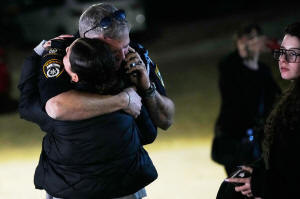
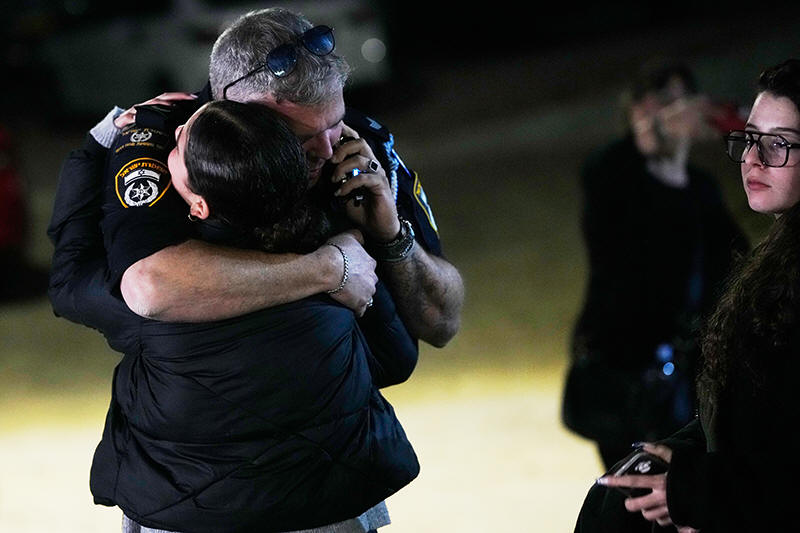
A police officer hugs a family member of Israeli hostage Ran Gvili
after the announcement that his remains were the last to be
recovered from Gaza, at his home in the village of Meitar, southern
Israel, Monday, Jan. 26, 2026. (AP Photo/Ohad Zwigenberg)

How the remains of last hostage were found
Gvili’s remains were found right along the “yellow line” dividing Gaza
just on the Israeli side, according to a military official, speaking
anonymously under army protocol.
The October 2023 attack on Israel that launched the war killed about
1,200 people and saw 251 taken hostage. Gvili, a 24-year-old police
officer known affectionately as “Rani,” was killed while fighting Hamas
militants.
On a call with reporters Monday, two U.S. officials credited Egypt,
Qatar and Turkey with helping to get Hamas to release Gvili’s body, and
said Hamas was very cooperative in making it happen.
The officials, who insisted on anonymity per the rules of a call setup
by the White House, said they now expect Israel to help both sides move
forward into phase two of the ceasefire and they want Hamas to disarm in
accordance with the agreement and believe they will.
Before Gvili’s remains were recovered, 20 living hostages and the
remains of 27 others had been returned to Israel since the ceasefire,
most recently in early December.
Israel has released roughly 2,000 Palestinian prisoners under the
ceasefire deal, many who were seized by Israeli troops during the
two-year war and held without charge. It also has released the bodies of
more than 300 Palestinians back to Gaza, where officials have struggled
to identify them.
In a symbolic act, Israeli President Isaac Herzog on Monday removed a
yellow pin worn by many to show solidarity with the hostages and their
families.
Hundreds of Palestinians killed in Gaza since the ceasefire
Palestinians in Gaza who spoke to The Associated Press in recent weeks
questioned whether the ceasefire's next steps will improve conditions,
pointing to ongoing bloodshed and challenges securing basic necessities.

Israeli forces on Monday fatally shot two people in Gaza, according to
hospitals that received the bodies. One man was close to the area where
the military was searching for Gvili, according to Shifa Hospital.
Israel’s offensive has killed at least 71,660 Palestinians since 2023,
according to Gaza’s Health Ministry — with more than 480 Palestinians
killed by Israeli fire since the latest ceasefire began. The ministry,
which is part of the Hamas-led government, maintains detailed casualty
records that are seen as generally reliable by U.N. agencies and
independent experts.
Israel's top court considers petition to open Gaza for international
journalists
The Foreign Press Association on Monday asked Israel’s Supreme Court to
allow journalists to enter Gaza freely and independently.
The FPA represents dozens of global news organizations and has been
pushing for independent media access to Gaza. Israel has barred
reporters from entering Gaza independently since the 2023 attacks by
Hamas, saying entry could put journalists and soldiers at risk.
FPA lawyers told the court that the restrictions are not justified and
that with aid workers moving in and out of Gaza, journalists should be
allowed in. They said tightly controlled visits under strict military
supervision are no substitute for independent access. The judges are
expected to rule soon.
___
Magdy reported from Cairo. Associated Press reporters Josef Federman,
Natalie Melzer and Melanie Lidman in Jerusalem, Will Weissert in
Washington, Edith M. Lederer at the United Nations, and Sally Abou
AlJoud in Beirut contributed to this report.
All contents © copyright 2026 Associated Press. All rights reserved |